Eurasian Jackdaw

Eurasian Jackdaw

Coloeus monedula

LCLeast ConcernNTVUENCR
Daily sighting probability ~50% · Likely
at Tangier

In 3 days ~90% in a week >90%

57 Verified sightings at Tangier
11,758 In all 20 parks From 2019 to 2026
March Best month
☀️ Diurnal When it's spotted

About the Eurasian Jackdaw

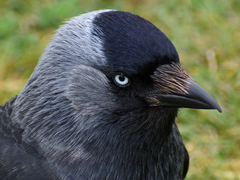
The western jackdaw (Coloeus monedula), also known as the Eurasian jackdaw, the European jackdaw, or simply the jackdaw, is a passerine bird in the crow family. It is found across Europe, western Asia and western North Africa; it is mostly resident, although northern and eastern populations migrate south in the winter. Four subspecies are recognised, which differ mainly in the darker or paler greyscale of the plumage on the head and nape. Linnaeus first described it formally, giving it the name Corvus monedula. The common name derives from the word jack, denoting "small", and daw, a less common synonym for "jackdaw", and the native English name for the bird.

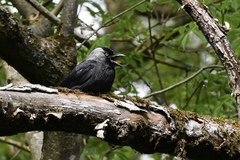
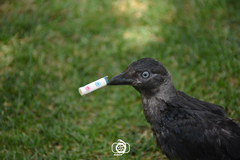
Measuring 34–39 centimetres (13–15 in) in length, the western jackdaw is a black-plumaged bird with a grey nape and distinctive pale iris. It is gregarious and vocal, living in small groups with a complex social structure in farmland, open woodland, on coastal cliffs, and in urban settings. Like its relatives, jackdaws are intelligent birds, and have been observed using tools. An omnivorous and opportunistic feeder, it eats a wide variety of plant material and invertebrates, as well as food waste from urban areas. Western jackdaws are monogamous and build simple nests of sticks in cavities in trees, cliffs, or buildings. About five pale blue or mint green eggs with brown to grey speckles are laid and incubated by the female. The young fledge in four to five weeks. Wikipedia →

Sounds

Recording0:09

Austria · 2026

© Franz Schantl · iNaturalist · CC BY-NC 4.0

Recording0:42

United Kingdom · 2026

© dbouquet100 · iNaturalist · CC BY-NC 4.0

Recording0:07

United Kingdom · 2026

© Suzanne Coleman · iNaturalist · CC BY-NC 4.0

Global Distribution

Parks Where Found

# Park Country Daily sighting probability
1 Gauja National Park 🇱🇻 Latvia
~80%
2 Hortobágy National Park 🇭🇺 Hungary
~60%
3 Cairngorms National Park 🇬🇧 United Kingdom
~50%
4 Snowdonia National Park 🇬🇧 United Kingdom
~50%
5 Wadden Sea National Park 🇩🇪 Germany
~40%
6 Kiskunság National Park 🇭🇺 Hungary
~40%
7 Biebrza National Park 🇵🇱 Poland
~30%
8 Monfragüe National Park 🇪🇸 Spain
~20%
9 Sierra de Guadarrama National Park 🇪🇸 Spain
~20%
10 Cévennes National Park 🇫🇷 France
~20%
11 Triglav National Park 🇸🇮 Slovenia
~20%
12 Fertő-Hanság National Park 🇭🇺 Hungary
~10%
13 Bavarian Forest National Park 🇩🇪 Germany
~10%
14 Camargue 🇫🇷 France
~10%
15 Sierra Nevada National Park 🇪🇸 Spain
~10%
16 Vanoise National Park 🇫🇷 France
~10%
17 Doñana National Park 🇪🇸 Spain
<5%
18 Pyrénées National Park 🇫🇷 France
<5%
19 Białowieża National Park 🇵🇱 Poland
<5%
20 Aigüestortes National Park 🇪🇸 Spain
<5%

Cities Where Found

# City Country Daily sighting probability
1 Fez 🇲🇦 Morocco
~90%
2 Amsterdam 🇳🇱 Netherlands
~80%
3 Ramallah 🇵🇸 Palestine
~80%
4 Izmir 🇹🇷 Turkey
~70%
5 Copenhagen 🇩🇰 Denmark
~70%
6 Rabat 🇲🇦 Morocco
~70%
7 Istanbul 🇹🇷 Turkey
~70%
8 Jerusalem 🇮🇱 Israel
~70%
9 Rotterdam [The Hague] 🇳🇱 Netherlands
~70%
10 Manchester 🇬🇧 United Kingdom
~60%

Zoos & Centres Where Found

# Zoo / Centre Country
1 Prague Zoo 🇨🇿 Czechia In captivity
2 Edinburgh Zoo 🇬🇧 United Kingdom In captivity
3 Krefelder Zoo 🇩🇪 Germany In captivity
4 Oasi Naturalistica di Sant'Alessio 🇮🇹 Italy In captivity
5 Vogel- und Tierpark Irgenöd 🇩🇪 Germany In captivity
6 Rákosův pavilon 🇨🇿 Czechia In captivity
7 Velemlokárium 🇨🇿 Czechia In captivity
8 LBV-Vogel- und Umweltstation Regenstauf Station für Greifvögel und Eulen 🇩🇪 Germany In captivity

Before you go

What are the chances of seeing a Eurasian Jackdaw in Tangier?

Likely

About 50% of wildlife watchers report a Eurasian Jackdaw sighting in Tangier on a given day, based on 57 verified sightings from GBIF citizen-science data. It is the 9th most-seen of the 42 birds we can rate there. Over three days the chance rises to about 90%, and over a week to over 90%, if each day is a fresh chance.

When is the best time to see a Eurasian Jackdaw in Tangier?

March

In that month about 60% of wildlife watchers report a Eurasian Jackdaw in Tangier on a given day, against about 30% in August, the lowest month. That is one of Tangier's wettest months, with about 80 mm of rain against almost none in July.

What time of day is best to see a Eurasian Jackdaw?

Between 10 am and 1 pm

Across all the parks we cover, that three-hour window holds the most Eurasian Jackdaw sightings with a recorded time, and about 9 in 10 of them come between 6 am and 6 pm: it is a daytime animal.

Is Tangier the best place to see a Eurasian Jackdaw?

19th of 62

Of the 62 cities where we can rate Eurasian Jackdaw sightings, Tangier ranks 19th at about 50%. The best odds are in Fez (Morocco, about 90%), Amsterdam (Netherlands, about 80%) and Ramallah (Palestine, about 80%).

Which relatives of the Eurasian Jackdaw live in Tangier?

Same order: Passeriformes

The closest relatives of the Eurasian Jackdaw that you can see in Tangier (order Passeriformes, Perching Birds) are Spotless Starling (about 80%), House Sparrow (about 60%) and Eurasian Blackbird (about 60%), with each one's daily chance of a sighting.

Where does the Eurasian Jackdaw sighting chance come from?

GBIF citizen-science records

It is estimated from how often the Eurasian Jackdaw is recorded against all the birds logged in Tangier (57 verified sightings), calibrated against known sighting rates. Figures are rounded to the nearest 10% because citizen-science data supports honest approximations, not decimals, and months with records from fewer than five people show "—". How it works.

← Back to Tangier