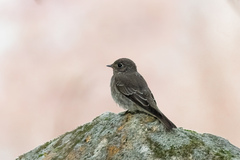
Dark-sided Flycatcher

Dark-sided Flycatcher

Muscicapa sibirica

Silhouette: Ekytza · PhyloPic

LCLeast ConcernNTVUENCR
Daily sighting probability <5% · Rare
at Tianjin

In 3 days ~10% in a week ~30%

29 Verified sightings at Tianjin
1,224 In all 20 parks From 2019 to 2026
August Best month
🌅 Crepuscular When it's spotted

About the Dark-sided Flycatcher

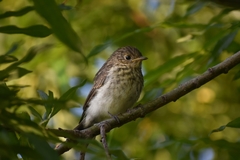
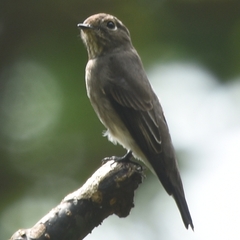
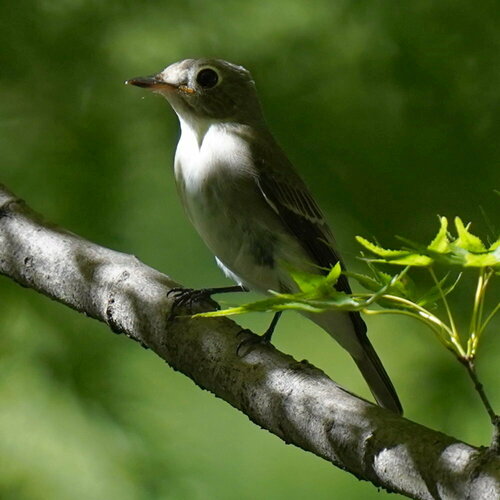
The dark-sided flycatcher (Muscicapa sibirica) is a small passerine bird belonging to the genus Muscicapa in the Old World flycatcher family Muscicapidae. It has a wide breeding distribution in the East Palearctic with northern birds migrating south for the winter. It is also known as the Siberian flycatcher or sooty flycatcher, the latter name is also used for the sooty flycatcher (Artomyias infuscata) of Africa.

The dark-sided flycatcher was formally described in 1789 by the German naturalist Johann Friedrich Gmelin in his revised and expanded edition of Carl Linnaeus's Systema Naturae. He placed it with the flycatchers in the genus Muscicapa and coined the binomial name Muscicapa sibirica. Gmelin based his account on the "Dunn flycatcher" that had been described in 1783 by the English ornithologist John Latham in his multi-volume work A General Synopsis of Birds. Latham reported that the bird was found around Lake Baikal in southern Siberia.

Four subspecies are recognised: Wikipedia →

Sounds

Call0:45

China · 2024

© Peter Boesman · XC916338 · CC BY-NC-ND 4.0

Flight call0:46

Russian Federation · 2019

© Stanislas Wroza · XC486372 · CC BY-NC-SA 4.0

Song1:00

Mongolia · 2017

© Frank Lambert · XC468358 · CC BY-NC-ND 4.0

Global Distribution

Parks Where Found

# Park Country Daily sighting probability
1 Jiuzhaigou National Park 🇨🇳 China
~20%
2 Danum Valley Conservation Area 🇲🇾 Malaysia
~10%
3 Langtang National Park 🇳🇵 Nepal
~10%
4 Kaeng Krachan National Park 🇹🇭 Thailand
~10%
5 Royal Manas National Park 🇧🇹 Bhutan
~10%
6 Gobi Gurvansaikhan National Park 🇲🇳 Mongolia
~10%
7 Khao Sok National Park 🇹🇭 Thailand
<5%
8 Khao Luang National Park 🇹🇭 Thailand
<5%
9 Gunung Leuser National Park 🇮🇩 Indonesia
<5%
10 Nikko National Park 🇯🇵 Japan
<5%
11 Kinabalu Park 🇲🇾 Malaysia
<5%
12 Khao Yai National Park 🇹🇭 Thailand
<5%
13 Cat Tien National Park 🇻🇳 Vietnam
<5%
14 Sepilok 🇲🇾 Malaysia
<5%
15 Manas National Park 🇮🇳 India
<5%
16 Namdapha National Park 🇮🇳 India
<5%
17 Doi Inthanon National Park 🇹🇭 Thailand
<5%
18 Taman Negara National Park 🇲🇾 Malaysia
<5%
19 Jim Corbett National Park 🇮🇳 India
<5%
20 Chitwan National Park 🇳🇵 Nepal
<5%

Cities Where Found

# City Country Daily sighting probability
1 Qingdao 🇨🇳 China
~10%
2 Hanoi 🇻🇳 Vietnam
~10%
3 Wuhan 🇨🇳 China
~10%
4 Tianjin 🇨🇳 China
<5%
5 Nanjing 🇨🇳 China
<5%
6 Beijing 🇨🇳 China
<5%
7 San Francisco 🇺🇸 United States
<5%
8 Suzhou 🇨🇳 China
<5%
9 Hangzhou 🇨🇳 China
<5%
10 Shanghai 🇨🇳 China
<5%

Before you go

What are the chances of seeing a Dark-sided Flycatcher in Tianjin?

Rare

Under 5% of wildlife watchers report a Dark-sided Flycatcher sighting in Tianjin on a given day, based on 29 verified sightings from GBIF citizen-science data. It is the 63rd most-seen of the 121 birds we can rate there. Over three days the chance rises to about 10%, and over a week to about 30%, if each day is a fresh chance.

When is the best time to see a Dark-sided Flycatcher in Tianjin?

August

In that month about 40% of wildlife watchers report a Dark-sided Flycatcher in Tianjin on a given day, against under 5% in June–July and October–April, the lowest months. That is one of Tianjin's wettest months, with about 120 mm of rain against almost none in January.

What time of day is best to see a Dark-sided Flycatcher?

Between 2 and 5 am

Across all the parks we cover, that three-hour window holds the most Dark-sided Flycatcher sightings with a recorded time, and about half of them come between 6 am and 6 pm: it is most active around dawn and dusk.

Is Tianjin the best place to see a Dark-sided Flycatcher?

4th of 23

Of the 23 cities where we can rate Dark-sided Flycatcher sightings, Tianjin ranks 4th at under 5%. The best odds are in Qingdao (China, about 10%), Hanoi (Vietnam, about 10%) and Wuhan (China, about 10%).

Where does the Dark-sided Flycatcher sighting chance come from?

GBIF citizen-science records

It is estimated from how often the Dark-sided Flycatcher is recorded against all the birds logged in Tianjin (29 verified sightings), calibrated against known sighting rates. Figures are rounded to the nearest 10% because citizen-science data supports honest approximations, not decimals, and months with records from fewer than five people show "—". How it works.

← Back to Tianjin