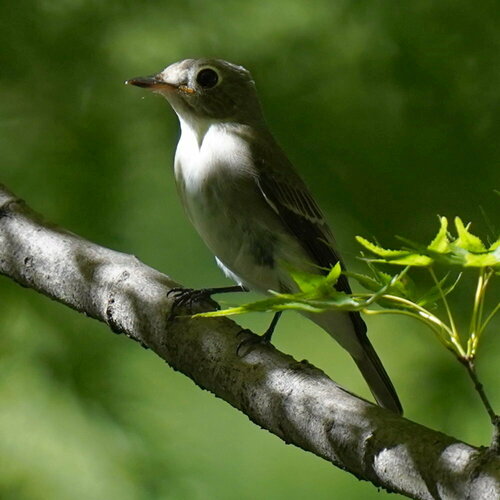
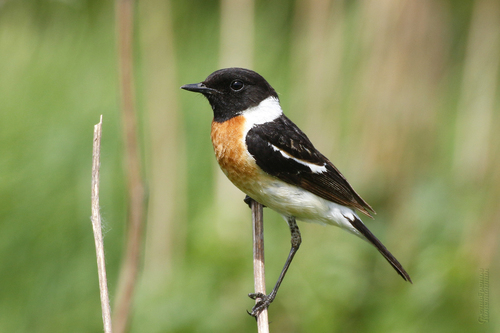
Siberian Stonechat

Siberian Stonechat

Saxicola maurus

Silhouette: PhyloPic

Daily sighting probability ~10% · With luck
at Tuen Mun

In 3 days ~30% in a week ~50%

15 Verified sightings at Tuen Mun
6,247 In all 17 parks From 2019 to 2026
January Best month
☀️ Diurnal When it's spotted

About the Siberian Stonechat

The Siberian stonechat or Asian stonechat (Saxicola maurus) is a recently validated species of the Old World flycatcher family (Muscicapidae). Like the other thrush-like flycatchers, it was often placed in the Turdidae in the past. It breeds in the East Palearctic including in easternmost Europe and winters in the Old World tropics.

The Siberian stonechat was formally described in 1773 as Muscicapa maura by the German naturalist Peter Simon Pallas based on a specimen collected at Karassum near the Ishim River in western Siberia. The specific epithet is from Latin maura meaning "African" or "Moorish" (i.e. "black" or "dark"). The Siberian stonechat is now placed in the genus Saxicola that was introduced in 1802 by the German naturalist Johann Matthäus Bechstein. The genus name combines the Latin saxum, saxi meaning "stone" with -cola meaning "dweller" from colere meaning "to inhabit".

Six subspecies are recognised: Wikipedia →

Sounds

Call0:38

Kazakhstan · 2023

© Ding Li Yong · XC809429 · CC BY-NC-ND 4.0

Alarm call0:45

Mongolia · 2019

© Oscar Campbell · XC495371 · CC BY-NC-SA 4.0

Song1:24

Kazakhstan · 2014

© R. Martin · XC236691 · CC BY-NC-SA 4.0

Global Distribution

Parks Where Found

# Park Country Daily sighting probability
1 Kaziranga National Park 🇮🇳 India
~50%
2 Manas National Park 🇮🇳 India
~50%
3 Chitwan National Park 🇳🇵 Nepal
~40%
4 Jim Corbett National Park 🇮🇳 India
~30%
5 Royal Bardia National Park 🇳🇵 Nepal
~30%
6 Kanha National Park 🇮🇳 India
~20%
7 Satpura National Park 🇮🇳 India
~20%
8 Namdapha National Park 🇮🇳 India
~20%
9 Bandhavgarh National Park 🇮🇳 India
~10%
10 Keoladeo National Park 🇮🇳 India
~10%
11 Langtang National Park 🇳🇵 Nepal
~10%
12 Royal Manas National Park 🇧🇹 Bhutan
~10%
13 Ranthambore National Park 🇮🇳 India
~10%
14 Hemis National Park 🇮🇳 India
~10%
15 Gir National Park 🇮🇳 India
~10%
16 Periyar National Park 🇮🇳 India
<5%
17 Sundarbans National Park 🇮🇳 India
<5%

Cities Where Found

# City Country Daily sighting probability
1 Vasai-Virar 🇮🇳 India
~50%
2 Shymkent 🇰🇿 Kazakhstan
~40%
3 Chattogram 🇧🇩 Bangladesh
~30%
4 Kalyan-Dombivli 🇮🇳 India
~30%
5 Kathmandu 🇳🇵 Nepal
~30%
6 Novosibirsk 🇷🇺 Russia
~20%
7 Nashik 🇮🇳 India
~20%
8 Indore 🇮🇳 India
~10%
9 Almaty 🇰🇿 Kazakhstan
~10%
10 Bhopal 🇮🇳 India
~10%

Before you go

What are the chances of seeing a Siberian Stonechat in Tuen Mun?

With luck

About 10% of wildlife watchers report a Siberian Stonechat sighting in Tuen Mun on a given day, based on 15 verified sightings from GBIF citizen-science data. It is the 63rd most-seen of the 183 birds we can rate there. Over three days the chance rises to about 30%, and over a week to about 50%, if each day is a fresh chance.

When is the best time to see a Siberian Stonechat in Tuen Mun?

January

In that month about 30% of wildlife watchers report a Siberian Stonechat in Tuen Mun on a given day, against under 5% in March to September, the lowest months. That is one of Tuen Mun's driest months, with about 35 mm of rain against 290 mm in June.

What time of day is best to see a Siberian Stonechat?

Between 8 and 11 am

Across all the parks we cover, that three-hour window holds the most Siberian Stonechat sightings with a recorded time, and about 9 in 10 of them come between 6 am and 6 pm: it is a daytime animal.

Is Tuen Mun the best place to see a Siberian Stonechat?

13th of 58

Of the 58 cities where we can rate Siberian Stonechat sightings, Tuen Mun ranks 13th at about 10%. The best odds are in Vasai-Virar (India, about 50%), Shymkent (Kazakhstan, about 40%) and Chattogram (Bangladesh, about 30%).

Where does the Siberian Stonechat sighting chance come from?

GBIF citizen-science records

It is estimated from how often the Siberian Stonechat is recorded against all the birds logged in Tuen Mun (15 verified sightings), calibrated against known sighting rates. Figures are rounded to the nearest 10% because citizen-science data supports honest approximations, not decimals, and months with records from fewer than five people show "—". How it works.
← Back to Tuen Mun