Song Sparrow

Song Sparrow

Melospiza melodia

Silhouette: Jason Dilworth · PhyloPic

LCLeast ConcernNTVUENCR
Daily sighting probability ~60% · Likely
at Washington

In 3 days ~90% in a week >90%

57,985 Verified sightings at Washington
48,294 In all 40 parks From 2019 to 2026
March Best month
☀️ Diurnal When it's spotted

About the Song Sparrow

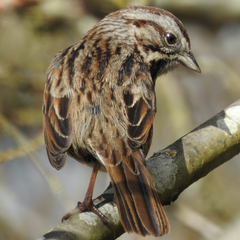
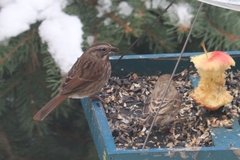
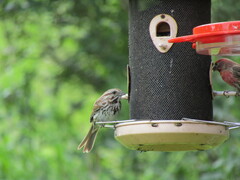
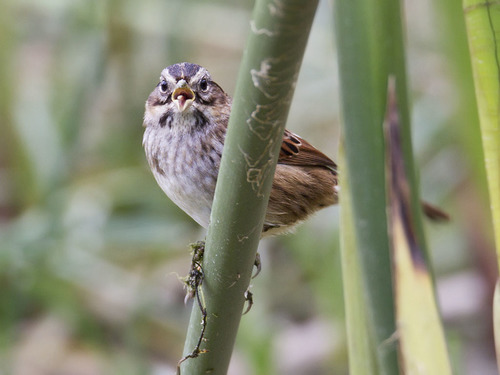
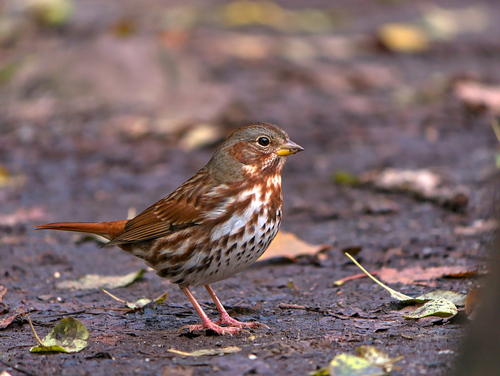
The song sparrow (Melospiza melodia) is a medium-sized New World sparrow. Among the native sparrows in North America, it is easily one of the most abundant, variable, and adaptable species. Adult song sparrows have brown upperparts with dark streaks on the back and are white underneath with dark streaking and a dark brown spot in the middle of the breast. They have a brown cap and a long brown rounded tail. Their face is gray with a brown streak through each eye. They are highly variable in size across numerous subspecies (for subspecies details, see below). The body length ranges from 11 to 18 cm (4.3 to 7.1 in) and wingspan can range from 18 to 25.4 cm (7.1 to 10.0 in). Body mass ranges from 11.9 to 53 g (0.42 to 1.87 oz). The average of all races is 32 g (1.1 oz) but the widespread nominate subspecies (M. m. melodia) weighs only about 22 g (0.78 oz) on average. The maximum lifespan in the wild is 11.3 years. The eggs of the song sparrow are brown with greenish-white spots. Females lay three to five eggs per clutch, with an average incubation time of 13–15 days before hatching.

In the field, they are most easily confused with Lincoln's sparrow and the Savannah... Wikipedia →

Sounds

Call0:52

United States · 2026

© Ed Pandolfino · XC1153739 · CC BY-NC-SA 4.0

Alarm call0:28

Denmark · 2026

© Lars Mogensen · XC1152149 · CC BY-NC-SA 4.0

Song0:12

United States · 2026

© Rory Nefdt · XC1142132 · CC BY-NC-SA 4.0

Global Distribution

Parks Where Found

# Park Country Daily sighting probability
1 Elk Island National Park 🇨🇦 Canada
~70%
2 Channel Islands National Park 🇺🇸 United States
~60%
3 Acadia National Park 🇺🇸 United States
~60%
4 Redwood National Park 🇺🇸 United States
~60%
5 Riding Mountain National Park 🇨🇦 Canada
~60%
6 Great Bear Rainforest 🇨🇦 Canada
~60%
7 Voyageurs National Park 🇺🇸 United States
~60%
8 Pacific Rim National Park Reserve 🇨🇦 Canada
~50%
9 Yosemite National Park 🇺🇸 United States
~50%
10 Olympic National Park 🇺🇸 United States
~50%
11 Cape Breton Highlands National Park 🇨🇦 Canada
~50%
12 Point Pelee National Park 🇨🇦 Canada
~40%
13 Great Smoky Mountains National Park 🇺🇸 United States
~40%
14 Grand Teton National Park 🇺🇸 United States
~40%
15 Isle Royale National Park 🇺🇸 United States
~30%
16 Zion National Park 🇺🇸 United States
~30%
17 Banff National Park 🇨🇦 Canada
~30%
18 Death Valley National Park 🇺🇸 United States
~30%
19 Shenandoah National Park 🇺🇸 United States
~30%
20 Gros Morne National Park 🇨🇦 Canada
~20%
21 Rocky Mountain National Park 🇺🇸 United States
~20%
22 Reserva de la Biosfera Mariposa Monarca 🇲🇽 Mexico
~20%
23 Glacier National Park 🇺🇸 United States
~20%
24 Saguaro National Park 🇺🇸 United States
~20%
25 Jasper National Park 🇨🇦 Canada
~10%
26 Sequoia and Kings Canyon National Parks 🇺🇸 United States
~10%
27 Congaree National Park 🇺🇸 United States
~10%
28 Kenai Fjords National Park 🇺🇸 United States
~10%
29 Yellowstone National Park 🇺🇸 United States
~10%
30 Grand Canyon National Park 🇺🇸 United States
~10%
31 Wood Buffalo National Park 🇨🇦 Canada
~10%
32 Badlands National Park 🇺🇸 United States
~10%
33 El Vizcaíno Biosphere Reserve 🇲🇽 Mexico
<5%
34 Guadalupe Mountains National Park 🇺🇸 United States
<5%
35 Big Bend National Park 🇺🇸 United States
<5%
36 Joshua Tree National Park 🇺🇸 United States
<5%
37 Kluane National Park 🇨🇦 Canada
<5%
38 Padre Island National Seashore 🇺🇸 United States
<5%
39 Bahía de Loreto National Park 🇲🇽 Mexico
<5%
40 Merritt Island National Wildlife Refuge 🇺🇸 United States
<5%

Cities Where Found

# City Country Daily sighting probability
1 Portland 🇺🇸 United States
~90%
2 Vancouver 🇨🇦 Canada
~90%
3 Seattle 🇺🇸 United States
~80%
4 Philadelphia 🇺🇸 United States
~70%
5 Salt Lake City 🇺🇸 United States
~70%
6 Boston 🇺🇸 United States
~70%
7 Toluca 🇲🇽 México
~70%
8 Montreal 🇨🇦 Canada
~60%
9 San Diego 🇺🇸 United States
~60%
10 Washington 🇺🇸 United States
~60%

Zoos & Centres Where Found

# Zoo / Centre Country
1 National Zoological Park 🇺🇸 United States In captivity
2 Columbus Zoo and Aquarium 🇺🇸 United States In captivity

Before you go

What are the chances of seeing a Song Sparrow in Washington?

Likely

About 60% of wildlife watchers report a Song Sparrow sighting in Washington on a given day, based on 57,985 verified sightings from GBIF citizen-science data. It is the 12th most-seen of the 267 birds we can rate there. Over three days the chance rises to about 90%, and over a week to over 90%, if each day is a fresh chance.

When is the best time to see a Song Sparrow in Washington?

March

In that month about 80% of wildlife watchers report a Song Sparrow in Washington on a given day, against about 20% in September, the lowest month.

What time of day is best to see a Song Sparrow?

Between 3 and 6 pm

Across all the parks we cover, that three-hour window holds the most Song Sparrow sightings with a recorded time, and about 8 in 10 of them come between 6 am and 6 pm: it is a daytime animal.

Is Washington the best place to see a Song Sparrow?

10th of 35

Of the 35 cities where we can rate Song Sparrow sightings, Washington ranks 10th at about 60%. The best odds are in Portland (United States, about 90%), Vancouver (Canada, about 90%) and Seattle (United States, about 80%).

Where does the Song Sparrow sighting chance come from?

GBIF citizen-science records

It is estimated from how often the Song Sparrow is recorded against all the birds logged in Washington (57,985 verified sightings), calibrated against known sighting rates. Figures are rounded to the nearest 10% because citizen-science data supports honest approximations, not decimals, and months with records from fewer than five people show "—". How it works.

← Back to Washington