
Garden Emerald

Garden Emerald

Chlorostilbon assimilis

Silhouette: Ferran Sayol · PhyloPic

LCLeast ConcernNTVUENCR
Daily sighting probability ~10% · With luck
at Coiba National Park

In 3 days ~40% in a week ~70%

29 Verified sightings at Coiba National Park From 2019 to 2026
1,222 In all 14 parks
August Best month
☀️ Diurnal When it's spotted

About the Garden Emerald

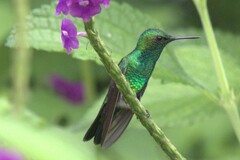
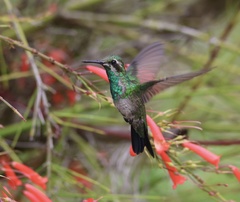
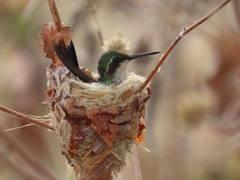
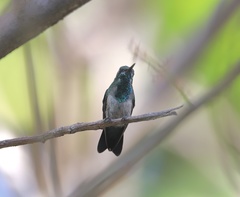
The garden emerald (Chlorostilbon assimilis) is a small hummingbird in the "emeralds", tribe Trochilini of subfamily Trochilinae. It is found in Costa Rica and Panama. The garden emerald was at one time considered a subspecies of the blue-tailed emerald (Chlorostilbon mellisugus). As its own species, it is monotypic.

The garden emerald is 7.8 to 8.5 cm (3.1 to 3.3 in) long and weighs about 3 to 4.1 g (0.11 to 0.14 oz). The adult male has dark metallic green upperparts with bluish green uppertail coverts. Its forked tail is blue-black and the central feathers have a light bluish green gloss. Its underparts are a brighter metallic green than the upperparts, sometimes with a light blue sheen, and it has white thigh tufts. The adult female has bright metallic green to bronze green upperparts with bluish green uppertail coverts. Its tail is blue-black, with dull metallic green central feathers and pale gray tips on the outer ones. It has dusky cheeks, a white or grayish white spot behind the eye, and pale gray underparts. Juvenile males are like the adult female but darker gray below.

The garden emerald is found... Wikipedia →

Sounds

Call0:34

Costa Rica · 2025

© Scott Olmstead · XC1055901 · CC BY-NC-SA 4.0

Call0:05

Costa Rica · 2018

© Brendan Sloan · XC482694 · CC BY-NC-ND 4.0

Global Distribution

Parks Where Found

# Park Country Daily sighting probability
1 Chirripó National Park 🇨🇷 Costa Rica
~20%
2 Coiba National Park 🇵🇦 Panama
~10%
3 Parque Natural Metropolitano 🇵🇦 Panama
~10%
4 San Lorenzo Protected Forest 🇵🇦 Panama
<5%
5 La Amistad International Park (Panama) 🇵🇦 Panama
<5%
6 Volcán Barú National Park 🇵🇦 Panama
<5%
7 Chagres National Park 🇵🇦 Panama
<5%
8 Piedras Blancas National Park 🇨🇷 Costa Rica
<5%
9 Darién National Park 🇵🇦 Panama
<5%
10 Soberanía National Park 🇵🇦 Panama
<5%
11 Marino Ballena National Park 🇨🇷 Costa Rica
<5%
12 Corcovado National Park 🇨🇷 Costa Rica
<5%
13 Tapantí-Macizo de la Muerte National Park 🇨🇷 Costa Rica
<5%
14 Bastimentos Island National Marine Park 🇵🇦 Panama
<5%

Cities Where Found

# City Country Daily sighting probability
1 Panama City 🇵🇦 Panama
~10%

Before you go

What are the chances of seeing a Garden Emerald in Coiba National Park?

With luck

About 10% of wildlife watchers report a Garden Emerald sighting in Coiba National Park on a given day, based on 29 verified sightings from GBIF citizen-science data from 2019 to 2026. It is the 58th most-seen of the 118 birds we can rate there. Over three days the chance rises to about 40%, and over a week to about 70%, if each day is a fresh chance.

When is the best time to see a Garden Emerald in Coiba National Park?

August

In that month about 30% of wildlife watchers report a Garden Emerald in Coiba National Park on a given day, against about 10% in March–April, July, September and December–January, the lowest months. May and October have too few records to rate.

What time of day is best to see a Garden Emerald?

Between 8 and 11 am

Across all the parks we cover, that three-hour window holds the most Garden Emerald sightings with a recorded time, and about 9 in 10 of them come between 6 am and 6 pm: it is a daytime animal.

Is Coiba National Park the best place to see a Garden Emerald?

2nd of 14

Of the 14 parks where we can rate Garden Emerald sightings, Coiba National Park ranks 2nd at about 10%. The best odds are in Chirripó National Park (Costa Rica, about 20%).

Where does the Garden Emerald sighting chance come from?

GBIF citizen-science records

It is estimated from how often the Garden Emerald is recorded against all the birds logged in Coiba National Park (29 verified sightings from 2019 to 2026), calibrated against known sighting rates. Figures are rounded to the nearest 10% because citizen-science data supports honest approximations, not decimals, and months with records from fewer than five people show "—". How it works.

← Back to Coiba National Park