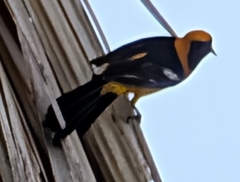
Hooded Oriole

Hooded Oriole

Icterus cucullatus

Silhouette: Matt Wilkins · PhyloPic

LCLeast ConcernNTVUENCR
Daily sighting probability ~20% · Possible
at Arrecifes de Cozumel National Park

In 3 days ~40% in a week ~70%

323 Verified sightings at Arrecifes de Cozumel National Park From 2019 to 2026
5,498 In all 18 parks
September Best month
☀️ Diurnal When it's spotted

About the Hooded Oriole

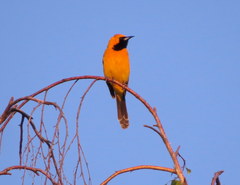
The hooded oriole (Icterus cucullatus) is a medium-sized New World oriole. The male of this species ranges in color from a bright orange to a paler yellow, with a black back, face, tail and bib, with the wing containing two white bars. The female is more of an olive color with some yellow accents.

Adults have a curved bill which is completely black and white wing bars. The adult male has a deep yellowish orange head with black on the face and throat; they are black on the back, wings and tail, orange on the underparts. The adult female is olive-green on the upper parts, yellowish on the breast and belly. Their calls consist of whistling and wheets, while their song is a mixture of both.

Their breeding habitat is open areas with trees, especially palms, across the Southwestern United States and northern Mexico. The nest is a tightly woven pouch attached to the underside of a leaf or tree branch. Sometimes their nest is filled with the egg of a brown-headed cowbird which is a parasite bird that lays its eggs in other birds nests for that species to take care of.

These birds migrate in flocks south to Mexico's southwestern coast; they are permanent residents... Wikipedia →

Sounds

Call1:21

United States · 2024

© Richard E. Webster · XC1040258 · CC BY-NC-SA 4.0

Song0:28

Mexico · 2019

© Manuel Grosselet · XC470290 · CC BY-NC-SA 4.0

Rattle0:50

United States · 2009

© Andrew Spencer · XC35372 · CC BY-NC-ND 2.5

Global Distribution

Parks Where Found

# Park Country Daily sighting probability
1 Cabo Pulmo National Park 🇲🇽 Mexico
~60%
2 Bahía de Loreto National Park 🇲🇽 Mexico
~60%
3 Sian Ka'an Biosphere Reserve 🇲🇽 Mexico
~50%
4 Celestún Biosphere Reserve 🇲🇽 Mexico
~40%
5 El Vizcaíno Biosphere Reserve 🇲🇽 Mexico
~30%
6 Calakmul Biosphere Reserve 🇲🇽 Mexico
~20%
7 Arrecifes de Cozumel National Park 🇲🇽 Mexico
~20%
8 Ría Lagartos Biosphere Reserve 🇲🇽 Mexico
~10%
9 Saguaro National Park 🇺🇸 United States
~10%
10 Cumbres de Monterrey National Park 🇲🇽 Mexico
~10%
11 Joshua Tree National Park 🇺🇸 United States
~10%
12 Death Valley National Park 🇺🇸 United States
~10%
13 Channel Islands National Park 🇺🇸 United States
<5%
14 Big Bend National Park 🇺🇸 United States
<5%
15 Cockscomb Basin Wildlife Sanctuary 🇧🇿 Belize
<5%
16 Zion National Park 🇺🇸 United States
<5%
17 Grand Canyon National Park 🇺🇸 United States
<5%
18 Sequoia and Kings Canyon National Parks 🇺🇸 United States
<5%

Cities Where Found

# City Country Daily sighting probability
1 Tijuana 🇲🇽 México
~30%
2 San Diego 🇺🇸 United States
~20%
3 Los Angeles 🇺🇸 United States
~20%
4 Guadalajara 🇲🇽 México
~10%
5 Puebla 🇲🇽 México
~10%
6 León 🇲🇽 México
~10%
7 San Francisco 🇺🇸 United States
~10%
8 Toluca 🇲🇽 México
~10%
9 Sacramento 🇺🇸 United States
<5%
10 Las Vegas 🇺🇸 United States
<5%

Zoos & Centres Where Found

# Zoo / Centre Country
1 Berlin Zoological Garden 🇩🇪 Germany In captivity
2 Arizona-Sonora Desert Museum 🇺🇸 United States In captivity
3 Aquarium Berlin 🇩🇪 Germany In captivity

Before you go

What are the chances of seeing a Hooded Oriole in Arrecifes de Cozumel National Park?

Possible

About 20% of wildlife watchers report a Hooded Oriole sighting in Arrecifes de Cozumel National Park on a given day, based on 323 verified sightings from GBIF citizen-science data from 2019 to 2026. It is the 65th most-seen of the 205 birds we can rate there. Over three days the chance rises to about 40%, and over a week to about 70%, if each day is a fresh chance.

When is the best time to see a Hooded Oriole in Arrecifes de Cozumel National Park?

September

In that month about 30% of wildlife watchers report a Hooded Oriole in Arrecifes de Cozumel National Park on a given day, against under 5% in August, the lowest month. That is one of Arrecifes de Cozumel National Park's wettest months, with about 170 mm of rain against 30 mm in March.

What time of day is best to see a Hooded Oriole?

Between 5 and 8 pm

Across all the parks we cover, that three-hour window holds the most Hooded Oriole sightings with a recorded time, and about 8 in 10 of them come between 6 am and 6 pm: it is a daytime animal.

Where does the Hooded Oriole sighting chance come from?

GBIF citizen-science records

It is estimated from how often the Hooded Oriole is recorded against all the birds logged in Arrecifes de Cozumel National Park (323 verified sightings from 2019 to 2026), calibrated against known sighting rates. Figures are rounded to the nearest 10% because citizen-science data supports honest approximations, not decimals, and months with records from fewer than five people show "—". How it works.

← Back to Arrecifes de Cozumel National Park