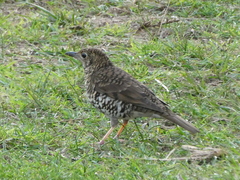
Bassian Thrush

Bassian Thrush

Zoothera lunulata

Silhouette: Francesco "Architetto" Rollandin · PhyloPic

LCLeast ConcernNTVUENCR Endemic
Daily sighting probability ~10% · With luck
at Cradle Mountain-Lake St Clair National Park

In 3 days ~20% in a week ~30%

45 Verified sightings at Cradle Mountain-Lake St Clair National Park From 2019 to 2026
1,886 In all 12 parks
August Best month
☀️ Diurnal When it's spotted

About the Bassian Thrush

The Bassian thrush (Zoothera lunulata), also known as the olive-tailed thrush, is a medium-sized mostly insectivorous thrush found from northern Queensland to southeastern Australia. It also occurs in Tasmania, on some larger islands of Bass Strait, and on Kangaroo Island. The thrushes range from 27 to 29 cm (10.5 to 11.5 in) in length and average 100 g (3.5 oz) in weight.

It is estimated that the range-wide population is large, though no official count has ever been established. The population appears to be declining because of ongoing habitat destruction and degradation, but not at a rate that is concerning.

The Bassian thrush lives in shrubland, forests, and rainforests. It appears to be a resident species, but there is some evidence that some individuals have nomadic tendencies, usually in the non-breeding season. The thrush ranges in colour from brown to olive, with a white ring around its eyes and black bars on its back, rear, and head. Its underbody is paler, with dark scalloping, and its wings have a dark bar running the length of the underside.

Nesting begins in the winter months (from late June) and continues till the end of summer. The two or three eggs which form a clutch vary from pale green or blue to light stone. The cup-shaped nest is usually built of strips of bark, at times mixed with leaves, and is lined with grasses and rootlets. Sites vary from a few feet to 50 feet (15 m) from ground. A fork in a tree is usually favoured, but the nest may be placed on a stump, or a ledge in a cave.

Bassian thrushes are known to dislodge their prey out of piles of leaves by disturbing the leaf litter. The birds move quietly and often pause to listen for the movements of the insects. Wikipedia →

Sounds

Song1:09

Australia · 2021

© Phil Gregory · XC687857 · CC BY-NC-SA 4.0

Call1:07

Australia · 2018

© Greg McLachlan · XC431291 · CC BY-NC-ND 4.0

Uncertain0:37

Australia · 2026

© Dominic Chaplin · XC1107115 · CC BY-NC-SA 4.0

Global Distribution

Parks Where Found

# Park Country Daily sighting probability
1 Lamington National Park 🇦🇺 Australia
~20%
2 Great Otway National Park 🇦🇺 Australia
~10%
3 Wilsons Promontory National Park 🇦🇺 Australia
~10%
4 Royal National Park 🇦🇺 Australia
~10%
5 Freycinet National Park 🇦🇺 Australia
~10%
6 Grampians National Park 🇦🇺 Australia
~10%
7 Cradle Mountain-Lake St Clair National Park 🇦🇺 Australia
~10%
8 Booderee National Park 🇦🇺 Australia
~10%
9 Maria Island National Park 🇦🇺 Australia
<5%
10 Blue Mountains National Park 🇦🇺 Australia
<5%
11 Springbrook National Park 🇦🇺 Australia
<5%
12 Kosciuszko National Park 🇦🇺 Australia
<5%

Cities Where Found

# City Country Daily sighting probability
1 Melbourne 🇦🇺 Australia
<5%
2 Sydney 🇦🇺 Australia
<5%

Before you go

What are the chances of seeing a Bassian Thrush in Cradle Mountain-Lake St Clair National Park?

With luck

About 10% of wildlife watchers report a Bassian Thrush sighting in Cradle Mountain-Lake St Clair National Park on a given day, based on 45 verified sightings from GBIF citizen-science data from 2019 to 2026. It is the 36th most-seen of the 49 birds we can rate there. Over three days the chance rises to about 20%, and over a week to about 30%, if each day is a fresh chance.

When is the best time to see a Bassian Thrush in Cradle Mountain-Lake St Clair National Park?

August

In that month about 20% of wildlife watchers report a Bassian Thrush in Cradle Mountain-Lake St Clair National Park on a given day, against under 5% in January, May–June and September–November, the lowest months. That is one of Cradle Mountain-Lake St Clair National Park's wettest months, with about 240 mm of rain against 95 mm in February.

What time of day is best to see a Bassian Thrush?

Between 2 and 5 pm

Across all the parks we cover, that three-hour window holds the most Bassian Thrush sightings with a recorded time, and nearly all of them come between 6 am and 6 pm: it is a daytime animal.

Is Cradle Mountain-Lake St Clair National Park the best place to see a Bassian Thrush?

7th of 12

Of the 12 parks where we can rate Bassian Thrush sightings, Cradle Mountain-Lake St Clair National Park ranks 7th at about 10%. The best odds are in Lamington National Park (Australia, about 20%), Great Otway National Park (Australia, about 10%) and Wilsons Promontory National Park (Australia, about 10%).

Which relatives of the Bassian Thrush live in Cradle Mountain-Lake St Clair National Park?

Same order: Passeriformes

The closest relatives of the Bassian Thrush that you can see in Cradle Mountain-Lake St Clair National Park (order Passeriformes, Perching Birds) are Black Currawong (over 90%), Crescent Honeyeater (about 80%) and Tasmanian Scrubwren (about 80%), with each one's daily chance of a sighting.

Where does the Bassian Thrush sighting chance come from?

GBIF citizen-science records

It is estimated from how often the Bassian Thrush is recorded against all the birds logged in Cradle Mountain-Lake St Clair National Park (45 verified sightings from 2019 to 2026), calibrated against known sighting rates. Figures are rounded to the nearest 10% because citizen-science data supports honest approximations, not decimals, and months with records from fewer than five people show "—". How it works.

← Back to Cradle Mountain-Lake St Clair National Park