
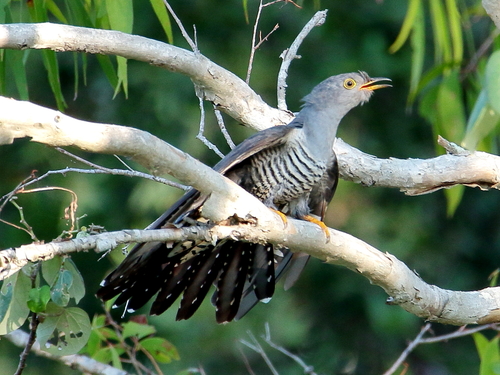
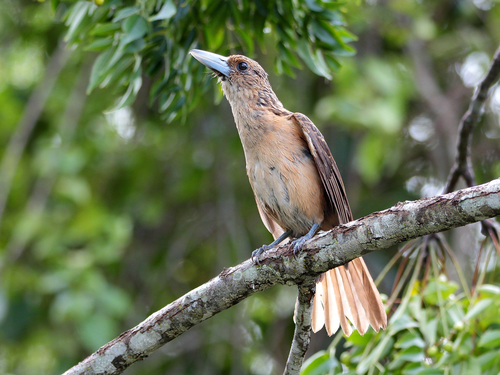
Pacific Koel

Pacific Koel

Eudynamys orientalis

Silhouette: Nicolas Huet le Jeune and Jean-Gabriel Prêtre (vectorized by T. Michael Keesey) · PhyloPic

LCLeast ConcernNTVUENCR
Daily sighting probability ~20% · Possible
at Daintree National Park

In 3 days ~60% in a week ~80%

427 Verified sightings at Daintree National Park From 2019 to 2026
1,947 In all 11 parks
October Best month
☀️ Diurnal When it's spotted

About the Pacific Koel

The Pacific koel (Eudynamys orientalis), also known as the eastern koel or formerly common koel, is a species of cuckoo in the family Cuculidae. In northern Australia, it is colloquially known as the rainbird or stormbird.

The Pacific koel was formally described by the Swedish naturalist Carl Linnaeus in 1766 in the twelfth edition of his Systema Naturae. He placed it with the cuckoos in the genus Cuculus and coined the binomial name Cuculus orientalis. Linnaeus based his account on the "Le Coucou noir des Indes" that had been described and illustrated in 1760 by the French zoologist Mathurin Jacques Brisson in his multi-volume work Ornithologie. The type locality is Ambon Island, one of the Maluku Islands of Indonesia. The Pacific koel is now placed in the genus Eudynamys that was introduced in 1827 by the naturalists Nicholas Vigors and Thomas Horsfield. It was formerly considered to be conspecific with the Asian koel (Eudynamys scolopaceus) and the black-billed koel (Eudynamys melanorhynchus).

Eight subspecies are recognised: Wikipedia →

Sounds

Song0:52

Solomon Islands · 2026

© Marc Anderson · XC1150390 · CC BY-NC-ND 4.0

Call0:13

Australia · 2024

© Jim Gordon · XC950489 · CC BY-NC-SA 4.0

Dawn song0:17

Australia · 2021

© Eddy Smith · XC672995 · CC BY-NC-SA 4.0

Global Distribution

Parks Where Found

# Park Country Daily sighting probability
1 Daintree National Park 🇦🇺 Australia
~20%
2 Blue Mountains National Park 🇦🇺 Australia
~10%
3 Royal National Park 🇦🇺 Australia
~10%
4 Booderee National Park 🇦🇺 Australia
~10%
5 Nitmiluk National Park 🇦🇺 Australia
~10%
6 Noosa National Park 🇦🇺 Australia
~10%
7 Litchfield National Park 🇦🇺 Australia
~10%
8 Kakadu National Park 🇦🇺 Australia
<5%
9 Springbrook National Park 🇦🇺 Australia
<5%
10 Lamington National Park 🇦🇺 Australia
<5%
11 Raja Ampat 🇮🇩 Indonesia
<5%

Cities Where Found

# City Country Daily sighting probability
1 Sydney 🇦🇺 Australia
~20%
2 Brisbane 🇦🇺 Australia
~10%
3 Melbourne 🇦🇺 Australia
<5%

Zoos & Centres Where Found

# Zoo / Centre Country
1 Hartley’s Crocodile Adventures 🇦🇺 Australia In captivity
2 Featherdale Sydney Wildlife Park 🇦🇺 Australia In captivity

Before you go

What are the chances of seeing a Pacific Koel in Daintree National Park?

Possible

About 20% of wildlife watchers report a Pacific Koel sighting in Daintree National Park on a given day, based on 427 verified sightings from GBIF citizen-science data from 2019 to 2026. It is the 45th most-seen of the 208 birds we can rate there. Over three days the chance rises to about 60%, and over a week to about 80%, if each day is a fresh chance.

When is the best time to see a Pacific Koel in Daintree National Park?

October and November

In those months about 50% of wildlife watchers report a Pacific Koel in Daintree National Park on a given day, against under 5% in April to August, the lowest months. Those are among Daintree National Park's driest months, with about 60 mm of rain a month against 380 mm in January.

What time of day is best to see a Pacific Koel?

Between 3 and 6 pm

Across all the parks we cover, that three-hour window holds the most Pacific Koel sightings with a recorded time, and about 9 in 10 of them come between 6 am and 6 pm: it is a daytime animal.

Is Daintree National Park the best place to see a Pacific Koel?

Yes

Of the 11 parks where we can rate Pacific Koel sightings, Daintree National Park has the highest daily chance: about 20%. Next come Blue Mountains National Park (Australia, about 10%) and Royal National Park (Australia, about 10%).

Which relatives of the Pacific Koel live in Daintree National Park?

Same family: Cuculidae

The closest relatives of the Pacific Koel that you can see in Daintree National Park (family Cuculidae, Cuckoos) are Pheasant Coucal (about 20%), Little Bronze Cuckoo (about 10%) and Rusty-breasted Cuckoo (about 10%), with each one's daily chance of a sighting.

Where does the Pacific Koel sighting chance come from?

GBIF citizen-science records

It is estimated from how often the Pacific Koel is recorded against all the birds logged in Daintree National Park (427 verified sightings from 2019 to 2026), calibrated against known sighting rates. Figures are rounded to the nearest 10% because citizen-science data supports honest approximations, not decimals, and months with records from fewer than five people show "—". How it works.

← Back to Daintree National Park