

Completed

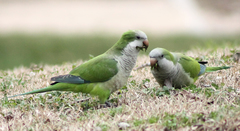

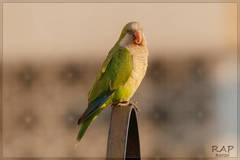
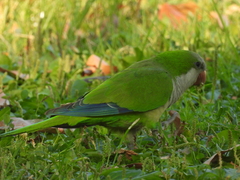

Monk Parakeet
Myiopsitta monachus
Silhouette: Sheatherius · PhyloPic
- KingdomAnimalia (Animals)
- PhylumChordata (Chordates)
- ClassAves (Birds)
- OrderPsittaciformes (Parrots)
- FamilyPsittacidae (New World and African Parrots)
- GenusMyiopsitta (Monk and Cliff Parakeets)
- SpeciesMyiopsitta monachus (Monk Parakeet)
In 3 days ~20% in a week ~30%
213 Verified sightings at Iguaçu National Park From 2019 to 2026
4,966 In all 13 parks
May Best month
☀️ Diurnal When it's spotted
About the Monk Parakeet
The monk parakeet (Myiopsitta monachus), also known as the Monk parrot or Quaker parrot, is a species of true parrot in the family Psittacidae. It is a small to medium bright-green parrot with a greyish breast and greenish-yellow abdomen. It originates from the temperate to subtropical areas of South America. Self-sustaining feral populations occur in many places, mainly in areas of similar climate in North America and Europe.
The monk parakeet was described by French polymath Georges-Louis Leclerc, Comte de Buffon, in 1780 in his Histoire Naturelle des Oiseaux. The bird was also illustrated in a hand-coloured plate engraved by François-Nicolas Martinet in the Planches Enluminées D'Histoire Naturelle, which was produced under the supervision of Edme-Louis Daubenton to accompany Buffon's text. Neither the plate caption nor Buffon's description included a scientific name, but in 1783, Dutch naturalist Pieter Boddaert coined the binomial name Psittacus monachus in his catalogue of the Planches Enluminées. As Buffon did not specify the origin of his specimen, in 1937 the American ornithologist James Peters assigned the type location as Montevideo, Uruguay. The monk parakeet... Wikipedia →
Recent sightings of Monk Parakeet in Iguaçu National Park
LIVEiNaturalistGlobal Distribution
Parks Where Found
| # | Park | Country | Daily sighting probability |
|---|---|---|---|
| 1 | El Palmar National Park | 🇦🇷 Argentina | |
| 2 | El Impenetrable National Park | 🇦🇷 Argentina | |
| 3 | Iberá National Park | 🇦🇷 Argentina | |
| 4 | Parque Estadual Encontro das Águas | 🇧🇷 Brazil | |
| 5 | Tijuca National Park | 🇧🇷 Brazil | |
| 6 | Iguazú National Park | 🇦🇷 Argentina | |
| 7 | El Vizcaíno Biosphere Reserve | 🇲🇽 Mexico | |
| 8 | Bahía de Loreto National Park | 🇲🇽 Mexico | |
| 9 | Iguaçu National Park | 🇧🇷 Brazil | |
| 10 | Cañón del Sumidero National Park | 🇲🇽 Mexico | |
| 11 | Everglades National Park | 🇺🇸 United States | |
| 12 | Chapada dos Guimarães National Park | 🇧🇷 Brazil | |
| 13 | Doñana National Park | 🇪🇸 Spain |
Cities Where Found
| # | City | Country | Daily sighting probability |
|---|---|---|---|
| 1 | Porto Alegre | 🇧🇷 Brazil | |
| 2 | Montevideo | 🇺🇾 Uruguay | |
| 3 | Cordoba | 🇦🇷 Argentina | |
| 4 | Mendoza | 🇦🇷 Argentina | |
| 5 | Buenos Aires | 🇦🇷 Argentina | |
| 6 | Santiago | 🇨🇱 Chile | |
| 7 | Madrid | 🇪🇸 Spain | |
| 8 | Rosario | 🇦🇷 Argentina | |
| 9 | Barcelona | 🇪🇸 Spain | |
| 10 | Tel Aviv | 🇮🇱 Israel |
Zoos & Centres Where Found
Closest Relatives at Iguaçu National Park


Before you go
What are the chances of seeing a Monk Parakeet in Iguaçu National Park?
With luck
About 10% of wildlife watchers report a Monk Parakeet sighting in Iguaçu National Park on a given day, based on 213 verified sightings from GBIF citizen-science data from 2019 to 2026. It is the 156th most-seen of the 346 birds we can rate there. Over three days the chance rises to about 20%, and over a week to about 30%, if each day is a fresh chance.
When is the best time to see a Monk Parakeet in Iguaçu National Park?
February, April–June, August–October and December
In those months about 10% of wildlife watchers report a Monk Parakeet in Iguaçu National Park on a given day, against under 5% in January, March, July and November, the lowest months.
What time of day is best to see a Monk Parakeet?
Between 3 and 6 pm
Across all the parks we cover, that three-hour window holds the most Monk Parakeet sightings with a recorded time, and about 9 in 10 of them come between 6 am and 6 pm: it is a daytime animal.
Is Iguaçu National Park the best place to see a Monk Parakeet?
9th of 13
Of the 13 parks where we can rate Monk Parakeet sightings, Iguaçu National Park ranks 9th at about 10%. The best odds are in El Palmar National Park (Argentina, about 80%), El Impenetrable National Park (Argentina, about 80%) and Iberá National Park (Argentina, about 70%). All parks ranked.
Which relatives of the Monk Parakeet live in Iguaçu National Park?
Same family: Psittacidae
The closest relatives of the Monk Parakeet that you can see in Iguaçu National Park (family Psittacidae, New World and African Parrots) are Scaly-headed Parrot (about 50%), White-eyed Parakeet (about 50%) and Yellow-chevroned Parakeet (about 20%), with each one's daily chance of a sighting.
Where does the Monk Parakeet sighting chance come from?
GBIF citizen-science records
It is estimated from how often the Monk Parakeet is recorded against all the birds logged in Iguaçu National Park (213 verified sightings from 2019 to 2026), calibrated against known sighting rates. Figures are rounded to the nearest 10% because citizen-science data supports honest approximations, not decimals, and months with records from fewer than five people show "—". How it works.
