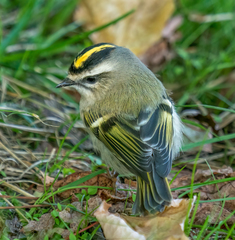
Golden-crowned Kinglet

Golden-crowned Kinglet

Regulus satrapa

Silhouette: Ferran Sayol · PhyloPic

LCLeast ConcernNTVUENCR
Daily sighting probability <5% · Rare
at Grand Canyon National Park

In 3 days <5% in a week ~10%

22 Verified sightings at Grand Canyon National Park From 2019 to 2026
27,003 In all 33 parks
November Best month
☀️ Diurnal When it's spotted

About the Golden-crowned Kinglet

The golden-crowned kinglet (Regulus satrapa) is a very small songbird in the family Regulidae that lives throughout much of North America. Adults are olive-gray on the upperparts with white underparts, thin bills and short tails. They have white wing bars, a black stripe through the eyes and a yellow crown surrounded by black. The adult male has an orange patch in the middle of the yellow crown. The juvenile is similar to the adult, but with a browner back and without the yellow crown. This is one of the smallest passerines in North America. Its length, at 8 to 11 cm (3.1 to 4.3 in), is probably the shortest of any American passerine. Its weight, averaging 6.1 g (0.22 oz) for females and 6.3 g (0.22 oz) for males and ranging from 4.5 to 7.8 g (0.16 to 0.28 oz), is similar to the American bushtit and black-tailed gnatcatcher. The golden-crowned kinglet has a wingspan of 5.5–7.1 in (14–18 cm).

The golden-crowned kinglet is insectivorous, foraging in trees or shrubs, where it eats insects (especially caterpillars), insect eggs and spiders. It produces a series of high-pitched calls on a single note, and tends not to fear human approach. Its nest is a well... Wikipedia →

Sounds

Call0:21

United States · 2026

© Greg Irving · XC1100995 · CC BY-NC-SA 4.0

Song0:22

Canada · 2022

© Sunny Tseng · XC752955 · CC BY-NC-SA 4.0

Uncertain0:17

United States · 2021

© Brian Hendrix · XC653057 · CC BY-NC-SA 4.0

Global Distribution

Parks Where Found

# Park Country Daily sighting probability
1 Pacific Rim National Park Reserve 🇨🇦 Canada
~50%
2 Glacier National Park 🇺🇸 United States
~50%
3 Reserva de la Biosfera Mariposa Monarca 🇲🇽 Mexico
~50%
4 Olympic National Park 🇺🇸 United States
~40%
5 Isle Royale National Park 🇺🇸 United States
~40%
6 Sequoia and Kings Canyon National Parks 🇺🇸 United States
~40%
7 Acadia National Park 🇺🇸 United States
~40%
8 Jasper National Park 🇨🇦 Canada
~40%
9 Banff National Park 🇨🇦 Canada
~40%
10 Redwood National Park 🇺🇸 United States
~40%
11 Great Bear Rainforest 🇨🇦 Canada
~40%
12 Cape Breton Highlands National Park 🇨🇦 Canada
~30%
13 Congaree National Park 🇺🇸 United States
~30%
14 Yosemite National Park 🇺🇸 United States
~30%
15 Great Smoky Mountains National Park 🇺🇸 United States
~20%
16 Point Pelee National Park 🇨🇦 Canada
~20%
17 Gros Morne National Park 🇨🇦 Canada
~10%
18 Grand Teton National Park 🇺🇸 United States
~10%
19 Voyageurs National Park 🇺🇸 United States
~10%
20 Shenandoah National Park 🇺🇸 United States
~10%
21 Riding Mountain National Park 🇨🇦 Canada
~10%
22 Rocky Mountain National Park 🇺🇸 United States
~10%
23 Katmai National Park 🇺🇸 United States
~10%
24 Kenai Fjords National Park 🇺🇸 United States
~10%
25 Wrangell-St. Elias National Park 🇺🇸 United States
<5%
26 Zion National Park 🇺🇸 United States
<5%
27 Yellowstone National Park 🇺🇸 United States
<5%
28 Elk Island National Park 🇨🇦 Canada
<5%
29 Kluane National Park 🇨🇦 Canada
<5%
30 Grand Canyon National Park 🇺🇸 United States
<5%
31 Big Bend National Park 🇺🇸 United States
<5%
32 Channel Islands National Park 🇺🇸 United States
<5%
33 Merritt Island National Wildlife Refuge 🇺🇸 United States
<5%

Cities Where Found

# City Country Daily sighting probability
1 Seattle 🇺🇸 United States
~40%
2 Vancouver 🇨🇦 Canada
~30%
3 Portland 🇺🇸 United States
~20%
4 Toronto 🇨🇦 Canada
~20%
5 Chicago 🇺🇸 United States
~10%
6 New York City 🇺🇸 United States
~10%
7 Boston 🇺🇸 United States
~10%
8 Montreal 🇨🇦 Canada
~10%
9 Detroit 🇺🇸 United States
~10%
10 Philadelphia 🇺🇸 United States
~10%

Zoos & Centres Where Found

# Zoo / Centre Country
1 Ralph Perkins II Wildlife Center and Woods Garden 🇺🇸 United States In captivity

Before you go

What are the chances of seeing a Golden-crowned Kinglet in Grand Canyon National Park?

Rare

Under 5% of wildlife watchers report a Golden-crowned Kinglet sighting in Grand Canyon National Park on a given day, based on 22 verified sightings from GBIF citizen-science data from 2019 to 2026. It is the 142nd most-seen of the 194 birds we can rate there. Over three days the chance rises to under 5%, and over a week to about 10%, if each day is a fresh chance.

When is the best time to see a Golden-crowned Kinglet in Grand Canyon National Park?

November

In that month about 10% of wildlife watchers report a Golden-crowned Kinglet in Grand Canyon National Park on a given day, against under 5% in December to October, the lowest months.

What time of day is best to see a Golden-crowned Kinglet?

Between 10 am and 1 pm

Across all the parks we cover, that three-hour window holds the most Golden-crowned Kinglet sightings with a recorded time, and about 9 in 10 of them come between 6 am and 6 pm: it is a daytime animal.

Where does the Golden-crowned Kinglet sighting chance come from?

GBIF citizen-science records

It is estimated from how often the Golden-crowned Kinglet is recorded against all the birds logged in Grand Canyon National Park (22 verified sightings from 2019 to 2026), calibrated against known sighting rates. Figures are rounded to the nearest 10% because citizen-science data supports honest approximations, not decimals, and months with records from fewer than five people show "—". How it works.

← Back to Grand Canyon National Park