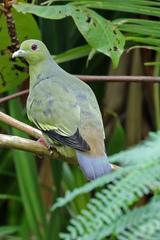
Pink-necked Green-Pigeon

Pink-necked Green-Pigeon

Treron vernans

Silhouette: Sheatherius · PhyloPic

LCLeast ConcernNTVUENCR
Daily sighting probability ~10% · With luck
at Gunung Leuser National Park

In 3 days ~30% in a week ~60%

30 Verified sightings at Gunung Leuser National Park From 2019 to 2026
1,941 In all 13 parks
December Best month
🌅 Crepuscular When it's spotted

About the Pink-necked Green-Pigeon

The pink-necked green pigeon (Treron vernans) is a species of bird of the pigeon and dove family, Columbidae. It is a common species of Southeast Asia, found from Thailand, and Vietnam south through to the major islands of Indonesia and the Philippines (where it is called "punay"). It is a medium-sized pigeon with predominantly green plumage; only the male has the pink neck that gives the species its name. The species lives in a wide range of forested and human-modified habitats and is particularly found in open habitats. Its diet is dominated by fruit, in particular figs. Pairs lay two eggs in a flimsy twig nest in a tree, shrub, or hedge, and work together to incubate the eggs and raise the chicks. The species is thought to be an important disperser of fruit seeds. The species has adapted well to human changes to the environment, and can be found in crowded cities as long as fruiting trees are present.

Carl Linnaeus described the pink-necked green pigeon as Columba vernans in 1771. Its specific name, vernans, is derived from the Latin word vernantis for "brilliant" or "flourishing". It was later moved to the green pigeon genus Treron. Within that genus the species... Wikipedia →

Sounds

Song0:39

Singapore · 2025

© Ding Li Yong · XC1067415 · CC BY-NC-ND 4.0

Call0:45

Malaysia · 2014

© Peter Boesman · XC290488 · CC BY-NC-ND 4.0

Recording0:12

Singapore · 2021

© Kim Chuah Lim · XC645000 · CC BY-NC-SA 4.0

Global Distribution

Parks Where Found

# Park Country Daily sighting probability
1 Bako National Park 🇲🇾 Malaysia
~40%
2 Bali Barat National Park 🇮🇩 Indonesia
~30%
3 Kinabatangan Wildlife Sanctuary 🇲🇾 Malaysia
~30%
4 Sepilok 🇲🇾 Malaysia
~20%
5 Way Kambas National Park 🇮🇩 Indonesia
~20%
6 Gunung Leuser National Park 🇮🇩 Indonesia
~10%
7 Tangkoko Nature Reserve 🇮🇩 Indonesia
~10%
8 Tanjung Puting National Park 🇮🇩 Indonesia
~10%
9 Taman Negara National Park 🇲🇾 Malaysia
<5%
10 Danum Valley Conservation Area 🇲🇾 Malaysia
<5%
11 Cat Tien National Park 🇻🇳 Vietnam
<5%
12 Kinabalu Park 🇲🇾 Malaysia
<5%
13 Kaeng Krachan National Park 🇹🇭 Thailand
<5%

Cities Where Found

# City Country Daily sighting probability
1 Singapore 🇸🇬 Singapore
~60%
2 Kuala Lumpur 🇲🇾 Malaysia
~60%
3 Jakarta 🇮🇩 Indonesia
~60%
4 Yogyakarta 🇮🇩 Indonesia
~50%
5 Cebu City 🇵🇭 Philippines
~50%
6 Denpasar 🇮🇩 Indonesia
~50%
7 Kuching 🇲🇾 Malaysia
~50%
8 Johor Bahru 🇲🇾 Malaysia
~40%
9 Bangkok 🇹🇭 Thailand
~30%
10 Semarang 🇮🇩 Indonesia
~10%

Zoos & Centres Where Found

# Zoo / Centre Country
1 Disney's Animal Kingdom 🇺🇸 United States In captivity
2 San Diego Zoo 🇺🇸 United States In captivity
3 Prague Zoo 🇨🇿 Czechia In captivity
4 ZooParc de Beauval 🇫🇷 France In captivity
5 Zoo Pilsen 🇨🇿 Czechia In captivity
6 Wrocław Zoological Garden 🇵🇱 Poland In captivity
7 Birdworld 🇬🇧 United Kingdom In captivity
8 Kuala Lumpur Bird Park 🇲🇾 Malaysia In captivity
9 Negros Forests and Ecological Foundation Biodiversity Conservation Center 🇵🇭 Philippines In captivity
10 Africarium 🇵🇱 Poland In captivity
11 Rákosův pavilon 🇨🇿 Czechia In captivity
12 Velemlokárium 🇨🇿 Czechia In captivity
13 terrarium ogrodu zoologicznego we Wrocławiu 🇵🇱 Poland In captivity

Before you go

What are the chances of seeing a Pink-necked Green-Pigeon in Gunung Leuser National Park?

With luck

About 10% of wildlife watchers report a Pink-necked Green-Pigeon sighting in Gunung Leuser National Park on a given day, based on 30 verified sightings from GBIF citizen-science data from 2019 to 2026. It is the 51st most-seen of the 166 birds we can rate there. Over three days the chance rises to about 30%, and over a week to about 60%, if each day is a fresh chance.

When is the best time to see a Pink-necked Green-Pigeon in Gunung Leuser National Park?

December

In that month about 30% of wildlife watchers report a Pink-necked Green-Pigeon in Gunung Leuser National Park on a given day, against under 5% in August, the lowest month.

What time of day is best to see a Pink-necked Green-Pigeon?

Between 1 and 4 am

Across all the parks we cover, that three-hour window holds the most Pink-necked Green-Pigeon sightings with a recorded time, and about 6 in 10 of them come between 6 pm and 6 am: it is most active around dawn and dusk.

Is Gunung Leuser National Park the best place to see a Pink-necked Green-Pigeon?

6th of 13

Of the 13 parks where we can rate Pink-necked Green-Pigeon sightings, Gunung Leuser National Park ranks 6th at about 10%. The best odds are in Bako National Park (Malaysia, about 40%), Bali Barat National Park (Indonesia, about 30%) and Kinabatangan Wildlife Sanctuary (Malaysia, about 30%).

Which relatives of the Pink-necked Green-Pigeon live in Gunung Leuser National Park?

Same family: Columbidae

The closest relatives of the Pink-necked Green-Pigeon that you can see in Gunung Leuser National Park (family Columbidae, Pigeons and Doves) are Zebra Dove (about 30%), Pearl-necked Dove (about 20%) and Little Cuckoo-Dove (about 10%), with each one's daily chance of a sighting.

Where does the Pink-necked Green-Pigeon sighting chance come from?

GBIF citizen-science records

It is estimated from how often the Pink-necked Green-Pigeon is recorded against all the birds logged in Gunung Leuser National Park (30 verified sightings from 2019 to 2026), calibrated against known sighting rates. Figures are rounded to the nearest 10% because citizen-science data supports honest approximations, not decimals, and months with records from fewer than five people show "—". How it works.

← Back to Gunung Leuser National Park