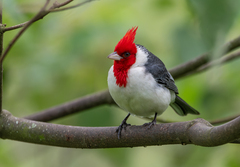
Brazilian Cardinal

Brazilian Cardinal

Paroaria coronata

Silhouette: Sheatherius · PhyloPic

LCLeast ConcernNTVUENCR
Daily sighting probability ~40% · Likely
at Haleakala National Park

In 3 days ~80% in a week >90%

307 Verified sightings at Haleakala National Park From 2019 to 2026
3,269 In all 10 parks
August Best month
☀️ Diurnal When it's spotted

About the Brazilian Cardinal

The red-crested cardinal (Paroaria coronata) is a passerine bird in the tanager family Thraupidae. Notwithstanding its similar name, this bird is not closely related to the true cardinal family Cardinalidae. It is sometimes known as the Brazilian cardinal.

In 1776 the English illustrator John Frederick Miller included a hand-coloured plate of the red-crested cardinal in his Icones animalium et plantarum. He coined the binomial name Loxia coronata. The type locality was subsequently designated as Rio Grande do Sul in southern Brazil. The red-crested cardinal is now one of six species placed in the genus Paroaria that was introduced in 1832 by the French naturalist Charles Lucien Bonaparte. The species is monotypic: no subspecies are recognised. The genus name is from Tiéguacú paroára, a name for a small yellow, red, and grey bird in the extinct Tupi language. The specific epithet coronata is Latin meaning "crowned"

The red-crested cardinal is a medium-sized species showing a red head, with a red bib and a short red crest that the bird raises when excited. Belly, breast, and undertail are white, with a gray back, wings, and tail. Wing coverts are gray...

Wikipedia →

Sounds

Song0:07

Argentina · 2026

Pedro Sanetti · XC1090718 · CC0

Recording0:31

Argentina · 2024

© Sabrina Andrea Rendon Anaya · XC872085 · CC BY-NC-SA 4.0

Call0:32

Brazil · 2021

© JAYRSON ARAUJO DE OLIVEIRA · XC686320 · CC BY-NC-SA 4.0

Global Distribution

Parks Where Found

# Park Country Daily sighting probability
1 El Impenetrable National Park 🇦🇷 Argentina
~80%
2 Kilauea Point National Wildlife Refuge 🇺🇸 United States
~70%
3 Iberá National Park 🇦🇷 Argentina
~70%
4 El Palmar National Park 🇦🇷 Argentina
~60%
5 Haleakala National Park 🇺🇸 United States
~40%
6 Madidi National Park 🇧🇴 Bolivia
~10%
7 Hawaii Volcanoes National Park 🇺🇸 United States
~10%
8 Iguaçu National Park 🇧🇷 Brazil
<5%
9 Iguazú National Park 🇦🇷 Argentina
<5%
10 Parque Estadual Encontro das Águas 🇧🇷 Brazil
<5%

Cities Where Found

# City Country Daily sighting probability
1 Asuncion 🇵🇾 Paraguay
~60%
2 Santa Cruz de la Sierra 🇧🇴 Bolivia
~40%
3 Buenos Aires 🇦🇷 Argentina
~40%
4 Rosario 🇦🇷 Argentina
~40%
5 Montevideo 🇺🇾 Uruguay
~40%
6 Porto Alegre 🇧🇷 Brazil
~30%
7 Mendoza 🇦🇷 Argentina
~20%
8 Cordoba 🇦🇷 Argentina
~10%
9 La Paz 🇧🇴 Bolivia
~10%
10 Curitiba 🇧🇷 Brazil
~10%

Zoos & Centres Where Found

# Zoo / Centre Country
1 Pairi Daiza 🇧🇪 Belgium In captivity
2 National Zoological Park 🇺🇸 United States In captivity
3 Parque das Aves 🇧🇷 Brazil In captivity
4 Abilene Zoological Gardens 🇺🇸 United States In captivity
5 Zoo Miami 🇺🇸 United States In captivity
6 Bronx Zoo 🇺🇸 United States In captivity
7 Milwaukee County Zoo 🇺🇸 United States In captivity
8 Birmingham Zoo 🇺🇸 United States In captivity
9 Woodland Park Zoo 🇺🇸 United States In captivity
10 Temaikén 🇦🇷 Argentina In captivity
11 Memphis Zoo 🇺🇸 United States In captivity
12 Singapore Zoo 🇸🇬 Singapore In captivity
13 Mesker Park Zoo and Botanic Garden 🇺🇸 United States In captivity
14 Budapest Zoo & Botanical Garden 🇭🇺 Hungary In captivity
15 London Zoo 🇬🇧 United Kingdom In captivity
16 El Paso Zoo 🇺🇸 United States In captivity
17 Rio de Janeiro Zoological Garden 🇧🇷 Brazil In captivity
18 Paphos Zoo 🇨🇾 Cyprus In captivity
19 The Abilene Zoo 🇺🇸 United States In captivity
20 St. Augustine Alligator Farm Zoological Park 🇺🇸 United States In captivity
21 Central Park Zoo 🇺🇸 United States In captivity
22 El Jardí dels Ocells 🇪🇸 Spain In captivity
23 Agroflori Parque de las Aves 🇧🇴 Bolivia In captivity
24 Stadtvolière Lindengut Winterthur 🇨🇭 Switzerland In captivity
25 Zooparque Itatiba 🇧🇷 Brazil In captivity

Before you go

What are the chances of seeing a Brazilian Cardinal in Haleakala National Park?

Likely

About 40% of wildlife watchers report a Brazilian Cardinal sighting in Haleakala National Park on a given day, based on 307 verified sightings from GBIF citizen-science data from 2019 to 2026. It is the 12th most-seen of the 32 birds we can rate there. Over three days the chance rises to about 80%, and over a week to over 90%, if each day is a fresh chance.

When is the best time to see a Brazilian Cardinal in Haleakala National Park?

April and August

In those months about 60% of wildlife watchers report a Brazilian Cardinal in Haleakala National Park on a given day, against about 30% in March and September, the lowest months.

What time of day is best to see a Brazilian Cardinal?

Between 9 am and noon

Across all the parks we cover, that three-hour window holds the most Brazilian Cardinal sightings with a recorded time, and nearly all of them come between 6 am and 6 pm: it is a daytime animal.

Which relatives of the Brazilian Cardinal live in Haleakala National Park?

Same order: Passeriformes

The closest relatives of the Brazilian Cardinal that you can see in Haleakala National Park (order Passeriformes, Perching Birds) are Iiwi (about 90%), Hawaii 'Amakihi (about 90%) and ʻApapane (about 90%), with each one's daily chance of a sighting.

Where does the Brazilian Cardinal sighting chance come from?

GBIF citizen-science records

It is estimated from how often the Brazilian Cardinal is recorded against all the birds logged in Haleakala National Park (307 verified sightings from 2019 to 2026), calibrated against known sighting rates. Figures are rounded to the nearest 10% because citizen-science data supports honest approximations, not decimals, and months with records from fewer than five people show "—". How it works.

← Back to Haleakala National Park