
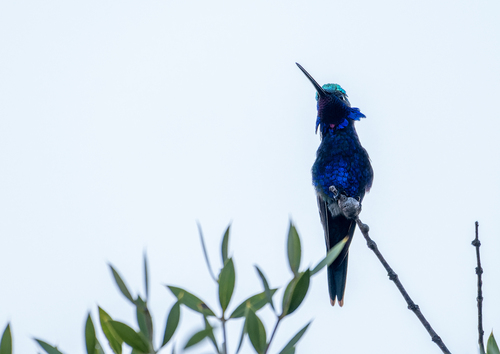
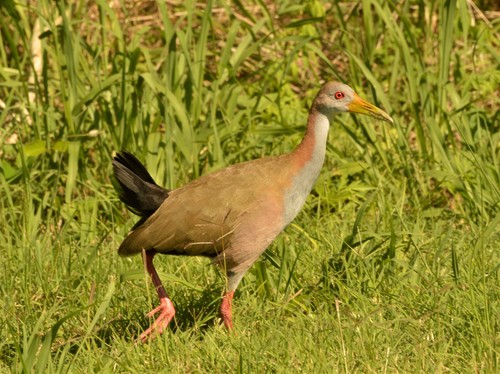
Glittering-bellied Emerald

Glittering-bellied Emerald

Chlorostilbon lucidus

Silhouette: Ferran Sayol · PhyloPic

LCLeast ConcernNTVUENCR
Daily sighting probability ~20% · Possible
at Iberá National Park

In 3 days ~50% in a week ~80%

349 Verified sightings at Iberá National Park From 2019 to 2026
2,326 In all 14 parks
September Best month
☀️ Diurnal When it's spotted

About the Glittering-bellied Emerald

The glittering-bellied emerald (Chlorostilbon lucidus) is a species of hummingbird in the "emeralds", tribe Trochilini of subfamily Trochilinae. It is found in Argentina, Bolivia, Brazil, Paraguay, and Uruguay. The glittering-bellied emerald was widely called by the scientific name Chlorostilbon aureoventris, but in 2006 José Pacheco and Bret Whitney showed that lucidus is the correct specific epithet due to the principle of priority.

The Clements taxonomy and BirdLife International's Handbook of the Birds of the World add C. l. igneous, whose population the IOC includes in the nominate. Some ornithologists believe that pucherani is "approaching the species threshold".

The authorities and distributions for the three subspecies are: Wikipedia →

Sounds

Flight call0:12

Brazil · 2026

© JAYRSON ARAUJO DE OLIVEIRA · XC1135372 · CC BY-NC-SA 4.0

Call0:41

Brazil · 2022

© GABRIEL LEITE · XC736081 · CC BY-NC-SA 4.0

Alarm call0:45

Argentina · 2021

© Franco Vushurovich · XC677036 · CC BY-NC-SA 4.0

Global Distribution

Parks Where Found

# Park Country Daily sighting probability
1 Chapada Diamantina National Park 🇧🇷 Brazil
~50%
2 El Impenetrable National Park 🇦🇷 Argentina
~40%
3 El Palmar National Park 🇦🇷 Argentina
~40%
4 Chapada dos Guimarães National Park 🇧🇷 Brazil
~30%
5 Serra da Canastra National Park 🇧🇷 Brazil
~30%
6 Iberá National Park 🇦🇷 Argentina
~20%
7 Emas National Park 🇧🇷 Brazil
~10%
8 Iguazú National Park 🇦🇷 Argentina
~10%
9 Amboró National Park 🇧🇴 Bolivia
~10%
10 Iguaçu National Park 🇧🇷 Brazil
~10%
11 Itatiaia National Park 🇧🇷 Brazil
<5%
12 Serra dos Órgãos National Park 🇧🇷 Brazil
<5%
13 Parque Estadual Encontro das Águas 🇧🇷 Brazil
<5%
14 Tijuca National Park 🇧🇷 Brazil
<5%

Cities Where Found

# City Country Daily sighting probability
1 Cochabamba 🇧🇴 Bolivia
~50%
2 Rosario 🇦🇷 Argentina
~40%
3 Asuncion 🇵🇾 Paraguay
~40%
4 Buenos Aires 🇦🇷 Argentina
~40%
5 Cordoba 🇦🇷 Argentina
~30%
6 Mendoza 🇦🇷 Argentina
~30%
7 Curitiba 🇧🇷 Brazil
~30%
8 Montevideo 🇺🇾 Uruguay
~20%
9 Campo Grande 🇧🇷 Brazil
~10%
10 Porto Alegre 🇧🇷 Brazil
~10%

Before you go

What are the chances of seeing a Glittering-bellied Emerald in Iberá National Park?

Possible

About 20% of wildlife watchers report a Glittering-bellied Emerald sighting in Iberá National Park on a given day, based on 349 verified sightings from GBIF citizen-science data from 2019 to 2026. It is the 111th most-seen of the 284 birds we can rate there. Over three days the chance rises to about 50%, and over a week to about 80%, if each day is a fresh chance.

When is the best time to see a Glittering-bellied Emerald in Iberá National Park?

September

In that month about 40% of wildlife watchers report a Glittering-bellied Emerald in Iberá National Park on a given day, against under 5% in July, the lowest month.

What time of day is best to see a Glittering-bellied Emerald?

Between 10 am and 1 pm

Across all the parks we cover, that three-hour window holds the most Glittering-bellied Emerald sightings with a recorded time, and nearly all of them come between 6 am and 6 pm: it is a daytime animal.

Which relatives of the Glittering-bellied Emerald live in Iberá National Park?

Same family: Trochilidae

The closest relatives of the Glittering-bellied Emerald that you can see in Iberá National Park (family Trochilidae, Hummingbirds) are Gilded Hummingbird (about 30%) and Blue-tufted Starthroat (about 10%), with each one's daily chance of a sighting.

Where does the Glittering-bellied Emerald sighting chance come from?

GBIF citizen-science records

It is estimated from how often the Glittering-bellied Emerald is recorded against all the birds logged in Iberá National Park (349 verified sightings from 2019 to 2026), calibrated against known sighting rates. Figures are rounded to the nearest 10% because citizen-science data supports honest approximations, not decimals, and months with records from fewer than five people show "—". How it works.

← Back to Iberá National Park