Double-crested Cormorant

Double-crested Cormorant

Phalacrocorax auritus

Silhouette: Andy Wilson · PhyloPic

LCLeast ConcernNTVUENCR
Daily sighting probability ~20% · Possible
at Isle Royale National Park

In 3 days ~40% in a week ~70%

65 Verified sightings at Isle Royale National Park From 2019 to 2026
55,686 In all 37 parks
August Best month
☀️ Diurnal When it's spotted

About the Double-crested Cormorant

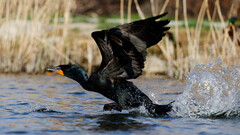
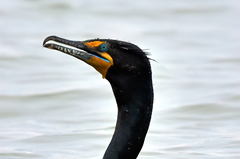
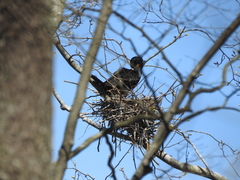
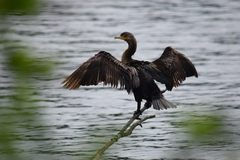
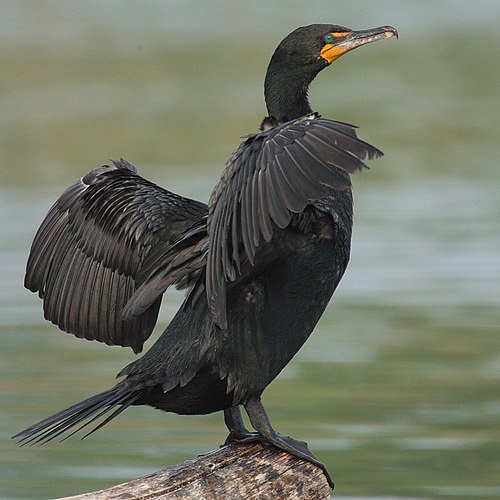
The double-crested cormorant (Nannopterum auritum) is a member of the cormorant family of water birds. It is found near rivers and lakes and in coastal areas and is widely distributed across North America, from the Aleutian Islands in Alaska down to Florida and Mexico. Measuring 70–90 cm (28–35 in) in length, it is entirely black except for a bare patch of orange-yellow facial skin and some extra plumage that it exhibits in the breeding season when it grows a double crest in which black feathers are mingled with white. Five subspecies are recognized. It mainly eats fish and hunts by swimming and diving. Its feathers, like all cormorants, are not waterproof, and it must dry them out after spending time in the water. Once threatened by the use of DDT, the numbers of this bird have increased markedly in recent years.

The double-crested cormorant was described by René Primevère Lesson in 1831. It was formerly classified in the genus Phalacrocorax, but a 2014 study supported reclassifying it and several other American cormorant species into the genus Nannopterum. The IOC followed this classification in 2021.

Its scientific genus name is derived from the Greek words νᾶνος... Wikipedia →
Sounds

Recording0:08

United States · 2023

© riley_j · iNaturalist · CC BY-NC 4.0

Recording0:15

United States · 2025

© Justin Donahue · iNaturalist · CC BY 4.0

Recording0:07

Canada · 2025

© sankarancls · iNaturalist · CC BY-NC 4.0

Global Distribution

Parks Where Found

# Park Country Daily sighting probability
1 Ría Lagartos Biosphere Reserve 🇲🇽 Mexico
~80%
2 Point Pelee National Park 🇨🇦 Canada
~70%
3 Merritt Island National Wildlife Refuge 🇺🇸 United States
~70%
4 Channel Islands National Park 🇺🇸 United States
~70%
5 Celestún Biosphere Reserve 🇲🇽 Mexico
~70%
6 El Vizcaíno Biosphere Reserve 🇲🇽 Mexico
~60%
7 Bahía de Loreto National Park 🇲🇽 Mexico
~60%
8 Big Cypress National Preserve 🇺🇸 United States
~60%
9 Cape Breton Highlands National Park 🇨🇦 Canada
~50%
10 Everglades National Park 🇺🇸 United States
~50%
11 Acadia National Park 🇺🇸 United States
~50%
12 Kenai Fjords National Park 🇺🇸 United States
~40%
13 Gros Morne National Park 🇨🇦 Canada
~40%
14 Redwood National Park 🇺🇸 United States
~30%
15 Padre Island National Seashore 🇺🇸 United States
~30%
16 Ciénaga de Zapata 🇨🇺 Cuba
~30%
17 Voyageurs National Park 🇺🇸 United States
~20%
18 Isle Royale National Park 🇺🇸 United States
~20%
19 Great Bear Rainforest 🇨🇦 Canada
~20%
20 Elk Island National Park 🇨🇦 Canada
~20%
21 Sian Ka'an Biosphere Reserve 🇲🇽 Mexico
~20%
22 Grand Teton National Park 🇺🇸 United States
~20%
23 Olympic National Park 🇺🇸 United States
~10%
24 Riding Mountain National Park 🇨🇦 Canada
~10%
25 Pacific Rim National Park Reserve 🇨🇦 Canada
~10%
26 Yellowstone National Park 🇺🇸 United States
~10%
27 Rocky Mountain National Park 🇺🇸 United States
~10%
28 Katmai National Park 🇺🇸 United States
<5%
29 Cabo Pulmo National Park 🇲🇽 Mexico
<5%
30 Death Valley National Park 🇺🇸 United States
<5%
31 Congaree National Park 🇺🇸 United States
<5%
32 Arrecifes de Cozumel National Park 🇲🇽 Mexico
<5%
33 Shenandoah National Park 🇺🇸 United States
<5%
34 Grand Canyon National Park 🇺🇸 United States
<5%
35 Great Smoky Mountains National Park 🇺🇸 United States
<5%
36 Glacier National Park 🇺🇸 United States
<5%
37 Big Bend National Park 🇺🇸 United States
<5%

Cities Where Found

# City Country Daily sighting probability
1 Tijuana 🇲🇽 México
~50%
2 San Diego 🇺🇸 United States
~40%
3 San Francisco 🇺🇸 United States
~40%
4 Los Angeles 🇺🇸 United States
~40%
5 New York City 🇺🇸 United States
~40%
6 Seattle 🇺🇸 United States
~30%
7 Miami 🇺🇸 United States
~30%
8 Sacramento 🇺🇸 United States
~30%
9 Denver 🇺🇸 United States
~30%
10 Mesa 🇺🇸 United States
~30%

Zoos & Centres Where Found

# Zoo / Centre Country
1 National Zoological Park 🇺🇸 United States In captivity
2 Denver Zoo 🇺🇸 United States In captivity
3 Silver Springs 🇺🇸 United States In captivity
4 Zoo Miami 🇺🇸 United States In captivity
5 Brookfield Zoo 🇺🇸 United States In captivity
6 Detroit Zoo 🇺🇸 United States In captivity
7 Jacksonville Zoo and Gardens 🇺🇸 United States In captivity
8 Audubon Zoo 🇺🇸 United States In captivity
9 Saint Louis Zoo 🇺🇸 United States In captivity
10 Cameron Park Zoo 🇺🇸 United States In captivity
11 Tracy Aviary 🇺🇸 United States In captivity
12 Florida Aquarium 🇺🇸 United States In captivity
13 Mote Marine Laboratory 🇺🇸 United States In captivity
14 Flint RiverQuarium 🇺🇸 United States In captivity
15 Seaside Seabird Sanctuary 🇺🇸 United States In captivity

Before you go

What are the chances of seeing a Double-crested Cormorant in Isle Royale National Park?

Possible

About 20% of wildlife watchers report a Double-crested Cormorant sighting in Isle Royale National Park on a given day, based on 65 verified sightings from GBIF citizen-science data from 2019 to 2026. It is the 42nd most-seen of the 105 birds we can rate there. Over three days the chance rises to about 40%, and over a week to about 70%, if each day is a fresh chance.

What time of day is best to see a Double-crested Cormorant?

Between noon and 3 pm

Across all the parks we cover, that three-hour window holds the most Double-crested Cormorant sightings with a recorded time, and about 8 in 10 of them come between 6 am and 6 pm: it is a daytime animal.

Where does the Double-crested Cormorant sighting chance come from?

GBIF citizen-science records

It is estimated from how often the Double-crested Cormorant is recorded against all the birds logged in Isle Royale National Park (65 verified sightings from 2019 to 2026), calibrated against known sighting rates. Figures are rounded to the nearest 10% because citizen-science data supports honest approximations, not decimals, and months with records from fewer than five people show "—". How it works.

← Back to Isle Royale National Park