

Violet-green Swallow

Violet-green Swallow

Tachycineta thalassina

Silhouette: Andy Wilson · PhyloPic

LCLeast ConcernNTVUENCR
Daily sighting probability ~10% · With luck
at Jasper National Park

In 3 days ~30% in a week ~60%

122 Verified sightings at Jasper National Park From 2019 to 2026
17,803 In all 38 parks
May Best month
☀️ Diurnal When it's spotted

About the Violet-green Swallow

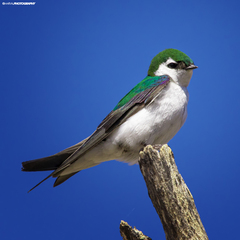
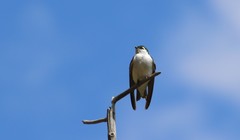
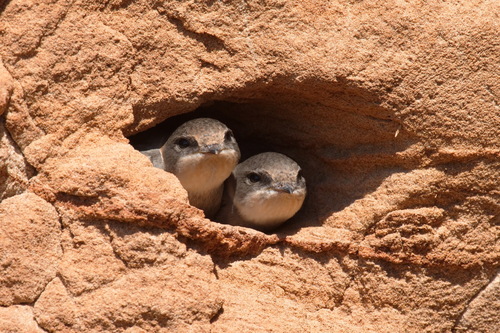
The violet-green swallow (Tachycineta thalassina) is a small North American passerine bird in the swallow family. These aerial insectivores are distributed along the west coast from Alaska to Mexico, extending as far east as Montana and Texas. With an appearance very similar to the tree swallow, these individuals can be identified by the white rump side-patches that appear to separate their green back and purple tail. Violet-green swallows are secondary cavity nesters, found in a number of habitats including deciduous and coniferous forest. In addition to nesting in tree holes within these habitats, they are also widely observed nesting in the cracks of large cliffs.

The distinct body form of swallows distinguishes them from other passerine birds. Their long pointed wings and slim, streamlined body evolved to catch insects while in flight; the violet-green swallow is no exception. With an average body length of 12–13 cm (4.7–5.1 in), the violet-green swallow is slightly shorter and appears more compact in flight compared to some other members of the genus Tachycineta. The violet-green swallow most closely resembles the tree swallow T. bicolor, but can be distinguished... Wikipedia →

Sounds

Flight call0:18

United States · 2018

© Richard E. Webster · XC575306 · CC BY-NC-SA 4.0

Song0:32

Canada · 1983

© Peter Ward · XC511281 · CC BY-NC-SA 4.0

Alarm call1:15

United States · 2015

© Elias Aristides Elias · XC255604 · CC BY-NC-SA 4.0

Global Distribution

Parks Where Found

# Park Country Daily sighting probability
1 Nahanni National Park 🇨🇦 Canada
~60%
2 Grand Canyon National Park 🇺🇸 United States
~40%
3 Rocky Mountain National Park 🇺🇸 United States
~40%
4 Yellowstone National Park 🇺🇸 United States
~40%
5 Grand Teton National Park 🇺🇸 United States
~30%
6 Kluane National Park 🇨🇦 Canada
~30%
7 Zion National Park 🇺🇸 United States
~30%
8 Badlands National Park 🇺🇸 United States
~20%
9 Denali National Park 🇺🇸 United States
~20%
10 Guadalupe Mountains National Park 🇺🇸 United States
~20%
11 Olympic National Park 🇺🇸 United States
~20%
12 Wrangell-St. Elias National Park 🇺🇸 United States
~20%
13 Banff National Park 🇨🇦 Canada
~20%
14 Glacier National Park 🇺🇸 United States
~20%
15 Redwood National Park 🇺🇸 United States
~20%
16 Reserva de la Biosfera Mariposa Monarca 🇲🇽 Mexico
~20%
17 Pacific Rim National Park Reserve 🇨🇦 Canada
~20%
18 Bahía de Loreto National Park 🇲🇽 Mexico
~20%
19 Sequoia and Kings Canyon National Parks 🇺🇸 United States
~10%
20 Kenai Fjords National Park 🇺🇸 United States
~10%
21 Great Bear Rainforest 🇨🇦 Canada
~10%
22 Jasper National Park 🇨🇦 Canada
~10%
23 Yosemite National Park 🇺🇸 United States
~10%
24 El Vizcaíno Biosphere Reserve 🇲🇽 Mexico
~10%
25 Death Valley National Park 🇺🇸 United States
~10%
26 Cabo Pulmo National Park 🇲🇽 Mexico
<5%
27 Celaque National Park 🇭🇳 Honduras
<5%
28 Cañón del Sumidero National Park 🇲🇽 Mexico
<5%
29 Big Bend National Park 🇺🇸 United States
<5%
30 Channel Islands National Park 🇺🇸 United States
<5%
31 Joshua Tree National Park 🇺🇸 United States
<5%
32 Saguaro National Park 🇺🇸 United States
<5%
33 Lago de Yojoa 🇭🇳 Honduras
<5%
34 Cumbres de Monterrey National Park 🇲🇽 Mexico
<5%
35 Cerro Azul Meámbar National Park 🇭🇳 Honduras
<5%
36 Bastimentos Island National Marine Park 🇵🇦 Panama
<5%
37 La Amistad International Park (Panama) 🇵🇦 Panama
<5%
38 Monteverde Cloud Forest Reserve 🇨🇷 Costa Rica
<5%

Cities Where Found

# City Country Daily sighting probability
1 Toluca 🇲🇽 México
~40%
2 Portland 🇺🇸 United States
~10%
3 Seattle 🇺🇸 United States
~10%
4 San Francisco 🇺🇸 United States
~10%
5 Vancouver 🇨🇦 Canada
~10%
6 Anchorage 🇺🇸 United States
~10%
7 Denver 🇺🇸 United States
~10%
8 Calgary 🇨🇦 Canada
<5%
9 Mexico City 🇲🇽 México
<5%
10 Mesa 🇺🇸 United States
<5%

Before you go

What are the chances of seeing a Violet-green Swallow in Jasper National Park?

With luck

About 10% of wildlife watchers report a Violet-green Swallow sighting in Jasper National Park on a given day, based on 122 verified sightings from GBIF citizen-science data from 2019 to 2026. It is the 49th most-seen of the 156 birds we can rate there. Over three days the chance rises to about 30%, and over a week to about 60%, if each day is a fresh chance.

When is the best time to see a Violet-green Swallow in Jasper National Park?

May and June

In those months about 20% of wildlife watchers report a Violet-green Swallow in Jasper National Park on a given day, against under 5% in March and August–January, the lowest months.

What time of day is best to see a Violet-green Swallow?

Between 8 and 11 am

Across all the parks we cover, that three-hour window holds the most Violet-green Swallow sightings with a recorded time, and about 9 in 10 of them come between 6 am and 6 pm: it is a daytime animal.

Where does the Violet-green Swallow sighting chance come from?

GBIF citizen-science records

It is estimated from how often the Violet-green Swallow is recorded against all the birds logged in Jasper National Park (122 verified sightings from 2019 to 2026), calibrated against known sighting rates. Figures are rounded to the nearest 10% because citizen-science data supports honest approximations, not decimals, and months with records from fewer than five people show "—". How it works.

← Back to Jasper National Park