Bengal Monitor

Bengal Monitor

Varanus bengalensis

Silhouette: Steven Traver · PhyloPic

LCNTNear ThreatenedVUENCR
Daily sighting probability ~30% · Possible
at Jim Corbett National Park

In 3 days ~70% in a week ~90%

13 Verified sightings at Jim Corbett National Park From 2019 to 2026
750 In all 15 parks
April Best month
🌅 Crepuscular When it's spotted

About the Bengal Monitor

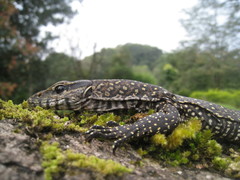
The Bengal monitor (Varanus bengalensis), also called Indian monitor, is a species of monitor lizard distributed widely in the Indian subcontinent and parts of Southeast Asia and West Asia. The populations of monitors in India and Sri Lanka differ in the scalation from those of Myanmar; these populations were once considered subspecies of the Bengal monitor, but are now considered two species within the V. bengalensis species complex. What was once the nominate subspecies, V. bengalensis, is found west of Myanmar, while the clouded monitor (V. nebulosus) is found to the east. Clouded monitors can be differentiated by the presence of a series of enlarged scales in the supraocular region. The number of ventral scales varies, decreasing from 108 in the west to 75 in the east (Java).

The Bengal monitor can reach 175 cm (69 in) with a snout-to-vent length (SVL) of 75 cm (30 in) and a tail of 100 cm (39 in). Males are generally larger than females. Heavy individuals may weigh nearly 7.2 kg (16 lb). Young Bengal monitors are more colourful than adults. Young have a series of dark crossbars on the neck, throat and back. The belly is white, banded with dark... Wikipedia →

Global Distribution

Parks Where Found

# Park Country Daily sighting probability
1 Wilpattu National Park 🇱🇰 Sri Lanka
~90%
2 Yala National Park 🇱🇰 Sri Lanka
~90%
3 Udawalawe National Park 🇱🇰 Sri Lanka
~80%
4 Kaziranga National Park 🇮🇳 India
~70%
5 Minneriya National Park 🇱🇰 Sri Lanka
~60%
6 Keoladeo National Park 🇮🇳 India
~50%
7 Manas National Park 🇮🇳 India
~40%
8 Periyar National Park 🇮🇳 India
~40%
9 Mudumalai National Park 🇮🇳 India
~40%
10 Nagarhole National Park 🇮🇳 India
~40%
11 Chitwan National Park 🇳🇵 Nepal
~30%
12 Jim Corbett National Park 🇮🇳 India
~30%
13 Royal Manas National Park 🇧🇹 Bhutan
~30%
14 Ranthambore National Park 🇮🇳 India
~30%
15 Bandipur National Park 🇮🇳 India
~30%

Cities Where Found

# City Country Daily sighting probability
1 Savar 🇧🇩 Bangladesh
~60%
2 Colombo [Sri Jayawardenepura Kotte] 🇱🇰 Sri Lanka
~50%
3 Dehradun 🇮🇳 India
~50%
4 Dhaka 🇧🇩 Bangladesh
~40%
5 Jodhpur 🇮🇳 India
~30%
6 Vadodara 🇮🇳 India
~30%
7 Kozhikode 🇮🇳 India
~30%
8 Kochi 🇮🇳 India
~20%
9 Kolkata 🇮🇳 India
~10%
10 Mumbai 🇮🇳 India
~10%

Zoos & Centres Where Found

# Zoo / Centre Country
1 Nandankanan Zoological Park 🇮🇳 India In captivity
2 Arignar Anna Zoological Park 🇮🇳 India In captivity
3 Tyavarekoppa Lion and Tiger Safari 🇮🇳 India In captivity
4 National Zoological Park Delhi 🇮🇳 India In captivity
5 Shenzhen Safari Park 🇨🇳 China In captivity
6 Cologne Zoological Garden 🇩🇪 Germany In captivity
7 Thrissur Zoo 🇮🇳 India In captivity
8 Cologne Zoo Aquarium 🇩🇪 Germany In captivity

Before you go

What are the chances of seeing a Bengal Monitor in Jim Corbett National Park?

Possible

About 30% of wildlife watchers report a Bengal Monitor sighting in Jim Corbett National Park on a given day, based on 13 verified sightings from GBIF citizen-science data from 2019 to 2026. Over three days the chance rises to about 70%, and over a week to about 90%, if each day is a fresh chance.

When is the best time to see a Bengal Monitor in Jim Corbett National Park?

April

In that month about 60% of wildlife watchers report a Bengal Monitor in Jim Corbett National Park on a given day, against under 5% in January and March, the lowest months. That is one of Jim Corbett National Park's driest months, with about 15 mm of rain against 360 mm in July.

What time of day is best to see a Bengal Monitor?

Between 8 and 11 am

Across all the parks we cover, that three-hour window holds the most Bengal Monitor sightings with a recorded time, and about 7 in 10 of them come between 6 am and 6 pm: it is most active around dawn and dusk.

Where does the Bengal Monitor sighting chance come from?

GBIF citizen-science records

It is estimated from how often the Bengal Monitor is recorded against all the reptiles logged in Jim Corbett National Park (13 verified sightings from 2019 to 2026), calibrated against known sighting rates. Figures are rounded to the nearest 10% because citizen-science data supports honest approximations, not decimals, and months with records from fewer than five people show "—". How it works.

← Back to Jim Corbett National Park