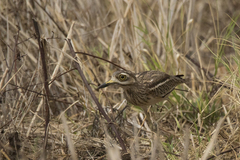
Indian Thick-knee

Indian Thick-knee

Burhinus indicus

Silhouette: Auckland Museum · PhyloPic

LCLeast ConcernNTVUENCR
Daily sighting probability <5% · Rare
at Jim Corbett National Park

In 3 days ~10%

41 Verified sightings at Jim Corbett National Park From 2019 to 2026
2,482 In all 17 parks
May Best month
🌅 Crepuscular When it's spotted

About the Indian Thick-knee

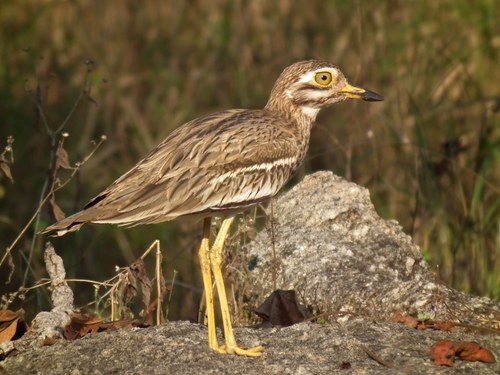
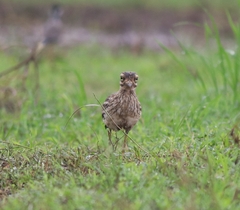
The Indian stone-curlew or Indian thick-knee (Burhinus indicus) is a species of bird in the family Burhinidae. It was formerly included as a subspecies of the Eurasian stone-curlew. This species is found in the plains of South and South-eastern Asia. They have large eyes and are brown with streaks and pale marks making it hard to spot against the background of soils and rocks. Mostly active in the dark, they produce calls similar to the true curlews, giving them their names.

The Indian stone-curlew was formally described in 1866 by the Italian zoologist Tommaso Salvadori based on specimens obtained in India. He coined the binomial name Oedicnemus indicus. The specific epithet is Latin meaning "Indian". The Indian stone-curlew is now placed in the genus Burhinus that was erected in 1811 by the German zoologist Johann Karl Wilhelm Illiger in 1811. The species is monotypic: no subspecies are recognised.

This species was formerly treated as a subspecies of the Eurasian stone-curlew Burhinus oedicnemus but the Indian population is distinctive in plumage, and non-migratory, leading to its being treated as a full species by Pamela Rasmussen in 2005. There has however been no... Wikipedia →
Sounds

Call0:46

Thailand · 2025

© Ding Li Yong · XC961728 · CC BY-NC-ND 4.0

Song0:36

Thailand · 2019

© Peter Ericsson · XC508633 · CC BY-NC-SA 4.0

Call0:14

India · 2017

© Sreekumar Chirukandoth · XC442820 · CC BY-NC-SA 4.0

Global Distribution

Parks Where Found

# Park Country Daily sighting probability
1 Udawalawe National Park 🇱🇰 Sri Lanka
~20%
2 Ranthambore National Park 🇮🇳 India
~20%
3 Gir National Park 🇮🇳 India
~20%
4 Bandhavgarh National Park 🇮🇳 India
~20%
5 Kanha National Park 🇮🇳 India
~10%
6 Yala National Park 🇱🇰 Sri Lanka
~10%
7 Keoladeo National Park 🇮🇳 India
~10%
8 Chitwan National Park 🇳🇵 Nepal
~10%
9 Kaeng Krachan National Park 🇹🇭 Thailand
~10%
10 Wilpattu National Park 🇱🇰 Sri Lanka
~10%
11 Satpura National Park 🇮🇳 India
~10%
12 Minneriya National Park 🇱🇰 Sri Lanka
<5%
13 Royal Bardia National Park 🇳🇵 Nepal
<5%
14 Jim Corbett National Park 🇮🇳 India
<5%
15 Manas National Park 🇮🇳 India
<5%
16 Doi Inthanon National Park 🇹🇭 Thailand
<5%
17 Kaziranga National Park 🇮🇳 India
<5%

Cities Where Found

# City Country Daily sighting probability
1 Bareilly 🇮🇳 India
~10%
2 Rajkot 🇮🇳 India
~10%
3 Lucknow 🇮🇳 India
~10%
4 Ahmedabad 🇮🇳 India
~10%
5 Thrissur 🇮🇳 India
<5%
6 Tiruppur 🇮🇳 India
<5%
7 Mysuru 🇮🇳 India
<5%
8 Kathmandu 🇳🇵 Nepal
<5%
9 Kota 🇮🇳 India
<5%
10 Ludhiana 🇮🇳 India
<5%

Before you go

What are the chances of seeing an Indian Thick-knee in Jim Corbett National Park?

Rare

Under 5% of wildlife watchers report an Indian Thick-knee sighting in Jim Corbett National Park on a given day, based on 41 verified sightings from GBIF citizen-science data from 2019 to 2026. It is the 240th most-seen of the 368 birds we can rate there. Over three days the chance rises to about 10%, if each day is a fresh chance.

When is the best time to see an Indian Thick-knee in Jim Corbett National Park?

May

In that month about 10% of wildlife watchers report an Indian Thick-knee in Jim Corbett National Park on a given day, against under 5% in June to April, the lowest months.

What time of day is best to see an Indian Thick-knee?

Between 3 and 6 am

Across all the parks we cover, that three-hour window holds the most Indian Thick-knee sightings with a recorded time, and about half of them come between 6 am and 6 pm: it is most active around dawn and dusk.

Is Jim Corbett National Park the best place to see an Indian Thick-knee?

14th of 17

Of the 17 parks where we can rate Indian Thick-knee sightings, Jim Corbett National Park ranks 14th at under 5%. The best odds are in Udawalawe National Park (Sri Lanka, about 20%), Ranthambore National Park (India, about 20%) and Gir National Park (India, about 20%).

Where does the Indian Thick-knee sighting chance come from?

GBIF citizen-science records

It is estimated from how often the Indian Thick-knee is recorded against all the birds logged in Jim Corbett National Park (41 verified sightings from 2019 to 2026), calibrated against known sighting rates. Figures are rounded to the nearest 10% because citizen-science data supports honest approximations, not decimals, and months with records from fewer than five people show "—". How it works.

← Back to Jim Corbett National Park