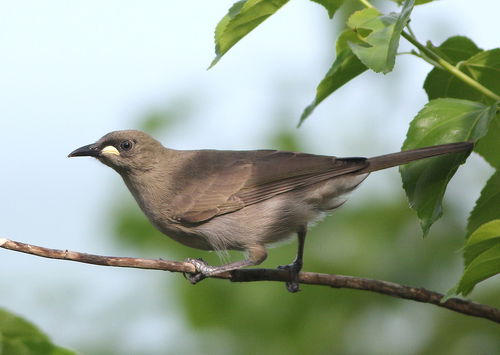
Australian Reed Warbler

Australian Reed Warbler

Acrocephalus australis

Silhouette: Yves Hoebeke · PhyloPic

LCLeast ConcernNTVUENCR
Daily sighting probability <5% · Rare
at Kakadu National Park

In 3 days <5% in a week ~10%

13 Verified sightings at Kakadu National Park From 2019 to 2026
206 In all 8 parks
August Best month
☀️ Diurnal When it's spotted

About the Australian Reed Warbler

The Australian reed warbler (Acrocephalus australis) is an acrocephalid warbler in the genus Acrocephalus and is the only Acrocephalus species native to Australia. It has also been observed in Papua New Guinea and nearby islands. The name Acrocephalus refers to the peaked crown found on reed warblers in this genus and can be translated to mean "topmost head" in Greek. The species name australis is translated to mean "southern" in Latin, and refers to the species range, Australia. In its western range the Australian reed warbler is also known as "Koordjikotji" (pronounced core'chee'caw'chee) in the local Aboriginal language of Perth and its surrounds.

Formerly placed in the then "wastebasket" family Sylviidae, the genus Acrocephalus is now included in the family Acrocephalidae, which encompasses 60 species in 7 genera widespread across Africa, Europe, Asia and the western Pacific regions. Within the Acrocephalidae, the Australian reed warbler is recognised as belonging to a monophyletic group consisting of Palearctic and Australasian region species. However, recent mitochondrial DNA analysis infers that pacific Acrocephalus warblers can be divided into two... Wikipedia →

Sounds

Song0:45

Australia · 2026

© Nick Talbot · XC1073189 · CC BY-NC-SA 4.0

Recording1:10

Australia · 2023

© Drew Davison · XC833800 · CC BY-NC-ND 4.0

Call0:42

Australia · 2019

© Ramit Singal · XC503666 · CC BY-NC-SA 4.0

Global Distribution

Parks Where Found

# Park Country Daily sighting probability
1 Kosciuszko National Park 🇦🇺 Australia
<5%
2 Grampians National Park 🇦🇺 Australia
<5%
3 Great Otway National Park 🇦🇺 Australia
<5%
4 Blue Mountains National Park 🇦🇺 Australia
<5%
5 Kakadu National Park 🇦🇺 Australia
<5%
6 Daintree National Park 🇦🇺 Australia
<5%
7 Royal National Park 🇦🇺 Australia
<5%
8 Lamington National Park 🇦🇺 Australia
<5%

Cities Where Found

# City Country Daily sighting probability
1 Perth 🇦🇺 Australia
~20%
2 Brisbane 🇦🇺 Australia
~20%
3 Melbourne 🇦🇺 Australia
~10%
4 Sydney 🇦🇺 Australia
~10%

Before you go

What are the chances of seeing an Australian Reed Warbler in Kakadu National Park?

Rare

Under 5% of wildlife watchers report an Australian Reed Warbler sighting in Kakadu National Park on a given day, based on 13 verified sightings from GBIF citizen-science data from 2019 to 2026. It is the 163rd most-seen of the 186 birds we can rate there. Over three days the chance rises to under 5%, and over a week to about 10%, if each day is a fresh chance.

When is the best time to see an Australian Reed Warbler in Kakadu National Park?

Any time of year

In every month with enough records, under 5% of wildlife watchers report an Australian Reed Warbler in Kakadu National Park on a given day, so our monthly data shows no clear season. February has too few records to rate.

What time of day is best to see an Australian Reed Warbler?

Between 8 and 11 am

Across all the parks we cover, that three-hour window holds the most Australian Reed Warbler sightings with a recorded time, and about 9 in 10 of them come between 6 am and 6 pm: it is a daytime animal.

Is Kakadu National Park the best place to see an Australian Reed Warbler?

Among the best

Of the 8 parks where we can rate Australian Reed Warbler sightings, Kakadu National Park ranks 5th at under 5%, level with the leaders once rounded. The best odds are in Kosciuszko National Park (Australia, under 5%), Grampians National Park (Australia, under 5%) and Great Otway National Park (Australia, under 5%).

Which relatives of the Australian Reed Warbler live in Kakadu National Park?

Same order: Passeriformes

The closest relatives of the Australian Reed Warbler that you can see in Kakadu National Park (order Passeriformes, Perching Birds) are Torresian Crow (about 70%), Willie Wagtail (about 60%) and White-bellied Cuckooshrike (about 60%), with each one's daily chance of a sighting.

Where does the Australian Reed Warbler sighting chance come from?

GBIF citizen-science records

It is estimated from how often the Australian Reed Warbler is recorded against all the birds logged in Kakadu National Park (13 verified sightings from 2019 to 2026), calibrated against known sighting rates. Figures are rounded to the nearest 10% because citizen-science data supports honest approximations, not decimals, and months with records from fewer than five people show "—". How it works.

← Back to Kakadu National Park