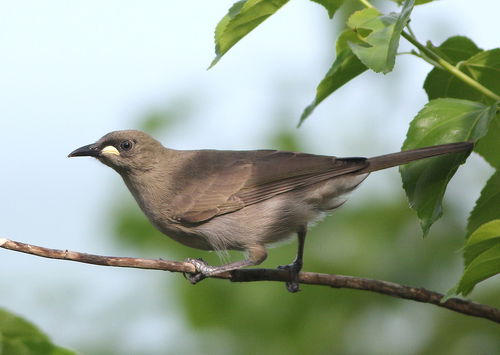
Black-faced Woodswallow

Black-faced Woodswallow

Artamus cinereus

Silhouette: Sheatherius · PhyloPic

LCLeast ConcernNTVUENCR
Daily sighting probability <5% · Rare
at Kakadu National Park

In 3 days <5%

6 Verified sightings at Kakadu National Park From 2019 to 2026
293 In all 6 parks
November Best month
☀️ Diurnal When it's spotted

About the Black-faced Woodswallow

The black-faced woodswallow (Artamus cinereus) is a woodswallow of the genus Artamus native to Australia, New Guinea, and the Sunda Islands, including Timor. It is 18–19 cm (7.1–7.5 in) long and is the most widespread species in the family Artamidae. Woodswallows have a soft call with chiff, chap and chattering calls which can include vocal mimicry

Increased vegetation due to inappropriate fire regimes has caused the woodswallows numbers to decline since 1993 in the Cape York Peninsula. The black-faced woodswallow was formally described in 1817 by the French ornithologist Louis Pierre Vieillot and given the current binomial name Artamus cinereus. The specific epithet is Latin meaning "ash-grey" or "ash-coloured". Although Vieillot gave the locality as the island of Timor, he had copied the description by the Dutch zoologist Coenraad Jacob Temminck of the "L'angroyan gris" from "la nouvelle Galle meridionale" (New South Wales) that had been published in 1807. Temminck mentioned that the central tail feathers were entirely black which is consistent with Australian race and but not with the race found on Timor where the central tail feathers have white tips. Temminck's specimen... Wikipedia →

Sounds

Alarm call0:36

Australia · 2021

© Marc Anderson · XC1004425 · CC BY-NC-ND 4.0

Call0:29

Australia · 2017

© Christopher Watson · XC641422 · CC BY-NC-SA 4.0

Call0:47

Australia · 2018

© Nigel Jackett · XC428464 · CC BY-NC-SA 4.0

Global Distribution

Parks Where Found

# Park Country Daily sighting probability
1 Uluru-Kata Tjuta National Park 🇦🇺 Australia
~40%
2 Cape Range 🇦🇺 Australia
~10%
3 Nitmiluk National Park 🇦🇺 Australia
<5%
4 Flinders Ranges National Park 🇦🇺 Australia
<5%
5 Hattah-Kulkyne National Park 🇦🇺 Australia
<5%
6 Kakadu National Park 🇦🇺 Australia
<5%

Cities Where Found

# City Country Daily sighting probability
1 Perth 🇦🇺 Australia
<5%

Zoos & Centres Where Found

# Zoo / Centre Country
1 Alice Springs Desert Park 🇦🇺 Australia In captivity
2 Featherdale Sydney Wildlife Park 🇦🇺 Australia In captivity

Before you go

What are the chances of seeing a Black-faced Woodswallow in Kakadu National Park?

Rare

Under 5% of wildlife watchers report a Black-faced Woodswallow sighting in Kakadu National Park on a given day, based on 6 verified sightings from GBIF citizen-science data from 2019 to 2026. It is the 182nd most-seen of the 186 birds we can rate there. Over three days the chance rises to under 5%, if each day is a fresh chance.

When is the best time to see a Black-faced Woodswallow in Kakadu National Park?

Any time of year

In every month with enough records, under 5% of wildlife watchers report a Black-faced Woodswallow in Kakadu National Park on a given day, so our monthly data shows no clear season. February has too few records to rate.

What time of day is best to see a Black-faced Woodswallow?

Between 7 and 10 am

Across all the parks we cover, that three-hour window holds the most Black-faced Woodswallow sightings with a recorded time, and about 9 in 10 of them come between 6 am and 6 pm: it is a daytime animal.

Is Kakadu National Park the best place to see a Black-faced Woodswallow?

6th of 6

Of the 6 parks where we can rate Black-faced Woodswallow sightings, Kakadu National Park ranks 6th at under 5%. The best odds are in Uluru-Kata Tjuta National Park (Australia, about 40%), Cape Range (Australia, about 10%) and Nitmiluk National Park (Australia, under 5%).

Which relatives of the Black-faced Woodswallow live in Kakadu National Park?

Same genus: Artamus

The closest relatives of the Black-faced Woodswallow that you can see in Kakadu National Park (genus Artamus, Woodswallows) are Little Woodswallow (about 10%) and White-breasted Woodswallow (about 10%), with each one's daily chance of a sighting.

Where does the Black-faced Woodswallow sighting chance come from?

GBIF citizen-science records

It is estimated from how often the Black-faced Woodswallow is recorded against all the birds logged in Kakadu National Park (6 verified sightings from 2019 to 2026), calibrated against known sighting rates. Figures are rounded to the nearest 10% because citizen-science data supports honest approximations, not decimals, and months with records from fewer than five people show "—". How it works.

← Back to Kakadu National Park