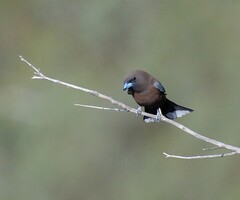
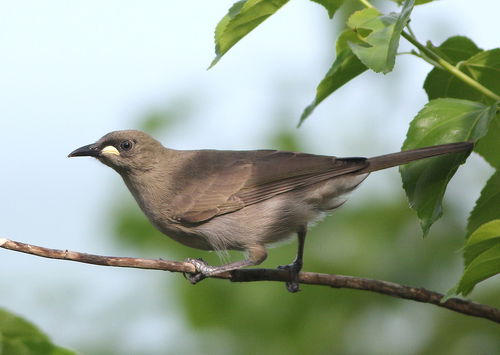
Little Woodswallow

Little Woodswallow

Artamus minor

Silhouette: Sheatherius · PhyloPic

LCLeast ConcernNTVUENCR Endemic
Daily sighting probability ~10% · With luck
at Kakadu National Park

In 3 days ~30% in a week ~50%

157 Verified sightings at Kakadu National Park From 2019 to 2026
468 In all 6 parks
June Best month
☀️ Diurnal When it's spotted

About the Little Woodswallow

The little woodswallow (Artamus minor), is a bird patchily distributed over much of mainland Australia, avoiding only the driest deserts and the area within about 300 kilometres of the southern coastline, and showing a preference for rugged terrain around inland ranges.

As its name suggests, at 12 to 14 cm in length it is the smallest of the woodswallows. It is dark, smoky brown overall, with deep gunmetal grey wings and a black-tipped, blue-tinged bill. Like other woodswallows, groups cluster huddled close together on high, dead branches to rest or sleep. Typical group sizes are modest but it is not uncommon to have hundreds gather together at a roost site.

Little woodswallows soar effortlessly above the treetops or along cliff faces when hunting flying insects—being small, they are easily confused with martins. The nest is a rudimentary affair, placed in a tree hollow or similar space, and made of twigs and other vegetable matter. Breeding takes place from August to January, or after rain. Three eggs are laid and the young leave the nest when barely able to fly, taking up a perch on a nearby tree and calling incessantly for the food the parents bring them. Wikipedia →

Sounds

Call0:23

Australia · 2012

© Matthias Feuersenger · XC107836 · CC BY-NC-ND 2.5

Flight call0:04

Australia · 2015

© Marc Anderson · XC233763 · CC BY-NC-ND 4.0

Call0:17

Australia · 2023

© nick talbot · XC820502 · CC BY-NC-SA 4.0

Global Distribution

Parks Where Found

# Park Country Daily sighting probability
1 Uluru-Kata Tjuta National Park 🇦🇺 Australia
~40%
2 Kakadu National Park 🇦🇺 Australia
~10%
3 Nitmiluk National Park 🇦🇺 Australia
~10%
4 Litchfield National Park 🇦🇺 Australia
~10%
5 Cape Range 🇦🇺 Australia
<5%
6 Flinders Ranges National Park 🇦🇺 Australia
<5%

Before you go

What are the chances of seeing a Little Woodswallow in Kakadu National Park?

With luck

About 10% of wildlife watchers report a Little Woodswallow sighting in Kakadu National Park on a given day, based on 157 verified sightings from GBIF citizen-science data from 2019 to 2026. It is the 98th most-seen of the 186 birds we can rate there. Over three days the chance rises to about 30%, and over a week to about 50%, if each day is a fresh chance.

When is the best time to see a Little Woodswallow in Kakadu National Park?

June and July

In those months about 20% of wildlife watchers report a Little Woodswallow in Kakadu National Park on a given day, against under 5% in April–May, September and November, the lowest months. Those are among Kakadu National Park's driest months, with almost no rain against 350 mm in January. February has too few records to rate.

What time of day is best to see a Little Woodswallow?

Between 9 am and noon

Across all the parks we cover, that three-hour window holds the most Little Woodswallow sightings with a recorded time, and about 9 in 10 of them come between 6 am and 6 pm: it is a daytime animal.

Is Kakadu National Park the best place to see a Little Woodswallow?

2nd of 6

Of the 6 parks where we can rate Little Woodswallow sightings, Kakadu National Park ranks 2nd at about 10%. The best odds are in Uluru-Kata Tjuta National Park (Australia, about 40%).

Where does the Little Woodswallow sighting chance come from?

GBIF citizen-science records

It is estimated from how often the Little Woodswallow is recorded against all the birds logged in Kakadu National Park (157 verified sightings from 2019 to 2026), calibrated against known sighting rates. Figures are rounded to the nearest 10% because citizen-science data supports honest approximations, not decimals, and months with records from fewer than five people show "—". How it works.

← Back to Kakadu National Park