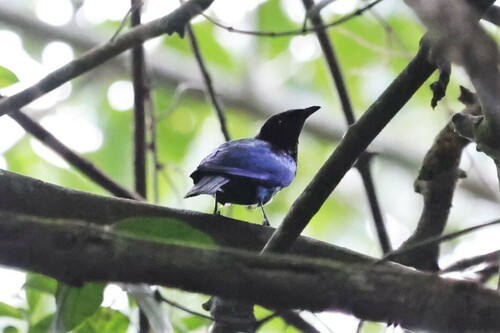
Village Indigobird

Village Indigobird

Vidua chalybeata

Silhouette: Sheatherius · PhyloPic

LCLeast ConcernNTVUENCR
Daily sighting probability ~10% · With luck
at Kibale National Park

In 3 days ~20% in a week ~30%

90 Verified sightings at Kibale National Park From 2019 to 2026
2,240 In all 40 parks
October Best month
☀️ Diurnal When it's spotted

About the Village Indigobird

The village indigobird (Vidua chalybeata), also known as the steelblue widowfinch or (in U.S. aviculture) the Combassou finch, is a small songbird belonging to the family Viduidae. It is distinguishable from other indigobird species by bill and leg colours, the colour tinge of the male's breeding plumage, song, and to lesser extent, the nestling's plumage and mouth pattern. The bill colour can be red or white depending on the population, and there is some regional variation in the colour tone of the male's plumage.

It is a resident breeding bird in most of Africa south of the Sahara Desert. This indigobird is found in many open habitats including open woodland, scrub and cultivation, but, as its name implies, it is most readily seen near villages.

It is a brood parasite which lays its eggs in the nests of red-billed firefinches. Unlike the common cuckoo, it does not destroy the host's egg. Typically, 2-4 eggs are added to those already present. The eggs of both the host and the firefinch are white, although the indigobird's are slightly larger. The nestling indigobirds mimic the unique gape pattern of the fledglings of the host species... Wikipedia →

Sounds

Call0:12

South Africa · 2020

© Tony Archer · XC522557 · CC BY-NC-SA 4.0

Song0:52

South Africa · 2015

© Faansie Peacock · XC307241 · CC BY-NC-SA 4.0

Imitation1:00

Tanzania · 2009

© Jeff DaCosta · XC41906 · CC BY-NC-ND 2.5

Global Distribution

Parks Where Found

# Park Country Daily sighting probability
1 Niokolo-Koba National Park 🇸🇳 Senegal
~40%
2 Ruaha National Park 🇹🇿 Tanzania
~20%
3 Lake Manyara National Park 🇹🇿 Tanzania
~20%
4 Mkomazi National Park 🇹🇿 Tanzania
~20%
5 South Luangwa National Park 🇿🇲 Zambia
~20%
6 Mana Pools National Park 🇿🇼 Zimbabwe
~10%
7 Lower Zambezi National Park 🇿🇲 Zambia
~10%
8 Liwonde National Park 🇲🇼 Malawi
~10%
9 Meru National Park 🇰🇪 Kenya
~10%
10 Gonarezhou National Park 🇿🇼 Zimbabwe
~10%
11 Kruger National Park 🇿🇦 South Africa
~10%
12 Tarangire National Park 🇹🇿 Tanzania
~10%
13 Akagera National Park 🇷🇼 Rwanda
~10%
14 Mikumi National Park 🇹🇿 Tanzania
~10%
15 Kidepo Valley National Park 🇺🇬 Uganda
~10%
16 Serengeti National Park 🇹🇿 Tanzania
~10%
17 Queen Elizabeth National Park 🇺🇬 Uganda
~10%
18 Kibale National Park 🇺🇬 Uganda
~10%
19 Tsavo East National Park 🇰🇪 Kenya
~10%
20 Tsavo West National Park 🇰🇪 Kenya
<5%
21 Nairobi National Park 🇰🇪 Kenya
<5%
22 Awash National Park 🇪🇹 Ethiopia
<5%
23 Arusha National Park 🇹🇿 Tanzania
<5%
24 Kafue National Park 🇿🇲 Zambia
<5%
25 Chobe National Park 🇧🇼 Botswana
<5%
26 Samburu National Reserve 🇰🇪 Kenya
<5%
27 Hluhluwe-Imfolozi Park 🇿🇦 South Africa
<5%
28 Virunga National Park 🇨🇩 Democratic Republic of the Congo
<5%
29 uMkhuze Game Reserve 🇿🇦 South Africa
<5%
30 Hwange National Park 🇿🇼 Zimbabwe
<5%
31 Bwindi Impenetrable National Park 🇺🇬 Uganda
<5%
32 Lake Nakuru National Park 🇰🇪 Kenya
<5%
33 Murchison Falls National Park 🇺🇬 Uganda
<5%
34 Lake Mburo National Park 🇺🇬 Uganda
<5%
35 Amboseli National Park 🇰🇪 Kenya
<5%
36 Ngorongoro Conservation Area 🇹🇿 Tanzania
<5%
37 Aberdare National Park 🇰🇪 Kenya
<5%
38 Masai Mara National Reserve 🇰🇪 Kenya
<5%
39 Moremi Game Reserve 🇧🇼 Botswana
<5%
40 iSimangaliso Wetland Park 🇿🇦 South Africa
<5%

Cities Where Found

# City Country Daily sighting probability
1 Mombasa 🇰🇪 Kenya
~20%
2 Abuja 🇳🇬 Nigeria
~20%
3 Nairobi 🇰🇪 Kenya
~10%
4 Ouagadougou 🇧🇫 Burkina Faso
~10%
5 Dar es-Salaam 🇹🇿 Tanzania
~10%
6 N'Djamena 🇹🇩 Chad
~10%
7 Lusaka 🇿🇲 Zambia
~10%
8 Dakar 🇸🇳 Senegal
~10%
9 Serrekunda 🇬🇲 Gambia
~10%
10 Lilongwe 🇲🇼 Malawi
~10%

Zoos & Centres Where Found

# Zoo / Centre Country
1 Bird Kingdom 🇨🇦 Canada In captivity

Before you go

What are the chances of seeing a Village Indigobird in Kibale National Park?

With luck

About 10% of wildlife watchers report a Village Indigobird sighting in Kibale National Park on a given day, based on 90 verified sightings from GBIF citizen-science data from 2019 to 2026. It is the 175th most-seen of the 366 birds we can rate there. Over three days the chance rises to about 20%, and over a week to about 30%, if each day is a fresh chance.

When is the best time to see a Village Indigobird in Kibale National Park?

May, July–August, October and December–February

In those months about 10% of wildlife watchers report a Village Indigobird in Kibale National Park on a given day, against under 5% in March–April, June, September and November, the lowest months.

What time of day is best to see a Village Indigobird?

Between 10 am and 1 pm

Across all the parks we cover, that three-hour window holds the most Village Indigobird sightings with a recorded time, and about 9 in 10 of them come between 6 am and 6 pm: it is a daytime animal.

Where does the Village Indigobird sighting chance come from?

GBIF citizen-science records

It is estimated from how often the Village Indigobird is recorded against all the birds logged in Kibale National Park (90 verified sightings from 2019 to 2026), calibrated against known sighting rates. Figures are rounded to the nearest 10% because citizen-science data supports honest approximations, not decimals, and months with records from fewer than five people show "—". How it works.

← Back to Kibale National Park