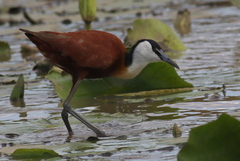
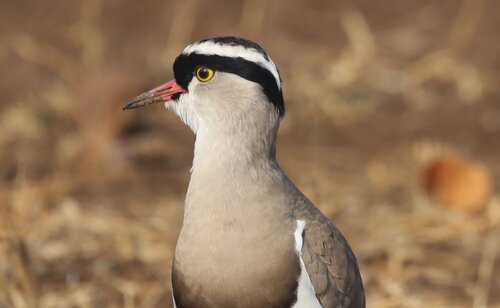
African Jacana

African Jacana

Actophilornis africanus

Silhouette: Burton Robert, USFWS · PhyloPic

LCLeast ConcernNTVUENCR
Daily sighting probability ~20% · Possible
at Lake Nakuru National Park

In 3 days ~50% in a week ~80%

227 Verified sightings at Lake Nakuru National Park From 2019 to 2026
14,148 In all 40 parks
December Best month
☀️ Diurnal When it's spotted

About the African Jacana

The African jacana (Actophilornis africanus) is a wader in the family Jacanidae. It has long toes and long claws that enable it to walk on floating vegetation in shallow lakes, its preferred habitat. It is widely distributed in sub-Saharan Africa. For the origin and pronunciation of the name, see Jacanidae.

The African jacana was formally described in 1789 by the German naturalist Johann Friedrich Gmelin in his revised and expanded edition of Carl Linnaeus's Systema Naturae. He placed it in the genus Parra and coined the binomial name Parra africana. Gmelin based his description on that by the English ornithologist John Latham who in 1785 had described and illustrated the species in his A General Synopsis of Birds. Gmelin and Latham gave the locality as "Africa": this was restricted to Ethiopia in 1915. The African jacana is now placed in the genus Actophilornis that was introduced in 1925 by the American ornithologist Harry C. Oberholser. The genus name combines the Ancient Greek aktē meaning "river bank" or "coastal strand", -philos meaning "-loving" and ornis meaning "bird".

The species is considered to be monotypic: no subspecies are recognised. Wikipedia →

Sounds

Call0:05

Uganda · 2025

© Bernard BOUSQUET · XC1053164 · CC BY-NC-SA 4.0

Song0:08

South Africa · 2014

© Nature sounds by Simply Birding · XC646370 · CC BY-NC-ND 4.0

Uncertain0:12

Zambia · 2020

© Dries Van de Loock · XC585201 · CC BY-NC-SA 4.0

Global Distribution

Parks Where Found

# Park Country Daily sighting probability
1 Liwonde National Park 🇲🇼 Malawi
~70%
2 Moremi Game Reserve 🇧🇼 Botswana
~70%
3 Amboseli National Park 🇰🇪 Kenya
~70%
4 Chobe National Park 🇧🇼 Botswana
~60%
5 Lower Zambezi National Park 🇿🇲 Zambia
~50%
6 South Luangwa National Park 🇿🇲 Zambia
~50%
7 iSimangaliso Wetland Park 🇿🇦 South Africa
~50%
8 Murchison Falls National Park 🇺🇬 Uganda
~50%
9 Queen Elizabeth National Park 🇺🇬 Uganda
~50%
10 Gonarezhou National Park 🇿🇼 Zimbabwe
~50%
11 Akagera National Park 🇷🇼 Rwanda
~40%
12 Mana Pools National Park 🇿🇼 Zimbabwe
~40%
13 Kafue National Park 🇿🇲 Zambia
~40%
14 uMkhuze Game Reserve 🇿🇦 South Africa
~40%
15 Kruger National Park 🇿🇦 South Africa
~40%
16 Mikumi National Park 🇹🇿 Tanzania
~30%
17 Tarangire National Park 🇹🇿 Tanzania
~30%
18 Gorongosa National Park 🇲🇿 Mozambique
~30%
19 Lake Mburo National Park 🇺🇬 Uganda
~30%
20 Hwange National Park 🇿🇼 Zimbabwe
~30%
21 Arusha National Park 🇹🇿 Tanzania
~20%
22 Virunga National Park 🇨🇩 Democratic Republic of the Congo
~20%
23 Lake Nakuru National Park 🇰🇪 Kenya
~20%
24 Niokolo-Koba National Park 🇸🇳 Senegal
~20%
25 Kidepo Valley National Park 🇺🇬 Uganda
~20%
26 Masai Mara National Reserve 🇰🇪 Kenya
~10%
27 Hluhluwe-Imfolozi Park 🇿🇦 South Africa
~10%
28 Pilanesberg National Park 🇿🇦 South Africa
~10%
29 Ngorongoro Conservation Area 🇹🇿 Tanzania
~10%
30 Nairobi National Park 🇰🇪 Kenya
~10%
31 Tsavo West National Park 🇰🇪 Kenya
~10%
32 Ruaha National Park 🇹🇿 Tanzania
~10%
33 Serengeti National Park 🇹🇿 Tanzania
~10%
34 Etosha National Park 🇳🇦 Namibia
~10%
35 Meru National Park 🇰🇪 Kenya
<5%
36 Tsavo East National Park 🇰🇪 Kenya
<5%
37 Samburu National Reserve 🇰🇪 Kenya
<5%
38 Semuliki National Park 🇺🇬 Uganda
<5%
39 Garden Route National Park 🇿🇦 South Africa
<5%
40 Table Mountain National Park 🇿🇦 South Africa
<5%

Cities Where Found

# City Country Daily sighting probability
1 Mombasa 🇰🇪 Kenya
~50%
2 Zanzibar City 🇹🇿 Tanzania
~30%
3 N'Djamena 🇹🇩 Chad
~30%
4 Brazzaville 🇨🇬 Republic of the Congo
~30%
5 Dakar 🇸🇳 Senegal
~20%
6 Serrekunda 🇬🇲 Gambia
~20%
7 Ouagadougou 🇧🇫 Burkina Faso
~20%
8 Abuja 🇳🇬 Nigeria
~20%
9 Accra 🇬🇭 Ghana
~20%
10 Lagos 🇳🇬 Nigeria
~20%

Zoos & Centres Where Found

# Zoo / Centre Country
1 Disney's Animal Kingdom 🇺🇸 United States In captivity
2 San Diego Zoo 🇺🇸 United States In captivity
3 Pairi Daiza 🇧🇪 Belgium In captivity
4 Zürich Zoo 🇨🇭 Switzerland In captivity
5 Walsrode World Bird Park 🇩🇪 Germany In captivity
6 ZooTampa 🇺🇸 United States In captivity
7 Houston Zoo 🇺🇸 United States In captivity
8 Tierpark Hagenbeck 🇩🇪 Germany In captivity
9 London Zoo 🇬🇧 United Kingdom In captivity
10 National Aviary 🇺🇸 United States In captivity

Before you go

What are the chances of seeing an African Jacana in Lake Nakuru National Park?

Possible

About 20% of wildlife watchers report an African Jacana sighting in Lake Nakuru National Park on a given day, based on 227 verified sightings from GBIF citizen-science data from 2019 to 2026. It is the 93rd most-seen of the 369 birds we can rate there. Over three days the chance rises to about 50%, and over a week to about 80%, if each day is a fresh chance.

When is the best time to see an African Jacana in Lake Nakuru National Park?

December

In that month about 40% of wildlife watchers report an African Jacana in Lake Nakuru National Park on a given day, against about 10% in January, the lowest month.

What time of day is best to see an African Jacana?

Between 3 and 6 pm

Across all the parks we cover, that three-hour window holds the most African Jacana sightings with a recorded time, and about 9 in 10 of them come between 6 am and 6 pm: it is a daytime animal.

Which relatives of the African Jacana live in Lake Nakuru National Park?

Same order: Charadriiformes

The closest relatives of the African Jacana that you can see in Lake Nakuru National Park (order Charadriiformes, Shorebirds and Allies) are Blacksmith Lapwing (about 70%), Grey-hooded Gull (about 60%) and Black-winged Stilt (about 50%), with each one's daily chance of a sighting.

Where does the African Jacana sighting chance come from?

GBIF citizen-science records

It is estimated from how often the African Jacana is recorded against all the birds logged in Lake Nakuru National Park (227 verified sightings from 2019 to 2026), calibrated against known sighting rates. Figures are rounded to the nearest 10% because citizen-science data supports honest approximations, not decimals, and months with records from fewer than five people show "—". How it works.

← Back to Lake Nakuru National Park