
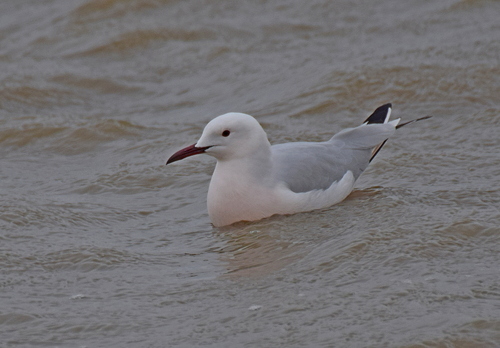
Gull-billed Tern

Gull-billed Tern

Gelochelidon nilotica

Silhouette: Sheatherius · PhyloPic

LCLeast ConcernNTVUENCR
Daily sighting probability ~40% · Likely
at Lake Nakuru National Park

In 3 days ~80% in a week >90%

429 Verified sightings at Lake Nakuru National Park From 2019 to 2026
5,410 In all 45 parks
April Best month
☀️ Diurnal When it's spotted

About the Gull-billed Tern

The gull-billed tern (Gelochelidon nilotica) is a tern in the family Laridae. It is widely distributed and breeds in scattered localities in Europe, Asia, northwest Africa, and the Americas. The Australian gull-billed tern was previously considered a subspecies.

The gull-billed tern was formally described in 1789 by the German naturalist Johann Friedrich Gmelin in his revised and expanded edition of Carl Linnaeus's Systema Naturae. He placed it with terns in the genus Sterna and coined the binomial name Sterna nilotica. Gmelin based his description on the "Egyptian tern" that had been described in 1785 by the English ornithologist John Latham in his book A General Synopsis of Birds. Latham had in turn based his own account on that by the Swedish naturalist Fredrik Hasselquist that was published in 1757. The gull-billed tern was moved to the resurrected genus Gelochelidon based on a molecular phylogenetic study published in 2005. The genus had been introduced in 1830 by the German zoologist Christian Ludwig Brehm. The genus name combines the Ancient Greek gelaō meaning "to laugh" with khelidōn meaning "swallow". The specific epithet nilotica is from Latin niloticus meaning... Wikipedia →

Sounds

Call0:55

Mongolia · 2026

© Ding Li Yong · XC1137721 · CC BY-NC-ND 4.0

Begging call0:31

China · 2025

© Bo Shunqi 薄顺奇 · XC1101289 · CC BY-NC-SA 4.0

Flight call1:14

Spain · 2025

© Esperanza Poveda · XC1075633 · CC BY-NC-SA 4.0

Global Distribution

Parks Where Found

# Park Country Daily sighting probability
1 Lake Nakuru National Park 🇰🇪 Kenya
~40%
2 Ngorongoro Conservation Area 🇹🇿 Tanzania
~30%
3 Yala National Park 🇱🇰 Sri Lanka
~30%
4 Ría Lagartos Biosphere Reserve 🇲🇽 Mexico
~30%
5 Camargue 🇫🇷 France
~30%
6 Bako National Park 🇲🇾 Malaysia
~20%
7 Padre Island National Seashore 🇺🇸 United States
~20%
8 Liwonde National Park 🇲🇼 Malawi
~20%
9 Lake Manyara National Park 🇹🇿 Tanzania
~20%
10 Wilpattu National Park 🇱🇰 Sri Lanka
~20%
11 Awash National Park 🇪🇹 Ethiopia
~20%
12 Ciénaga de Zapata 🇨🇺 Cuba
~10%
13 Serengeti National Park 🇹🇿 Tanzania
~10%
14 Queen Elizabeth National Park 🇺🇬 Uganda
~10%
15 Udawalawe National Park 🇱🇰 Sri Lanka
~10%
16 Doñana National Park 🇪🇸 Spain
~10%
17 Amboseli National Park 🇰🇪 Kenya
~10%
18 Monfragüe National Park 🇪🇸 Spain
~10%
19 Murchison Falls National Park 🇺🇬 Uganda
~10%
20 Celestún Biosphere Reserve 🇲🇽 Mexico
<5%
21 Tsavo West National Park 🇰🇪 Kenya
<5%
22 Virunga National Park 🇨🇩 Democratic Republic of the Congo
<5%
23 Minneriya National Park 🇱🇰 Sri Lanka
<5%
24 El Vizcaíno Biosphere Reserve 🇲🇽 Mexico
<5%
25 Tsavo East National Park 🇰🇪 Kenya
<5%
26 Caroni Swamp 🇹🇹 Trinidad and Tobago
<5%
27 Arusha National Park 🇹🇿 Tanzania
<5%
28 Bastimentos Island National Marine Park 🇵🇦 Panama
<5%
29 Palo Verde National Park 🇨🇷 Costa Rica
<5%
30 Arrecifes de Cozumel National Park 🇲🇽 Mexico
<5%
31 Wadden Sea National Park 🇩🇪 Germany
<5%
32 Bali Barat National Park 🇮🇩 Indonesia
<5%
33 Cabo Blanco Absolute Nature Reserve 🇨🇷 Costa Rica
<5%
34 Tarangire National Park 🇹🇿 Tanzania
<5%
35 Las Baulas Marine National Park 🇨🇷 Costa Rica
<5%
36 Everglades National Park 🇺🇸 United States
<5%
37 Tayrona National Natural Park 🇨🇴 Colombia
<5%
38 Nairobi National Park 🇰🇪 Kenya
<5%
39 Carara National Park 🇨🇷 Costa Rica
<5%
40 La Amistad International Park (Panama) 🇵🇦 Panama
<5%
41 Merritt Island National Wildlife Refuge 🇺🇸 United States
<5%
42 Sierra de Guadarrama National Park 🇪🇸 Spain
<5%
43 Keoladeo National Park 🇮🇳 India
<5%
44 Parque Natural Metropolitano 🇵🇦 Panama
<5%
45 Soberanía National Park 🇵🇦 Panama
<5%

Cities Where Found

# City Country Daily sighting probability
1 Zanzibar City 🇹🇿 Tanzania
~60%
2 Karachi 🇵🇰 Pakistan
~30%
3 Kuwait City 🇰🇼 Kuwait
~30%
4 Manama 🇧🇭 Bahrain
~30%
5 São Luís 🇧🇷 Brazil
~20%
6 Dakar 🇸🇳 Senegal
~20%
7 Dar es-Salaam 🇹🇿 Tanzania
~10%
8 Barranquilla 🇨🇴 Colombia
~10%
9 Luxor 🇪🇬 Egypt
~10%
10 Mumbai 🇮🇳 India
~10%

Zoos & Centres Where Found

# Zoo / Centre Country
1 Zoobotánico Jerez 🇪🇸 Spain In captivity

Before you go

What are the chances of seeing a Gull-billed Tern in Lake Nakuru National Park?

Likely

About 40% of wildlife watchers report a Gull-billed Tern sighting in Lake Nakuru National Park on a given day, based on 429 verified sightings from GBIF citizen-science data from 2019 to 2026. It is the 39th most-seen of the 369 birds we can rate there. Over three days the chance rises to about 80%, and over a week to over 90%, if each day is a fresh chance.

When is the best time to see a Gull-billed Tern in Lake Nakuru National Park?

April

In that month about 70% of wildlife watchers report a Gull-billed Tern in Lake Nakuru National Park on a given day, against about 30% in June and August, the lowest months. That is one of Lake Nakuru National Park's wettest months, with about 120 mm of rain against 20 mm in February.

What time of day is best to see a Gull-billed Tern?

Between 9 am and noon

Across all the parks we cover, that three-hour window holds the most Gull-billed Tern sightings with a recorded time, and about 9 in 10 of them come between 6 am and 6 pm: it is a daytime animal.

Is Lake Nakuru National Park the best place to see a Gull-billed Tern?

Yes

Of the 45 parks where we can rate Gull-billed Tern sightings, Lake Nakuru National Park has the highest daily chance: about 40%. Next come Ngorongoro Conservation Area (Tanzania, about 30%) and Yala National Park (Sri Lanka, about 30%). All parks ranked.

Which relatives of the Gull-billed Tern live in Lake Nakuru National Park?

Same family: Laridae

The closest relatives of the Gull-billed Tern that you can see in Lake Nakuru National Park (family Laridae, Gulls, Terns, and Skimmers) are Grey-hooded Gull (about 60%), Whiskered Tern (about 30%) and White-winged Tern (about 10%), with each one's daily chance of a sighting.

Where does the Gull-billed Tern sighting chance come from?

GBIF citizen-science records

It is estimated from how often the Gull-billed Tern is recorded against all the birds logged in Lake Nakuru National Park (429 verified sightings from 2019 to 2026), calibrated against known sighting rates. Figures are rounded to the nearest 10% because citizen-science data supports honest approximations, not decimals, and months with records from fewer than five people show "—". How it works.

← Back to Lake Nakuru National Park