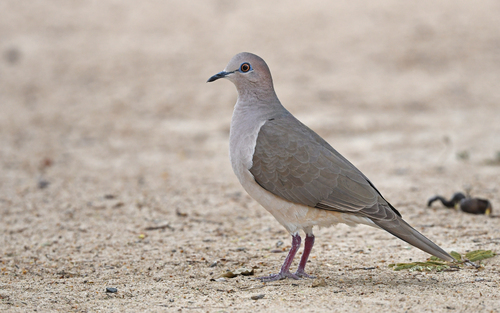
Plumbeous Pigeon

Plumbeous Pigeon

Patagioenas plumbea

Silhouette: Ferran Sayol · PhyloPic

LCLeast ConcernNTVUENCR
Daily sighting probability <5% · Rare
at Los Nevados National Natural Park

In 3 days <5%

16 Verified sightings at Los Nevados National Natural Park From 2019 to 2026
5,525 In all 18 parks
February Best month
☀️ Diurnal When it's spotted

About the Plumbeous Pigeon

The plumbeous pigeon (Patagioenas plumbea) is a species of bird in the family Columbidae. It is found in Bolivia, Brazil, Colombia, Ecuador, French Guiana, Guyana, Panama, Paraguay, Peru, Suriname, and Venezuela. The plumbeous pigeon is most closely related to the ruddy pigeon (P. subvinacea), short-billed pigeon (P. nigrirostris), and dusky pigeon (P. goodsoni), and they have sometimes been placed in subgenus Oenoenas.

Vocal differences among and even within the subspecies hint that more than one species may be involved. The plumbeous pigeon is 34 cm (13 in) long and weighs 172 to 231 g (6.1 to 8.1 oz). Males have a dark gray head, neck, and underparts that sometimes have a pinkish or purplish tinge. The shoulders, back, rump, wings, and tail are dark grayish brown to drab olive. The hindneck sometimes has bronzy spots. The eye is red and surrounded by bare purplish red skin. The female's purplish wash... Wikipedia →

Sounds

Song0:55

Brazil · 2026

© JAYRSON ARAUJO DE OLIVEIRA · XC1183895 · CC BY-NC-SA 4.0

Call0:16

Ecuador · 2010

© Manuel Sánchez-Nivicela · XC1176725 · CC BY-NC-ND 4.0

Canto0:17

Brazil · 2018

© Caio Brito · XC556473 · CC BY-NC-SA 4.0

Global Distribution

Parks Where Found

# Park Country Daily sighting probability
1 Amboró National Park 🇧🇴 Bolivia
~40%
2 Itatiaia National Park 🇧🇷 Brazil
~40%
3 Yasuní National Park 🇪🇨 Ecuador
~30%
4 Tambopata National Reserve 🇵🇪 Peru
~30%
5 Farallones de Cali National Natural Park 🇨🇴 Colombia
~30%
6 Darién National Park 🇵🇦 Panama
~20%
7 Amacayacu National Natural Park 🇨🇴 Colombia
~20%
8 Cuyabeno Wildlife Reserve 🇪🇨 Ecuador
~20%
9 Manu National Park 🇵🇪 Peru
~10%
10 Anavilhanas National Park 🇧🇷 Brazil
~10%
11 Utría National Natural Park 🇨🇴 Colombia
~10%
12 Serra dos Órgãos National Park 🇧🇷 Brazil
~10%
13 Brownsberg Nature Park 🇸🇷 Suriname
~10%
14 Podocarpus National Park 🇪🇨 Ecuador
~10%
15 Sierra de la Macarena National Park 🇨🇴 Colombia
~10%
16 Chingaza National Natural Park 🇨🇴 Colombia
<5%
17 Parque Estadual Encontro das Águas 🇧🇷 Brazil
<5%
18 Los Nevados National Natural Park 🇨🇴 Colombia
<5%

Cities Where Found

# City Country Daily sighting probability
1 Belo Horizonte 🇧🇷 Brazil
<5%
2 Santos 🇧🇷 Brazil
<5%
3 São Paulo 🇧🇷 Brazil
<5%

Before you go

What are the chances of seeing a Plumbeous Pigeon in Los Nevados National Natural Park?

Rare

Under 5% of wildlife watchers report a Plumbeous Pigeon sighting in Los Nevados National Natural Park on a given day, based on 16 verified sightings from GBIF citizen-science data from 2019 to 2026. It is the 348th most-seen of the 424 birds we can rate there. Over three days the chance rises to under 5%, if each day is a fresh chance.

When is the best time to see a Plumbeous Pigeon in Los Nevados National Natural Park?

Any time of year

In every month with enough records, under 5% of wildlife watchers report a Plumbeous Pigeon in Los Nevados National Natural Park on a given day, so our monthly data shows no clear season.

What time of day is best to see a Plumbeous Pigeon?

Between 8 and 11 am

Across all the parks we cover, that three-hour window holds the most Plumbeous Pigeon sightings with a recorded time, and about 9 in 10 of them come between 6 am and 6 pm: it is a daytime animal.

Where does the Plumbeous Pigeon sighting chance come from?

GBIF citizen-science records

It is estimated from how often the Plumbeous Pigeon is recorded against all the birds logged in Los Nevados National Natural Park (16 verified sightings from 2019 to 2026), calibrated against known sighting rates. Figures are rounded to the nearest 10% because citizen-science data supports honest approximations, not decimals, and months with records from fewer than five people show "—". How it works.

← Back to Los Nevados National Natural Park