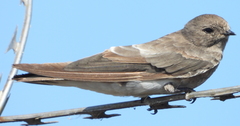
Plain Martin

Plain Martin

Riparia paludicola

Silhouette: Andy Wilson · PhyloPic

LCLeast ConcernNTVUENCR
Daily sighting probability ~10% · With luck
at Lower Zambezi National Park

In 3 days ~30% in a week ~60%

52 Verified sightings at Lower Zambezi National Park From 2019 to 2026
3,601 In all 37 parks
August Best month
☀️ Diurnal When it's spotted

About the Plain Martin

The brown-throated martin, brown-throated sand martin or plain martin (Riparia paludicola) is a small passerine bird in the swallow family, Hirundinidae, that is widely distributed across Africa. It was formerly regarded as conspecific with the grey-throated martin (Riparia chinensis) and the Madagascar martin (Riparia cowani).

The brown-throated martin was formally described in 1817 by the French ornithologist Louis Pierre Vieillot. He placed it in the genus Hirundo and coined the binomial name Hirundo paludicola. The specific epithet paludicola is Latin meaning "marsh-dweller" (from palus, paludis meaning "swamp" and -cola meaning "dweller". Vieillot based his account on "L'hirondelle à front roux" from South Africa that had been described and illustrated in 1806 by François Levaillant. The brown-throated martin is now one of six martins placed in the genus Riparia that was introduced in 1817 by the German naturalist Johann Reinhold Forster. It was formerly considered to be conspecific with the grey-throated martin (Riparia chinensis) and the Madagascar martin (Riparia cowani).

Six subspecies are recognised. They differ in size and plumage tones of the upperparts... Wikipedia →

Sounds

Flight call0:05

Madagascar · 2020

© Ken Behrens · XC623649 · CC BY-NC-SA 4.0

Call0:14

South Africa · 2020

© Tony Archer · XC528055 · CC BY-NC-SA 4.0

Call0:22

Ethiopia · 2015

© Peter Boesman · XC300667 · CC BY-NC-ND 4.0

Global Distribution

Parks Where Found

# Park Country Daily sighting probability
1 Arusha National Park 🇹🇿 Tanzania
~40%
2 Nairobi National Park 🇰🇪 Kenya
~30%
3 Aberdare National Park 🇰🇪 Kenya
~30%
4 Masai Mara National Reserve 🇰🇪 Kenya
~20%
5 Gonarezhou National Park 🇿🇼 Zimbabwe
~20%
6 Lake Nakuru National Park 🇰🇪 Kenya
~20%
7 South Luangwa National Park 🇿🇲 Zambia
~20%
8 De Hoop Nature Reserve 🇿🇦 South Africa
~20%
9 Awash National Park 🇪🇹 Ethiopia
~10%
10 Lower Zambezi National Park 🇿🇲 Zambia
~10%
11 Mantadia National Park 🇲🇬 Madagascar
~10%
12 Amboseli National Park 🇰🇪 Kenya
~10%
13 Mana Pools National Park 🇿🇼 Zimbabwe
~10%
14 West Coast National Park 🇿🇦 South Africa
~10%
15 Bale Mountains National Park 🇪🇹 Ethiopia
~10%
16 Ruaha National Park 🇹🇿 Tanzania
~10%
17 Ranomafana National Park 🇲🇬 Madagascar
~10%
18 Garden Route National Park 🇿🇦 South Africa
~10%
19 Serengeti National Park 🇹🇿 Tanzania
~10%
20 Addo Elephant National Park 🇿🇦 South Africa
~10%
21 Kruger National Park 🇿🇦 South Africa
<5%
22 iSimangaliso Wetland Park 🇿🇦 South Africa
<5%
23 Chobe National Park 🇧🇼 Botswana
<5%
24 Ngorongoro Conservation Area 🇹🇿 Tanzania
<5%
25 Mikumi National Park 🇹🇿 Tanzania
<5%
26 Hwange National Park 🇿🇼 Zimbabwe
<5%
27 Queen Elizabeth National Park 🇺🇬 Uganda
<5%
28 Volcanoes National Park 🇷🇼 Rwanda
<5%
29 Moremi Game Reserve 🇧🇼 Botswana
<5%
30 Pilanesberg National Park 🇿🇦 South Africa
<5%
31 Tarangire National Park 🇹🇿 Tanzania
<5%
32 uMkhuze Game Reserve 🇿🇦 South Africa
<5%
33 Table Mountain National Park 🇿🇦 South Africa
<5%
34 Lake Manyara National Park 🇹🇿 Tanzania
<5%
35 Murchison Falls National Park 🇺🇬 Uganda
<5%
36 Samburu National Reserve 🇰🇪 Kenya
<5%
37 Bwindi Impenetrable National Park 🇺🇬 Uganda
<5%

Cities Where Found

# City Country Daily sighting probability
1 Nairobi 🇰🇪 Kenya
~10%
2 Antananarivo 🇲🇬 Madagascar
~10%
3 Cape Town 🇿🇦 South Africa
~10%
4 Johannesburg 🇿🇦 South Africa
<5%
5 Addis Ababa 🇪🇹 Ethiopia
<5%
6 Durban 🇿🇦 South Africa
<5%
7 Marrakesh 🇲🇦 Morocco
<5%
8 Pretoria 🇿🇦 South Africa
<5%
9 Kampala 🇺🇬 Uganda
<5%

Before you go

What are the chances of seeing a Plain Martin in Lower Zambezi National Park?

With luck

About 10% of wildlife watchers report a Plain Martin sighting in Lower Zambezi National Park on a given day, based on 52 verified sightings from GBIF citizen-science data from 2019 to 2026. It is the 127th most-seen of the 241 birds we can rate there. Over three days the chance rises to about 30%, and over a week to about 60%, if each day is a fresh chance.

When is the best time to see a Plain Martin in Lower Zambezi National Park?

August

In that month about 40% of wildlife watchers report a Plain Martin in Lower Zambezi National Park on a given day, against under 5% in October, the lowest month. That is one of Lower Zambezi National Park's driest months, with almost no rain against 290 mm in January. February and March have too few records to rate.

What time of day is best to see a Plain Martin?

Between 9 am and noon

Across all the parks we cover, that three-hour window holds the most Plain Martin sightings with a recorded time, and about 9 in 10 of them come between 6 am and 6 pm: it is a daytime animal.

Which relatives of the Plain Martin live in Lower Zambezi National Park?

Same family: Hirundinidae

The closest relatives of the Plain Martin that you can see in Lower Zambezi National Park (family Hirundinidae, Swallows and Martins) are Wire-tailed Swallow (about 40%), Gray-rumped Swallow (about 10%) and Mosque Swallow (about 10%), with each one's daily chance of a sighting.

Where does the Plain Martin sighting chance come from?

GBIF citizen-science records

It is estimated from how often the Plain Martin is recorded against all the birds logged in Lower Zambezi National Park (52 verified sightings from 2019 to 2026), calibrated against known sighting rates. Figures are rounded to the nearest 10% because citizen-science data supports honest approximations, not decimals, and months with records from fewer than five people show "—". How it works.

← Back to Lower Zambezi National Park