Yellow-Tailed Black Cockatoo

Yellow-Tailed Black Cockatoo

Zanda funerea

Endemic
Daily sighting probability ~20% · Possible
at Maria Island National Park

In 3 days ~50% in a week ~80%

68 Verified sightings at Maria Island National Park From 2019 to 2026
5,890 In all 14 parks
April Best month
☀️ Diurnal When it's spotted

About the Yellow-Tailed Black Cockatoo

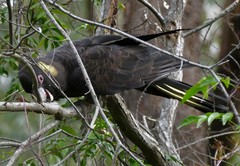
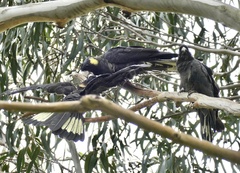
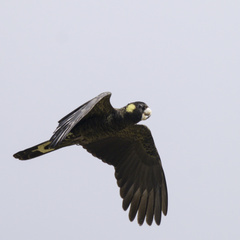
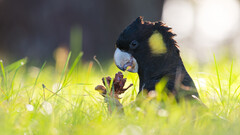
The yellow-tailed black cockatoo (Zanda funerea) is a large cockatoo native to the south-east of Australia measuring 55–65 cm (22–26 in) in length. It has a short crest on the top of its head. Its plumage is mostly brownish black and it has prominent yellow cheek patches and a yellow tail band. The body feathers are edged with yellow giving a scalloped appearance. The adult male has a black beak and pinkish-red eye-rings, and the female has a bone-coloured beak and grey eye-rings. In flight, yellow-tailed black cockatoos flap deeply and slowly, with a peculiar heavy fluid motion. Their loud, wailing calls carry for long distances. The yellow-tailed black cockatoo is found in temperate forests and forested areas across south and central eastern Queensland to southeastern South Australia, including a very small population persisting in the Eyre Peninsula. Two subspecies are recognised, although Tasmanian and southern mainland populations of the southern subspecies xanthanotus may be distinct enough from each other to bring the total to three. Birds of subspecies funereus (Queensland to eastern Victoria) have longer wings and tails and darker plumage overall, while those of xanthanotus (western Victoria, South Australia and Tasmania) have more prominent scalloping.

The subspecies whiteae is found south of Victoria to the East of South Australia and is smaller in size. The yellow-tailed black cockatoo's diet primarily includes seeds of native and introduced plants while also feeding on wood-boring grubs. They nest in large hollows high in old growth native trees (~ greater than 200 years old), generally Eucalyptus regnans. Although they remain common throughout much of their range, fragmentation of habitat and loss of large trees suitable for nesting has caused population decline in Victoria and South Australia. Furthermore, the species may lose most of its mainland range due to climate change. In some places yellow-tailed black cockatoos appear to have partially adapted to recent human alteration of landscape and they can often be seen in parts of urban Canberra, Sydney, Adelaide and Melbourne. The species is not commonly seen in aviculture, especially outside Australia. Like most parrots, it is protected by CITES, an international agreement that makes trade, export, and import of listed wild-caught species illegal. Wikipedia →

Global Distribution

Parks Where Found

# Park Country Daily sighting probability
1 Wilsons Promontory National Park 🇦🇺 Australia
~50%
2 Great Otway National Park 🇦🇺 Australia
~40%
3 Booderee National Park 🇦🇺 Australia
~30%
4 Blue Mountains National Park 🇦🇺 Australia
~30%
5 Royal National Park 🇦🇺 Australia
~30%
6 Grampians National Park 🇦🇺 Australia
~30%
7 Cradle Mountain-Lake St Clair National Park 🇦🇺 Australia
~30%
8 Maria Island National Park 🇦🇺 Australia
~20%
9 Springbrook National Park 🇦🇺 Australia
~20%
10 Kosciuszko National Park 🇦🇺 Australia
~20%
11 Freycinet National Park 🇦🇺 Australia
~10%
12 Noosa National Park 🇦🇺 Australia
~10%
13 Flinders Chase 🇦🇺 Australia
~10%
14 Lamington National Park 🇦🇺 Australia
~10%

Cities Where Found

# City Country Daily sighting probability
1 Sydney 🇦🇺 Australia
~10%
2 Hobart 🇦🇺 Australia
~10%
3 Melbourne 🇦🇺 Australia
<5%
4 Brisbane 🇦🇺 Australia
<5%

Zoos & Centres Where Found

# Zoo / Centre Country
1 Australia Zoo 🇦🇺 Australia In captivity
2 Cleland Wildlife Park 🇦🇺 Australia In captivity
3 East Coast Natureworld 🇦🇺 Australia In captivity
4 Paphos Zoo 🇨🇾 Cyprus In captivity
5 Loro Parque 🇪🇸 Spain In captivity
6 Gorge Wildlife Park 🇦🇺 Australia In captivity
7 Featherdale Sydney Wildlife Park 🇦🇺 Australia In captivity
8 Bonorong Wildlife Sanctuary 🇦🇺 Australia In captivity
9 Greenough Wildlife & Bird Park 🇦🇺 Australia In captivity
10 Caversham Wildlife Park 🇦🇺 Australia In captivity
11 Wildlife Habitat Port Douglas 🇦🇺 Australia In captivity
12 Wirrimbirra Flora & Fauna Sanctuary 🇦🇺 Australia In captivity

Before you go

What are the chances of seeing a Yellow-Tailed Black Cockatoo in Maria Island National Park?

Possible

About 20% of wildlife watchers report a Yellow-Tailed Black Cockatoo sighting in Maria Island National Park on a given day, based on 68 verified sightings from GBIF citizen-science data from 2019 to 2026. It is the 46th most-seen of the 81 birds we can rate there. Over three days the chance rises to about 50%, and over a week to about 80%, if each day is a fresh chance.

When is the best time to see a Yellow-Tailed Black Cockatoo in Maria Island National Park?

April

In that month about 40% of wildlife watchers report a Yellow-Tailed Black Cockatoo in Maria Island National Park on a given day, against about 10% in January, June and September, the lowest months.

What time of day is best to see a Yellow-Tailed Black Cockatoo?

Between 11 am and 2 pm

Across all the parks we cover, that three-hour window holds the most Yellow-Tailed Black Cockatoo sightings with a recorded time, and nearly all of them come between 6 am and 6 pm: it is a daytime animal.

Which relatives of the Yellow-Tailed Black Cockatoo live in Maria Island National Park?

Same family: Psittacidae

The closest relatives of the Yellow-Tailed Black Cockatoo that you can see in Maria Island National Park (family Psittacidae, New World and African Parrots) are Green Rosella (about 80%) and Swift Parrot (about 20%), with each one's daily chance of a sighting.

Where does the Yellow-Tailed Black Cockatoo sighting chance come from?

GBIF citizen-science records

It is estimated from how often the Yellow-Tailed Black Cockatoo is recorded against all the birds logged in Maria Island National Park (68 verified sightings from 2019 to 2026), calibrated against known sighting rates. Figures are rounded to the nearest 10% because citizen-science data supports honest approximations, not decimals, and months with records from fewer than five people show "—". How it works.

← Back to Maria Island National Park