
Reddish Egret

Reddish Egret

Egretta rufescens

Silhouette: Amanda Kuhlman · PhyloPic

LCNTNear ThreatenedVUENCR
Daily sighting probability ~40% · Likely
at Padre Island National Seashore

In 3 days ~80% in a week >90%

530 Verified sightings at Padre Island National Seashore From 2019 to 2026
10,439 In all 22 parks
September Best month
☀️ Diurnal When it's spotted

About the Reddish Egret

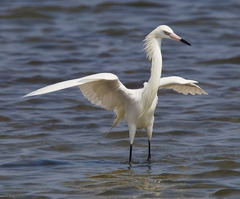
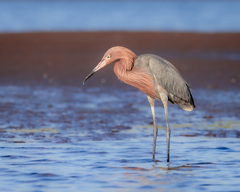
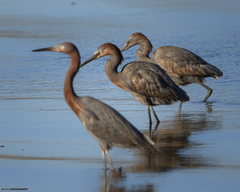
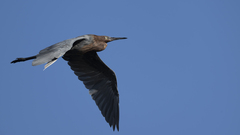
The reddish egret (Egretta rufescens) is a medium-sized heron that is a resident breeder in Central America, the Bahamas, the Caribbean, the Gulf Coast of the United States (primarily Texas), and Mexico. The egret is known for its unusual foraging behavior compared to other herons as well as its association with mud flats, its habitat of choice.

In the past, this bird was a victim of the plume trade and is North America's "rarest and least studied ardeid." The reddish egret was formally described in 1789 by the German naturalist Johann Friedrich Gmelin in his revised and expanded edition of Carl Linnaeus's Systema Naturae. He placed it with the herons, cranes and egrets in the genus Ardea and coined the binomial name Ardea rufescens. Gmelin based his description on that of the English ornithologist John Latham who in 1785 had included the species in his multi-volume A General Synopsis of Birds. Latham had in turn based his own description on the "L'Aigrette rousse, de la Louisiane" that the French polymath Comte de Buffon had described and illustrated in his Histoire Naturelle des Oiseaux. The reddish egret is now placed with 12 other species in the genus Egretta that... Wikipedia →

Sounds

Call0:14

Mexico · 2020

© Isain Contreras Rodríguez · XC568815 · CC BY-NC-SA 4.0

Display0:16

United States · 2013

© Andrew Spencer · XC130178 · CC BY-NC-SA 3.0

Call0:14

United States · 2017

© Paul Marvin · XC452975 · CC BY-NC-SA 4.0

Global Distribution

Parks Where Found

# Park Country Daily sighting probability
1 Ría Lagartos Biosphere Reserve 🇲🇽 Mexico
~50%
2 El Vizcaíno Biosphere Reserve 🇲🇽 Mexico
~50%
3 Merritt Island National Wildlife Refuge 🇺🇸 United States
~40%
4 Celestún Biosphere Reserve 🇲🇽 Mexico
~40%
5 Padre Island National Seashore 🇺🇸 United States
~40%
6 Ciénaga de Zapata 🇨🇺 Cuba
~40%
7 Bahía de Loreto National Park 🇲🇽 Mexico
~30%
8 Las Baulas Marine National Park 🇨🇷 Costa Rica
~10%
9 Arrecifes de Cozumel National Park 🇲🇽 Mexico
~10%
10 Everglades National Park 🇺🇸 United States
~10%
11 Sian Ka'an Biosphere Reserve 🇲🇽 Mexico
~10%
12 Jaragua National Park 🇩🇴 Dominican Republic
~10%
13 Montes Azules Biosphere Reserve 🇲🇽 Mexico
<5%
14 Ostional Wildlife Refuge 🇨🇷 Costa Rica
<5%
15 Carara National Park 🇨🇷 Costa Rica
<5%
16 Corcovado National Park 🇨🇷 Costa Rica
<5%
17 Big Cypress National Preserve 🇺🇸 United States
<5%
18 Tayrona National Natural Park 🇨🇴 Colombia
<5%
19 Channel Islands National Park 🇺🇸 United States
<5%
20 Palo Verde National Park 🇨🇷 Costa Rica
<5%
21 Piedras Blancas National Park 🇨🇷 Costa Rica
<5%
22 Tortuguero National Park 🇨🇷 Costa Rica
<5%

Cities Where Found

# City Country Daily sighting probability
1 San Diego 🇺🇸 United States
~10%
2 Havana 🇨🇺 Cuba
~10%
3 Mesa 🇺🇸 United States
~10%
4 Los Angeles 🇺🇸 United States
<5%
5 Barranquilla 🇨🇴 Colombia
<5%
6 Miami 🇺🇸 United States
<5%
7 Houston 🇺🇸 United States
<5%

Before you go

What are the chances of seeing a Reddish Egret in Padre Island National Seashore?

Likely

About 40% of wildlife watchers report a Reddish Egret sighting in Padre Island National Seashore on a given day, based on 530 verified sightings from GBIF citizen-science data from 2019 to 2026. It is the 15th most-seen of the 171 birds we can rate there. Over three days the chance rises to about 80%, and over a week to over 90%, if each day is a fresh chance.

When is the best time to see a Reddish Egret in Padre Island National Seashore?

September

In that month about 60% of wildlife watchers report a Reddish Egret in Padre Island National Seashore on a given day, against about 30% in February–March, May, August and November, the lowest months. That is one of Padre Island National Seashore's wettest months, with about 120 mm of rain against 40 mm in February.

What time of day is best to see a Reddish Egret?

Between 9 am and noon

Across all the parks we cover, that three-hour window holds the most Reddish Egret sightings with a recorded time, and about 9 in 10 of them come between 6 am and 6 pm: it is a daytime animal.

Which relatives of the Reddish Egret live in Padre Island National Seashore?

Same genus: Egretta

The closest relatives of the Reddish Egret that you can see in Padre Island National Seashore (genus Egretta, Small Egrets and Herons) are Tricolored Heron (about 20%), Snowy Egret (about 20%) and Little Blue Heron (about 10%), with each one's daily chance of a sighting.

Where does the Reddish Egret sighting chance come from?

GBIF citizen-science records

It is estimated from how often the Reddish Egret is recorded against all the birds logged in Padre Island National Seashore (530 verified sightings from 2019 to 2026), calibrated against known sighting rates. Figures are rounded to the nearest 10% because citizen-science data supports honest approximations, not decimals, and months with records from fewer than five people show "—". How it works.

← Back to Padre Island National Seashore