
Middle American Ameiva

Middle American Ameiva

Holcosus festivus

Silhouette: SeismicShrimp · PhyloPic

LCLeast ConcernNTVUENCR
Daily sighting probability ~50% · Likely
at Pico Bonito National Park

In 3 days ~90% in a week >90%

30 Verified sightings at Pico Bonito National Park From 2019 to 2026
2,200 In all 21 parks
December Best month
☀️ Diurnal When it's spotted

About the Middle American Ameiva

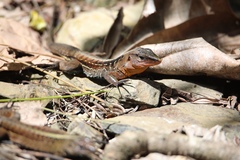
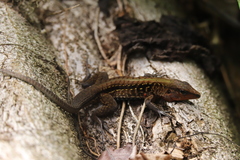
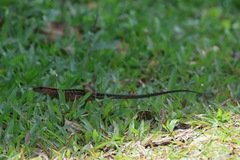
Holcosus festivus, commonly known as the Central American whiptail, the Middle American ameiva, and the tiger ameiva, is a species of lizard in the family Teiidae. The species is native to Central America and northern South America.

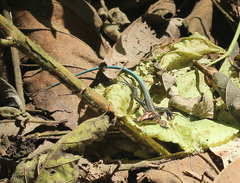
H. festivus is found from southern Mexico to Colombia. H. festivus is brown-colored, with darker browns making a zig-zag pattern down the back. A similar species is Holcosus quadrilineatus. Juveniles have metallic-blue tails.

H. festivus lives in open habitats. H. f. occidentalis Taylor, 1956 – Costa Rica Nota bene: A taxon author (binomial authority or trinomial authority) in parentheses indicates that the taxon (species or subspecies) was originally described in a different genus (in this case, a genus other than Holcosus).

The subspecific name, edwardsii, is in honor of French zoologist Alphonse Milne-Edwards. Wikipedia →

Global Distribution

Parks Where Found

# Park Country Daily sighting probability
1 Tenorio Volcano National Park 🇨🇷 Costa Rica
~70%
2 Arenal Volcano National Park 🇨🇷 Costa Rica
~60%
3 Braulio Carrillo National Park 🇨🇷 Costa Rica
~60%
4 Pico Bonito National Park 🇭🇳 Honduras
~50%
5 Tortuguero National Park 🇨🇷 Costa Rica
~50%
6 Piedras Blancas National Park 🇨🇷 Costa Rica
~50%
7 Utría National Natural Park 🇨🇴 Colombia
~50%
8 Cockscomb Basin Wildlife Sanctuary 🇧🇿 Belize
~50%
9 Cahuita National Park 🇨🇷 Costa Rica
~40%
10 Gandoca-Manzanillo Wildlife Refuge 🇨🇷 Costa Rica
~40%
11 Cerro Azul Meámbar National Park 🇭🇳 Honduras
~40%
12 Soberanía National Park 🇵🇦 Panama
~40%
13 Corcovado National Park 🇨🇷 Costa Rica
~40%
14 Bastimentos Island National Marine Park 🇵🇦 Panama
~30%
15 Darién National Park 🇵🇦 Panama
~20%
16 Marino Ballena National Park 🇨🇷 Costa Rica
~20%
17 La Amistad International Park (Panama) 🇵🇦 Panama
~10%
18 Poás Volcano National Park 🇨🇷 Costa Rica
~10%
19 Tapantí-Macizo de la Muerte National Park 🇨🇷 Costa Rica
~10%
20 Manuel Antonio National Park 🇨🇷 Costa Rica
~10%
21 Monteverde Cloud Forest Reserve 🇨🇷 Costa Rica
~10%

Closest Relatives at Pico Bonito National Park

No species of the same family or order lives in Pico Bonito National Park, so these are its closest relatives here: other reptiles.

Before you go

What are the chances of seeing a Middle American Ameiva in Pico Bonito National Park?

Likely

About 50% of wildlife watchers report a Middle American Ameiva sighting in Pico Bonito National Park on a given day, based on 30 verified sightings from GBIF citizen-science data from 2019 to 2026. It is the 4th most-seen of the 21 reptiles we can rate there. Over three days the chance rises to about 90%, and over a week to over 90%, if each day is a fresh chance.

When is the best time to see a Middle American Ameiva in Pico Bonito National Park?

December

In that month about 70% of wildlife watchers report a Middle American Ameiva in Pico Bonito National Park on a given day, against about 10% in June, the lowest month. That is one of Pico Bonito National Park's wettest months, with about 290 mm of rain against 80 mm in April.

What time of day is best to see a Middle American Ameiva?

Between 10 am and 1 pm

Across all the parks we cover, that three-hour window holds the most Middle American Ameiva sightings with a recorded time, and about 9 in 10 of them come between 6 am and 6 pm: it is a daytime animal.

Where does the Middle American Ameiva sighting chance come from?

GBIF citizen-science records

It is estimated from how often the Middle American Ameiva is recorded against all the reptiles logged in Pico Bonito National Park (30 verified sightings from 2019 to 2026), calibrated against known sighting rates. Figures are rounded to the nearest 10% because citizen-science data supports honest approximations, not decimals, and months with records from fewer than five people show "—". How it works.

← Back to Pico Bonito National Park