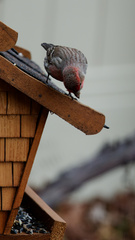
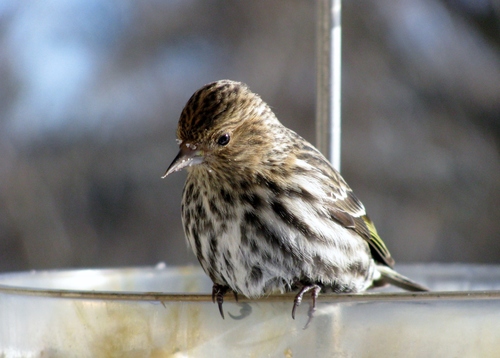
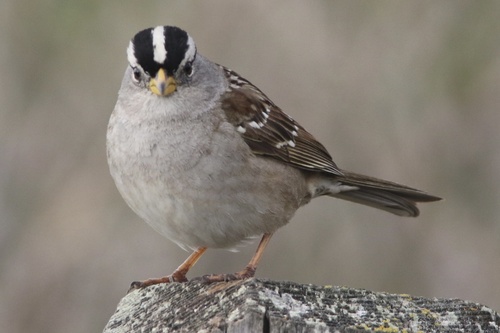
House Finch

House Finch

Haemorhous mexicanus

Silhouette: Andy Wilson · PhyloPic

LCLeast ConcernNTVUENCR
Daily sighting probability ~10% · With luck
at Redwood National Park

In 3 days ~20% in a week ~40%

154 Verified sightings at Redwood National Park From 2019 to 2026
32,391 In all 36 parks
May Best month
☀️ Diurnal When it's spotted

About the House Finch

The house finch (Haemorhous mexicanus) is a North American bird in the finch family. It is native to Mexico and southwestern United States, but has since been introduced to the eastern part of North America and Hawaiʻi, and is found year-round in almost all parts of the United States and most of Mexico, with breeding grounds well into Canada as far north as northern Alberta. There are estimated to be 40 million house finches across North America, making it the second-most populous finch, just behind the American goldfinch. The house finch and the other two American rosefinches (Cassin's and purple finch) are placed in the genus Haemorhous.

House finches are mainly permanent residents throughout their range; some birds migrate to the south, with adult females moving longer distances than males. Their breeding habitat is urban and suburban areas across North America, as well as various semi-open areas in the west from southern Canada to the Mexican state of Oaxaca; the population in central Chiapas may be descended from escaped cagebirds. Analyses of nest records from house finches in California spanning more than a century found that egg‐laying occurred... Wikipedia →

Sounds

Song0:06

United States · 2020

© Pat Goltz · XC1148298 · CC BY-NC-SA 4.0

Call0:48

United States · 2010

© Stuart Fisher · XC790022 · CC BY-NC-SA 4.0

Begging call1:26

United States · 2022

© Thomas G. Graves · XC731970 · CC BY-NC-SA 4.0

Global Distribution

Parks Where Found

# Park Country Daily sighting probability
1 Saguaro National Park 🇺🇸 United States
~70%
2 Bahía de Loreto National Park 🇲🇽 Mexico
~70%
3 Channel Islands National Park 🇺🇸 United States
~70%
4 Joshua Tree National Park 🇺🇸 United States
~70%
5 Death Valley National Park 🇺🇸 United States
~60%
6 Guadalupe Mountains National Park 🇺🇸 United States
~60%
7 Cabo Pulmo National Park 🇲🇽 Mexico
~50%
8 Zion National Park 🇺🇸 United States
~50%
9 Big Bend National Park 🇺🇸 United States
~50%
10 Reserva de la Biosfera Mariposa Monarca 🇲🇽 Mexico
~40%
11 El Vizcaíno Biosphere Reserve 🇲🇽 Mexico
~40%
12 Sequoia and Kings Canyon National Parks 🇺🇸 United States
~30%
13 Grand Canyon National Park 🇺🇸 United States
~20%
14 Rocky Mountain National Park 🇺🇸 United States
~20%
15 Olympic National Park 🇺🇸 United States
~20%
16 Great Smoky Mountains National Park 🇺🇸 United States
~20%
17 Shenandoah National Park 🇺🇸 United States
~20%
18 Cumbres de Monterrey National Park 🇲🇽 Mexico
~10%
19 Great Bear Rainforest 🇨🇦 Canada
~10%
20 Redwood National Park 🇺🇸 United States
~10%
21 Point Pelee National Park 🇨🇦 Canada
~10%
22 Badlands National Park 🇺🇸 United States
~10%
23 Acadia National Park 🇺🇸 United States
<5%
24 Yellowstone National Park 🇺🇸 United States
<5%
25 Grand Teton National Park 🇺🇸 United States
<5%
26 Yosemite National Park 🇺🇸 United States
<5%
27 Riding Mountain National Park 🇨🇦 Canada
<5%
28 Merritt Island National Wildlife Refuge 🇺🇸 United States
<5%
29 Elk Island National Park 🇨🇦 Canada
<5%
30 Congaree National Park 🇺🇸 United States
<5%
31 Glacier National Park 🇺🇸 United States
<5%
32 Banff National Park 🇨🇦 Canada
<5%
33 Jasper National Park 🇨🇦 Canada
<5%
34 Pacific Rim National Park Reserve 🇨🇦 Canada
<5%
35 Everglades National Park 🇺🇸 United States
<5%
36 Big Cypress National Preserve 🇺🇸 United States
<5%

Cities Where Found

# City Country Daily sighting probability
1 Tijuana 🇲🇽 México
~80%
2 Mexico City 🇲🇽 México
~80%
3 Torreón 🇲🇽 México
~80%
4 Puebla 🇲🇽 México
~80%
5 Salt Lake City 🇺🇸 United States
~80%
6 Los Angeles 🇺🇸 United States
~80%
7 Phoenix 🇺🇸 United States
~80%
8 León 🇲🇽 México
~80%
9 Toluca 🇲🇽 México
~80%
10 Denver 🇺🇸 United States
~80%

Zoos & Centres Where Found

# Zoo / Centre Country
1 Prague Zoo 🇨🇿 Czechia In captivity
2 Houston Zoo 🇺🇸 United States In captivity
3 Parque museo La Venta 🇲🇽 Mexico In captivity
4 National Aquarium 🇺🇸 United States In captivity
5 Rákosův pavilon 🇨🇿 Czechia In captivity
6 Velemlokárium 🇨🇿 Czechia In captivity
7 Primarily Primates Inc. 🇺🇸 United States In captivity

Before you go

What are the chances of seeing a House Finch in Redwood National Park?

With luck

About 10% of wildlife watchers report a House Finch sighting in Redwood National Park on a given day, based on 154 verified sightings from GBIF citizen-science data from 2019 to 2026. It is the 97th most-seen of the 226 birds we can rate there. Over three days the chance rises to about 20%, and over a week to about 40%, if each day is a fresh chance.

When is the best time to see a House Finch in Redwood National Park?

May

In that month about 20% of wildlife watchers report a House Finch in Redwood National Park on a given day, against under 5% in February–March, June and August–September, the lowest months. That is one of Redwood National Park's driest months, with about 90 mm of rain against 360 mm in January.

What time of day is best to see a House Finch?

Between 8 and 11 am

Across all the parks we cover, that three-hour window holds the most House Finch sightings with a recorded time, and about 9 in 10 of them come between 6 am and 6 pm: it is a daytime animal.

Where does the House Finch sighting chance come from?

GBIF citizen-science records

It is estimated from how often the House Finch is recorded against all the birds logged in Redwood National Park (154 verified sightings from 2019 to 2026), calibrated against known sighting rates. Figures are rounded to the nearest 10% because citizen-science data supports honest approximations, not decimals, and months with records from fewer than five people show "—". How it works.

← Back to Redwood National Park