Common Loon

Common Loon

Gavia immer

Silhouette: Unknown (photo), John E. McCormack, Michael G. Harvey, Brant C. Faircloth, Nicholas G. Crawford, Travis C. Glenn, Robb T. Brumfield & T. Michael Keesey · PhyloPic

LCLeast ConcernNTVUENCR
Daily sighting probability ~50% · Likely
at Riding Mountain National Park

In 3 days ~90% in a week >90%

696 Verified sightings at Riding Mountain National Park From 2019 to 2026
20,930 In all 39 parks
May Best month
☀️ Diurnal When it's spotted

About the Common Loon

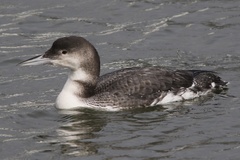
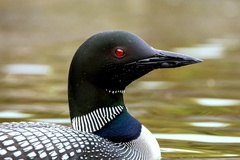
The common loon or great northern diver (Gavia immer) is a large member of the loon, or diver, family of birds. Breeding adults have a plumage that includes a broad black head and neck with a greenish, purplish, or bluish sheen, blackish or blackish-grey upperparts, and pure white underparts except some black on the undertail coverts and vent. Non-breeding adults are brownish with a dark neck and head marked with dark grey-brown. Their upperparts are dark brownish-grey with an unclear pattern of squares on the shoulders, and the underparts, lower face, chin, and throat are whitish. The sexes look alike, though males are significantly heavier than females. During the breeding season, loons live on lakes and other waterways in Canada, the northern United States (including Alaska), and southern parts of Greenland and Iceland. Small numbers breed on Svalbard and sporadically elsewhere in Arctic Eurasia. Common loons winter on both coasts of North America as far north as Newfoundland and Alaska, and as far south as Mexico, as well as on the Atlantic coast of Europe.

Common loons eat a variety of animal prey including fish, crustaceans, insect larvae, molluscs, and occasionally aquatic plant life. They swallow most of their prey underwater, where it is caught, but some larger items are first brought to the surface. Loons are monogamous; that is, a single female and male often together defend a territory and may breed together for a decade or more. Both members of a pair build a large nest out of dead marsh grasses and other plants formed into a mound along the vegetated shores of lakes. A single brood is raised each year from a clutch of one or two olive-brown oval eggs with dark brown spots which are incubated for about 28 days by both parents. Fed by both parents, the chicks fledge in 70 to 77 days. The chicks are capable of diving underwater when just a few days old, and they fly to their wintering areas before ice forms in the fall.

The common loon is assessed as a species of least concern on the IUCN Red List of Endangered Species. It is one of the species to which the Agreement on the Conservation of African-Eurasian Migratory Waterbirds applies. The United States Forest Service has designated the common loon a species of special status because of threats from habitat loss and toxic metal poisoning in its US range.

The common loon is the provincial bird of Ontario, and it appears on Canadian currency, including the one-dollar "loonie" coin and a previous series of $20 bills. Wikipedia →

Sounds

Song0:15

Canada · 2025

© Denis Provencher · XC1009388 · CC BY-NC-SA 4.0

Call0:20

Iceland · 2023

© Frantz Barrault · XC835553 · CC BY-NC-SA 4.0

Flight call0:43

United States · 2020

© Michael Hurben · XC569715 · CC BY-NC-SA 4.0

Global Distribution

Parks Where Found

# Park Country Daily sighting probability
1 Isle Royale National Park 🇺🇸 United States
~80%
2 Riding Mountain National Park 🇨🇦 Canada
~50%
3 Acadia National Park 🇺🇸 United States
~50%
4 Jasper National Park 🇨🇦 Canada
~50%
5 Voyageurs National Park 🇺🇸 United States
~40%
6 Great Bear Rainforest 🇨🇦 Canada
~30%
7 Pacific Rim National Park Reserve 🇨🇦 Canada
~30%
8 Gros Morne National Park 🇨🇦 Canada
~30%
9 Banff National Park 🇨🇦 Canada
~30%
10 Cape Breton Highlands National Park 🇨🇦 Canada
~20%
11 El Vizcaíno Biosphere Reserve 🇲🇽 Mexico
~20%
12 Redwood National Park 🇺🇸 United States
~20%
13 Olympic National Park 🇺🇸 United States
~20%
14 Glacier National Park 🇺🇸 United States
~20%
15 Katmai National Park 🇺🇸 United States
~20%
16 Point Pelee National Park 🇨🇦 Canada
~20%
17 Wrangell-St. Elias National Park 🇺🇸 United States
~10%
18 Elk Island National Park 🇨🇦 Canada
~10%
19 Kluane National Park 🇨🇦 Canada
~10%
20 Vatnajokull National Park 🇮🇸 Iceland
~10%
21 Padre Island National Seashore 🇺🇸 United States
~10%
22 Merritt Island National Wildlife Refuge 🇺🇸 United States
<5%
23 Sierra de Guadarrama National Park 🇪🇸 Spain
<5%
24 Channel Islands National Park 🇺🇸 United States
<5%
25 Kenai Fjords National Park 🇺🇸 United States
<5%
26 Grand Teton National Park 🇺🇸 United States
<5%
27 Denali National Park 🇺🇸 United States
<5%
28 Yellowstone National Park 🇺🇸 United States
<5%
29 Svalbard 🇳🇴 Norway
<5%
30 Death Valley National Park 🇺🇸 United States
<5%
31 Bahía de Loreto National Park 🇲🇽 Mexico
<5%
32 Wadden Sea National Park 🇩🇪 Germany
<5%
33 Camargue 🇫🇷 France
<5%
34 Shenandoah National Park 🇺🇸 United States
<5%
35 Zion National Park 🇺🇸 United States
<5%
36 Big Cypress National Preserve 🇺🇸 United States
<5%
37 Yosemite National Park 🇺🇸 United States
<5%
38 Everglades National Park 🇺🇸 United States
<5%
39 Rocky Mountain National Park 🇺🇸 United States
<5%

Cities Where Found

# City Country Daily sighting probability
1 Anchorage 🇺🇸 United States
~20%
2 Boston 🇺🇸 United States
~10%
3 San Diego 🇺🇸 United States
~10%
4 Minneapolis [Saint Paul] 🇺🇸 United States
~10%
5 Toronto 🇨🇦 Canada
~10%
6 Vancouver 🇨🇦 Canada
~10%
7 New York City 🇺🇸 United States
<5%
8 San Francisco 🇺🇸 United States
<5%
9 Seattle 🇺🇸 United States
<5%
10 Montreal 🇨🇦 Canada
<5%

Before you go

What are the chances of seeing a Common Loon in Riding Mountain National Park?

Likely

About 50% of wildlife watchers report a Common Loon sighting in Riding Mountain National Park on a given day, based on 696 verified sightings from GBIF citizen-science data from 2019 to 2026. It is the 13th most-seen of the 181 birds we can rate there. Over three days the chance rises to about 90%, and over a week to over 90%, if each day is a fresh chance.

When is the best time to see a Common Loon in Riding Mountain National Park?

May

In that month about 70% of wildlife watchers report a Common Loon in Riding Mountain National Park on a given day, against about 10% in January, the lowest month.

What time of day is best to see a Common Loon?

Between 2 and 5 pm

Across all the parks we cover, that three-hour window holds the most Common Loon sightings with a recorded time, and about 8 in 10 of them come between 6 am and 6 pm: it is a daytime animal.

Is Riding Mountain National Park the best place to see a Common Loon?

2nd of 39

Of the 39 parks where we can rate Common Loon sightings, Riding Mountain National Park ranks 2nd at about 50%. The best odds are in Isle Royale National Park (United States, about 80%). All parks ranked.

Where does the Common Loon sighting chance come from?

GBIF citizen-science records

It is estimated from how often the Common Loon is recorded against all the birds logged in Riding Mountain National Park (696 verified sightings from 2019 to 2026), calibrated against known sighting rates. Figures are rounded to the nearest 10% because citizen-science data supports honest approximations, not decimals, and months with records from fewer than five people show "—". How it works.

← Back to Riding Mountain National Park