White-throated Needletail

White-throated Needletail

Hirundapus caudacutus

Silhouette: Aviceda (vectorized by T. Michael Keesey) · PhyloPic

LCLeast ConcernNTVUENCR
Daily sighting probability ~10% · With luck
at Royal Manas National Park

In 3 days ~30% in a week ~60%

129 Verified sightings at Royal Manas National Park From 2019 to 2026
643 In all 16 parks
April Best month
☀️ Diurnal When it's spotted

About the White-throated Needletail

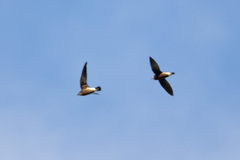
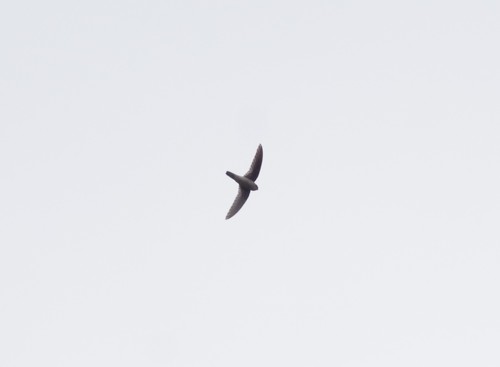
The white-throated needletail (Hirundapus caudacutus), also known as the needle-tailed swift or spine-tailed swift, is a large swift in the genus Hirundapus. It is reputed to reach speeds of up to 170 km/h (110 mph) in horizontal flight, but this is unverified because the methods used to measure its speed have not been published.

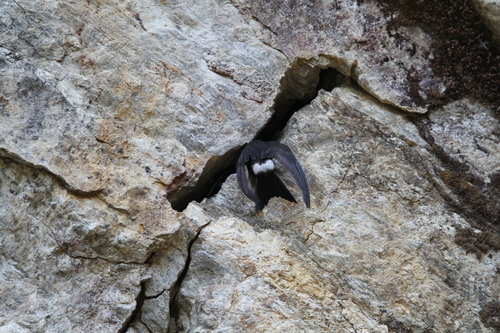
75 km/h (47 mph) is more likely, but this is still at least 100 times the bird's length per second. They build their nests in rock crevices in cliffs or hollow trees. They do not like to sit on the ground and spend most of their time in the air. They feed on small, flying insects like beetles, flies, bees and moths.

The white-throated needletail is a migratory bird, breeding in Central Asia and southern Siberia, and wintering south in the Indian subcontinent, Southeast Asia and Australia. It is a rare vagrant in Western Europe and has been recorded as far west as Norway, Sweden and Great Britain. In June 2013, an individual was spotted in Great Britain for the first time in 22 years. It later flew into a wind turbine and died; its body was sent to a museum.

In June 2022, a bird was recovered on an expedition ship MV Ortelius near Fair Isle approx 70 miles off Duncansby Head, Caithness, Scotland and successfully released. In October 2025, a white-throated needletail was spotted at Tophill Low Nature Reserve in East Yorkshire, England.

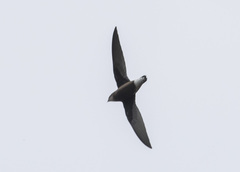
White-throated needletails are large swifts with a robust, barrel-like body. They measure about 20 cm (7.9 in) and weigh between 110 and 120 grams (3.9 and 4.2 oz). They are greyish-brown except for a white throat and a white patch, extending from the base of the tail to the flanks.

Needle-tailed swifts get their name from the spined end of their tail, which is not forked as it is in the typical swifts of the genus Apus. The white-throated needletail was first described by the English ornithologist John Latham in 1801 under the binomial name Hirundo caudacuta. Their current genus Hirundapus is constructed from the names of the swallow genus Hirundo and the swift genus Apus. The specific name caudacutus comes from the Latin words cauda meaning "tail" and acutus meaning "pointed". Wikipedia →

Sounds

Flight call0:05

Japan · 2025

© Uku Paal · XC1016659 · CC BY-NC-SA 4.0

Flight call0:25

Japan · 2026

© Ding Li Yong · XC1140488 · CC BY-NC-ND 4.0

Recording0:23

2026

© Warren Tomlinson · iNaturalist · CC BY-NC 4.0

Global Distribution

Parks Where Found

# Park Country Daily sighting probability
1 Royal Manas National Park 🇧🇹 Bhutan
~10%
2 Wilsons Promontory National Park 🇦🇺 Australia
~10%
3 Lamington National Park 🇦🇺 Australia
<5%
4 Booderee National Park 🇦🇺 Australia
<5%
5 Springbrook National Park 🇦🇺 Australia
<5%
6 Manas National Park 🇮🇳 India
<5%
7 Kosciuszko National Park 🇦🇺 Australia
<5%
8 Royal National Park 🇦🇺 Australia
<5%
9 Great Otway National Park 🇦🇺 Australia
<5%
10 Noosa National Park 🇦🇺 Australia
<5%
11 Tangkoko Nature Reserve 🇮🇩 Indonesia
<5%
12 Blue Mountains National Park 🇦🇺 Australia
<5%
13 Daintree National Park 🇦🇺 Australia
<5%
14 Khao Yai National Park 🇹🇭 Thailand
<5%
15 Kinabalu Park 🇲🇾 Malaysia
<5%
16 Kaeng Krachan National Park 🇹🇭 Thailand
<5%

Cities Where Found

# City Country Daily sighting probability
1 Sydney 🇦🇺 Australia
<5%
2 Nanjing 🇨🇳 China
<5%
3 Brisbane 🇦🇺 Australia
<5%
4 Singapore 🇸🇬 Singapore
<5%
5 Beijing 🇨🇳 China
<5%
6 Melbourne 🇦🇺 Australia
<5%

Before you go

What are the chances of seeing a White-throated Needletail in Royal Manas National Park?

With luck

About 10% of wildlife watchers report a White-throated Needletail sighting in Royal Manas National Park on a given day, based on 129 verified sightings from GBIF citizen-science data from 2019 to 2026. It is the 132nd most-seen of the 388 birds we can rate there. Over three days the chance rises to about 30%, and over a week to about 60%, if each day is a fresh chance.

When is the best time to see a White-throated Needletail in Royal Manas National Park?

April

In that month about 20% of wildlife watchers report a White-throated Needletail in Royal Manas National Park on a given day, against under 5% in October and December–March, the lowest months. August and September have too few records to rate.

What time of day is best to see a White-throated Needletail?

Between 7 and 10 am

Across all the parks we cover, that three-hour window holds the most White-throated Needletail sightings with a recorded time, and about 8 in 10 of them come between 6 am and 6 pm: it is a daytime animal.

Is Royal Manas National Park the best place to see a White-throated Needletail?

Yes

Of the 16 parks where we can rate White-throated Needletail sightings, Royal Manas National Park has the highest daily chance: about 10%. Next come Wilsons Promontory National Park (Australia, about 10%) and Lamington National Park (Australia, under 5%).

Which relatives of the White-throated Needletail live in Royal Manas National Park?

Same family: Apodidae

The closest relatives of the White-throated Needletail that you can see in Royal Manas National Park (family Apodidae, Swifts) are Asian Palm-Swift (about 10%) and Himalayan Swiftlet (about 10%), with each one's daily chance of a sighting.

Where does the White-throated Needletail sighting chance come from?

GBIF citizen-science records

It is estimated from how often the White-throated Needletail is recorded against all the birds logged in Royal Manas National Park (129 verified sightings from 2019 to 2026), calibrated against known sighting rates. Figures are rounded to the nearest 10% because citizen-science data supports honest approximations, not decimals, and months with records from fewer than five people show "—". How it works.

← Back to Royal Manas National Park