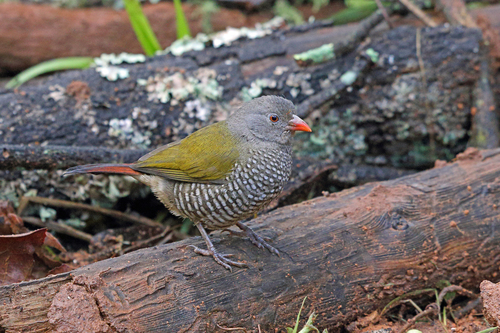
Bronze Mannikin

Bronze Mannikin

Lonchura cucullata

Silhouette: Ferran Sayol · PhyloPic

LCLeast ConcernNTVUENCR
Daily sighting probability <5% · Rare
at Ruaha National Park

In 3 days ~10% in a week ~20%

5 Verified sightings at Ruaha National Park From 2019 to 2026
6,113 In all 39 parks
April Best month
☀️ Diurnal When it's spotted

About the Bronze Mannikin

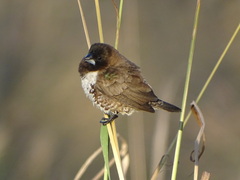
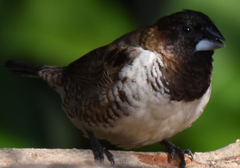
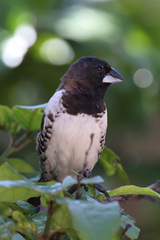
The bronze mannikin or bronze munia (Spermestes cucullata) is a small passerine (i.e. perching) bird of the Afrotropics. This very social estrildid finch is an uncommon to locally abundant bird in much of Africa south of the Sahara Desert, where it is resident, nomadic or irruptive in mesic savanna or forest margin habitats. It has an estimated global extent of occurrence of 23,600,000 km2 (9,100,000 sq mi). It is the smallest and most widespread of four munia species on the African mainland, the other being black-and-white, red-backed and magpie mannikin. It co-occurs with the Madagascar mannikin on the Comoro Islands, and was introduced to Puerto Rico. Especially in the West Africa, it is considered a pest in grain and rice fields. It is locally trapped for the pet bird trade.

The bronze mannikin was formally described in 1837 by the English naturalist William Swainson and given the binomial name Spermestes cucullata. The specific epithet is from Late Latin cucullatus meaning "hooded". The type locality is Senegal.

Two subspecies are recognised: Wikipedia →

Sounds

Recording0:31

Botswana · 2020

© Dewald du Plessis · iNaturalist · CC BY-NC 4.0

Recording0:06

Gabon · 2021

© bureaubenjamin · iNaturalist · CC BY-NC 4.0

Recording0:11

South Africa · 2021

© Errol Douwes · iNaturalist · CC BY-NC 4.0

Global Distribution

Parks Where Found

# Park Country Daily sighting probability
1 Nairobi National Park 🇰🇪 Kenya
~40%
2 Kibale National Park 🇺🇬 Uganda
~40%
3 Semuliki National Park 🇺🇬 Uganda
~40%
4 Akagera National Park 🇷🇼 Rwanda
~30%
5 Queen Elizabeth National Park 🇺🇬 Uganda
~20%
6 Lake Mburo National Park 🇺🇬 Uganda
~20%
7 Murchison Falls National Park 🇺🇬 Uganda
~20%
8 Volcanoes National Park 🇷🇼 Rwanda
~20%
9 Virunga National Park 🇨🇩 Democratic Republic of the Congo
~20%
10 Mikumi National Park 🇹🇿 Tanzania
~20%
11 Table Mountain National Park 🇿🇦 South Africa
~20%
12 Arusha National Park 🇹🇿 Tanzania
~20%
13 iSimangaliso Wetland Park 🇿🇦 South Africa
~10%
14 Bwindi Impenetrable National Park 🇺🇬 Uganda
~10%
15 Meru National Park 🇰🇪 Kenya
~10%
16 Liwonde National Park 🇲🇼 Malawi
~10%
17 Lake Nakuru National Park 🇰🇪 Kenya
~10%
18 Aberdare National Park 🇰🇪 Kenya
~10%
19 Lake Manyara National Park 🇹🇿 Tanzania
~10%
20 uMkhuze Game Reserve 🇿🇦 South Africa
~10%
21 Kidepo Valley National Park 🇺🇬 Uganda
~10%
22 Masai Mara National Reserve 🇰🇪 Kenya
~10%
23 Hluhluwe-Imfolozi Park 🇿🇦 South Africa
~10%
24 Kruger National Park 🇿🇦 South Africa
~10%
25 Nyungwe National Park 🇷🇼 Rwanda
~10%
26 Addo Elephant National Park 🇿🇦 South Africa
<5%
27 Gorongosa National Park 🇲🇿 Mozambique
<5%
28 Mkomazi National Park 🇹🇿 Tanzania
<5%
29 South Luangwa National Park 🇿🇲 Zambia
<5%
30 Pilanesberg National Park 🇿🇦 South Africa
<5%
31 Mana Pools National Park 🇿🇼 Zimbabwe
<5%
32 Ruaha National Park 🇹🇿 Tanzania
<5%
33 Serengeti National Park 🇹🇿 Tanzania
<5%
34 Ngorongoro Conservation Area 🇹🇿 Tanzania
<5%
35 Tarangire National Park 🇹🇿 Tanzania
<5%
36 Kafue National Park 🇿🇲 Zambia
<5%
37 Chobe National Park 🇧🇼 Botswana
<5%
38 Tsavo West National Park 🇰🇪 Kenya
<5%
39 Amboseli National Park 🇰🇪 Kenya
<5%

Cities Where Found

# City Country Daily sighting probability
1 Brazzaville 🇨🇬 Republic of the Congo
~80%
2 Maputo 🇲🇿 Mozambique
~70%
3 Yaoundé 🇨🇲 Cameroon
~70%
4 Serrekunda 🇬🇲 Gambia
~60%
5 Kigali 🇷🇼 Rwanda
~60%
6 Durban 🇿🇦 South Africa
~60%
7 Abuja 🇳🇬 Nigeria
~60%
8 Nairobi 🇰🇪 Kenya
~50%
9 Mombasa 🇰🇪 Kenya
~50%
10 Harare 🇿🇼 Zimbabwe
~50%

Before you go

What are the chances of seeing a Bronze Mannikin in Ruaha National Park?

Rare

Under 5% of wildlife watchers report a Bronze Mannikin sighting in Ruaha National Park on a given day, based on 5 verified sightings from GBIF citizen-science data from 2019 to 2026. It is the 260th most-seen of the 276 birds we can rate there. Over three days the chance rises to about 10%, and over a week to about 20%, if each day is a fresh chance.

When is the best time to see a Bronze Mannikin in Ruaha National Park?

March and April

In those months about 10% of wildlife watchers report a Bronze Mannikin in Ruaha National Park on a given day, against under 5% in May to February, the lowest months. Those are among Ruaha National Park's wettest months, with about 120 mm of rain a month against almost none in June.

What time of day is best to see a Bronze Mannikin?

Between 8 and 11 am

Across all the parks we cover, that three-hour window holds the most Bronze Mannikin sightings with a recorded time, and about 9 in 10 of them come between 6 am and 6 pm: it is a daytime animal.

Which relatives of the Bronze Mannikin live in Ruaha National Park?

Same family: Estrildidae

The closest relatives of the Bronze Mannikin that you can see in Ruaha National Park (family Estrildidae, Waxbills and Allies) are Green-winged Pytilia (about 50%), Red-cheeked Cordon-bleu (about 50%) and Red-billed Firefinch (about 30%), with each one's daily chance of a sighting.

Where does the Bronze Mannikin sighting chance come from?

GBIF citizen-science records

It is estimated from how often the Bronze Mannikin is recorded against all the birds logged in Ruaha National Park (5 verified sightings from 2019 to 2026), calibrated against known sighting rates. Figures are rounded to the nearest 10% because citizen-science data supports honest approximations, not decimals, and months with records from fewer than five people show "—". How it works.

← Back to Ruaha National Park