
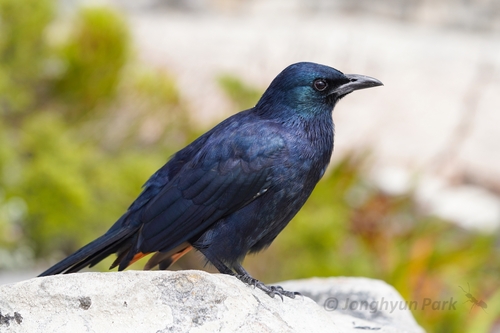
Greater Blue-eared Starling

Greater Blue-eared Starling

Lamprotornis chalybaeus

Silhouette: Rafael Maia · PhyloPic

LCLeast ConcernNTVUENCR
Daily sighting probability <5% · Rare
at Serengeti National Park

In 3 days ~10% in a week ~30%

127 Verified sightings at Serengeti National Park From 2019 to 2026
10,799 In all 36 parks
November Best month
☀️ Diurnal When it's spotted

About the Greater Blue-eared Starling

The greater blue-eared starling or greater blue-eared glossy-starling (Lamprotornis chalybaeus) is a bird that breeds from Senegal east to Ethiopia and south through eastern Africa to northeastern South Africa and Angola. It is a very common species of open woodland bird, and undertakes some seasonal migration.

There are four accepted subspecies: Lamprotornis chalybaeus chalybaeus — Sahel region Lamprotornis chalybaeus cyaniventris — northeastern Africa Lamprotornis chalybaeus nordmanni — southern Africa Lamprotornis chalybaeus scyobius — central and East Africa

The greater blue-eared starling is a 22 cm long, short tailed bird. This starling is glossy blue-green with a purple-blue belly and blue ear patch. Its iris is bright yellow or orange. The sexes are similar, but the juvenile is duller and has blackish brown underparts.

The populations from southern Kenya southwards are smaller than northern birds and are sometimes considered to be a separate subspecies, L. c. sycobius. The lesser blue-eared starling is similar to this species, but the blue of the belly does not extend forward of the legs.

The greater blue-eared starling has a range of musical... Wikipedia →

Sounds

Call0:26

Botswana · 2026

© Ehren Eksteen · XC1187096 · CC BY-NC-SA 4.0

Song0:08

Kenya · 2023

© isaac kilusu · XC794135 · CC BY-NC-SA 4.0

Alarm call0:12

South Africa · 2019

© Daniel Danckwerts · XC525287 · CC BY-NC-SA 4.0

Global Distribution

Parks Where Found

# Park Country Daily sighting probability
1 Lake Nakuru National Park 🇰🇪 Kenya
~60%
2 Akagera National Park 🇷🇼 Rwanda
~60%
3 Kruger National Park 🇿🇦 South Africa
~50%
4 Awash National Park 🇪🇹 Ethiopia
~50%
5 Gonarezhou National Park 🇿🇼 Zimbabwe
~40%
6 Mikumi National Park 🇹🇿 Tanzania
~40%
7 Kidepo Valley National Park 🇺🇬 Uganda
~30%
8 Kafue National Park 🇿🇲 Zambia
~30%
9 Moremi Game Reserve 🇧🇼 Botswana
~30%
10 Hwange National Park 🇿🇼 Zimbabwe
~30%
11 Masai Mara National Reserve 🇰🇪 Kenya
~30%
12 Liwonde National Park 🇲🇼 Malawi
~20%
13 Chobe National Park 🇧🇼 Botswana
~20%
14 Meru National Park 🇰🇪 Kenya
~20%
15 Lake Mburo National Park 🇺🇬 Uganda
~20%
16 South Luangwa National Park 🇿🇲 Zambia
~20%
17 Mkomazi National Park 🇹🇿 Tanzania
~20%
18 Ruaha National Park 🇹🇿 Tanzania
~20%
19 Niokolo-Koba National Park 🇸🇳 Senegal
~10%
20 Tsavo West National Park 🇰🇪 Kenya
~10%
21 Tsavo East National Park 🇰🇪 Kenya
~10%
22 Nairobi National Park 🇰🇪 Kenya
~10%
23 Virunga National Park 🇨🇩 Democratic Republic of the Congo
~10%
24 Serengeti National Park 🇹🇿 Tanzania
<5%
25 Aberdare National Park 🇰🇪 Kenya
<5%
26 Gorongosa National Park 🇲🇿 Mozambique
<5%
27 Lower Zambezi National Park 🇿🇲 Zambia
<5%
28 Murchison Falls National Park 🇺🇬 Uganda
<5%
29 Tarangire National Park 🇹🇿 Tanzania
<5%
30 Pilanesberg National Park 🇿🇦 South Africa
<5%
31 Samburu National Reserve 🇰🇪 Kenya
<5%
32 Mana Pools National Park 🇿🇼 Zimbabwe
<5%
33 Amboseli National Park 🇰🇪 Kenya
<5%
34 Ngorongoro Conservation Area 🇹🇿 Tanzania
<5%
35 Queen Elizabeth National Park 🇺🇬 Uganda
<5%
36 Bwindi Impenetrable National Park 🇺🇬 Uganda
<5%

Cities Where Found

# City Country Daily sighting probability
1 Maiduguri 🇳🇬 Nigeria
~90%
2 Harare 🇿🇼 Zimbabwe
~20%
3 Accra 🇬🇭 Ghana
~10%
4 Serrekunda 🇬🇲 Gambia
<5%
5 Dakar 🇸🇳 Senegal
<5%
6 Addis Ababa 🇪🇹 Ethiopia
<5%
7 Mombasa 🇰🇪 Kenya
<5%
8 Nairobi 🇰🇪 Kenya
<5%
9 Kigali 🇷🇼 Rwanda
<5%
10 Kampala 🇺🇬 Uganda
<5%

Zoos & Centres Where Found

# Zoo / Centre Country
1 San Diego Zoo 🇺🇸 United States In captivity
2 ZooParc de Beauval 🇫🇷 France In captivity
3 Zoorasia 🇯🇵 Japan In captivity
4 Warsaw Zoo 🇵🇱 Poland In captivity
5 Lisbon Zoo 🇵🇹 Portugal In captivity
6 San Antonio Zoo 🇺🇸 United States In captivity
7 Sapporo Maruyama Zoo 🇯🇵 Japan In captivity
8 Attica Zoological Park 🇬🇷 Greece In captivity
9 Ueno Zoo 🇯🇵 Japan In captivity
10 Bird Paradise 🇸🇬 Singapore In captivity
11 Faunia 🇪🇸 Spain In captivity
12 Rainforest Wild Asia 🇸🇬 Singapore In captivity
13 Tiergarten Straubing 🇩🇪 Germany In captivity
14 Monkeyland 🇿🇦 South Africa In captivity
15 Santillana Zoo 🇪🇸 Spain In captivity
16 Tierpark Walldorf 🇩🇪 Germany In captivity
17 Birds of Eden 🇿🇦 South Africa In captivity
18 herpetarium warszawskiego ZOO 🇵🇱 Poland In captivity
19 akwarium warszawskiego ZOO 🇵🇱 Poland In captivity
20 hipopotamiarnia i akwarium morskie warszawskiego ZOO 🇵🇱 Poland In captivity

Before you go

What are the chances of seeing a Greater Blue-eared Starling in Serengeti National Park?

Rare

Under 5% of wildlife watchers report a Greater Blue-eared Starling sighting in Serengeti National Park on a given day, based on 127 verified sightings from GBIF citizen-science data from 2019 to 2026. It is the 241st most-seen of the 469 birds we can rate there. Over three days the chance rises to about 10%, and over a week to about 30%, if each day is a fresh chance.

When is the best time to see a Greater Blue-eared Starling in Serengeti National Park?

June to December

In those months about 10% of wildlife watchers report a Greater Blue-eared Starling in Serengeti National Park on a given day, against under 5% in January to May, the lowest months.

What time of day is best to see a Greater Blue-eared Starling?

Between 8 and 11 am

Across all the parks we cover, that three-hour window holds the most Greater Blue-eared Starling sightings with a recorded time, and about 9 in 10 of them come between 6 am and 6 pm: it is a daytime animal.

Which relatives of the Greater Blue-eared Starling live in Serengeti National Park?

Same genus: Lamprotornis

The closest relatives of the Greater Blue-eared Starling that you can see in Serengeti National Park (genus Lamprotornis, Glossy Starlings and Allies) are Superb Starling (about 70%), Hildebrandt's Starling (about 50%) and Rüppell's Glossy-starling (about 50%), with each one's daily chance of a sighting.

Where does the Greater Blue-eared Starling sighting chance come from?

GBIF citizen-science records

It is estimated from how often the Greater Blue-eared Starling is recorded against all the birds logged in Serengeti National Park (127 verified sightings from 2019 to 2026), calibrated against known sighting rates. Figures are rounded to the nearest 10% because citizen-science data supports honest approximations, not decimals, and months with records from fewer than five people show "—". How it works.

← Back to Serengeti National Park