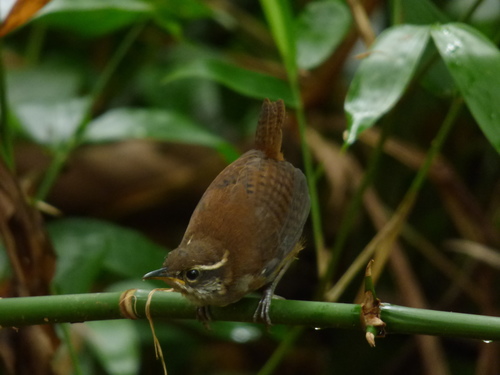
Thrush-like Wren

Thrush-like Wren

Campylorhynchus turdinus

Silhouette: Andy Wilson · PhyloPic

LCLeast ConcernNTVUENCR
Daily sighting probability ~20% · Possible
at Sierra de la Macarena National Park

In 3 days ~40% in a week ~70%

159 Verified sightings at Sierra de la Macarena National Park From 2019 to 2026
7,424 In all 12 parks
May Best month
☀️ Diurnal When it's spotted

About the Thrush-like Wren

The thrush-like wren (Campylorhynchus turdinus) is a South American species of bird in the family Troglodytidae, the wrens. As suggested by its common and scientific name, its size and coloration are vaguely reminiscent of that of a thrush, although the general impression it gives in life is very different and not at all "thrush-like".

With a total length of approximately 20 cm (8 in), it is among the largest species of wrens. The head and mantle are brownish-gray. The wings and upper tail are dull brown with dense blackish barring. The whitish underparts are heavily spotted with dusky, except on the throat. It typically shows a distinctive whitish eyebrow and the relatively long tail is commonly held cocked. The slightly decurved bill is relatively long, and, for a wren, thick. The irides are dull amber, maroon or brown.

Unlike most other wrens, it is typically found from mid-levels to canopy height. Despite its size, it is relatively inconspicuous, and usually revealed only by its loud, complex voice, which is highly characteristic. It feeds primarily on insects, but will also take vegetable matter and small invertebrates. Typically forages in pairs or small groups. Wikipedia →

Sounds

Alarm call1:10

Ecuador · 2026

© Manuel Sánchez-Nivicela · XC1182232 · CC BY-NC-ND 4.0

Duet0:19

Brazil · 2026

© JAYRSON ARAUJO DE OLIVEIRA · XC1162090 · CC BY-NC-SA 4.0

Call0:40

Brazil · 2025

© Joost van Bruggen · XC1050629 · CC BY-NC-ND 4.0

Global Distribution

Parks Where Found

# Park Country Daily sighting probability
1 Iguazú National Park 🇦🇷 Argentina
~40%
2 Parque Estadual Encontro das Águas 🇧🇷 Brazil
~40%
3 Iguaçu National Park 🇧🇷 Brazil
~40%
4 Chapada dos Guimarães National Park 🇧🇷 Brazil
~40%
5 Amacayacu National Natural Park 🇨🇴 Colombia
~30%
6 Yasuní National Park 🇪🇨 Ecuador
~30%
7 Tambopata National Reserve 🇵🇪 Peru
~20%
8 Cuyabeno Wildlife Reserve 🇪🇨 Ecuador
~20%
9 Sierra de la Macarena National Park 🇨🇴 Colombia
~20%
10 Manu National Park 🇵🇪 Peru
~10%
11 Amboró National Park 🇧🇴 Bolivia
<5%
12 Podocarpus National Park 🇪🇨 Ecuador
<5%

Cities Where Found

# City Country Daily sighting probability
1 Campo Grande 🇧🇷 Brazil
~60%
2 Santa Cruz de la Sierra 🇧🇴 Bolivia
~50%
3 Asuncion 🇵🇾 Paraguay
~40%

Before you go

What are the chances of seeing a Thrush-like Wren in Sierra de la Macarena National Park?

Possible

About 20% of wildlife watchers report a Thrush-like Wren sighting in Sierra de la Macarena National Park on a given day, based on 159 verified sightings from GBIF citizen-science data from 2019 to 2026. It is the 72nd most-seen of the 418 birds we can rate there. Over three days the chance rises to about 40%, and over a week to about 70%, if each day is a fresh chance.

When is the best time to see a Thrush-like Wren in Sierra de la Macarena National Park?

May

In that month about 30% of wildlife watchers report a Thrush-like Wren in Sierra de la Macarena National Park on a given day, against about 10% in January–April, June–July and September–November, the lowest months. That is one of Sierra de la Macarena National Park's wettest months, with about 430 mm of rain against 95 mm in January.

What time of day is best to see a Thrush-like Wren?

Between 7 and 10 am

Across all the parks we cover, that three-hour window holds the most Thrush-like Wren sightings with a recorded time, and about 8 in 10 of them come between 6 am and 6 pm: it is a daytime animal.

Which relatives of the Thrush-like Wren live in Sierra de la Macarena National Park?

Same family: Troglodytidae

The closest relatives of the Thrush-like Wren that you can see in Sierra de la Macarena National Park (family Troglodytidae, Wrens) are Southern House Wren (about 40%), Scaly-breasted Wren (about 20%) and Rufous-and-white Wren (about 10%), with each one's daily chance of a sighting.

Where does the Thrush-like Wren sighting chance come from?

GBIF citizen-science records

It is estimated from how often the Thrush-like Wren is recorded against all the birds logged in Sierra de la Macarena National Park (159 verified sightings from 2019 to 2026), calibrated against known sighting rates. Figures are rounded to the nearest 10% because citizen-science data supports honest approximations, not decimals, and months with records from fewer than five people show "—". How it works.

← Back to Sierra de la Macarena National Park