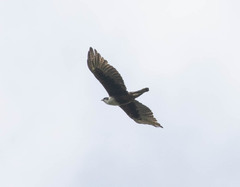
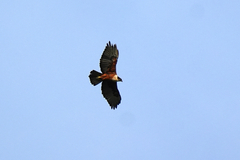
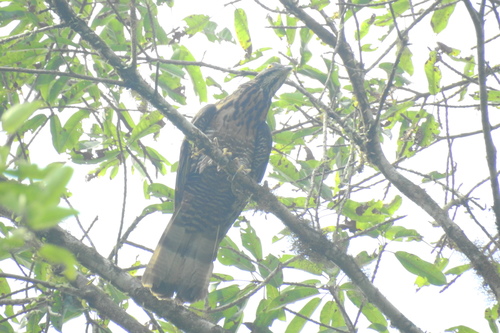
Rufous-bellied Eagle

Rufous-bellied Eagle

Lophotriorchis kienerii

Silhouette: Sheatherius · PhyloPic

LCNTNear ThreatenedVUENCR
Daily sighting probability <5% · Rare
at Tangkoko Nature Reserve

In 3 days ~10% in a week ~20%

30 Verified sightings at Tangkoko Nature Reserve From 2019 to 2026
1,394 In all 24 parks
February Best month
☀️ Diurnal When it's spotted

About the Rufous-bellied Eagle

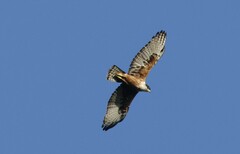
The rufous-bellied eagle or rufous-bellied hawk-eagle (Lophotriorchis kienerii) is a bird of prey in the family Accipitridae that is found in the forested regions of tropical Asia. Relatively small for eagles and contrastingly patterned like a falcon, this species was earlier placed in the genus Hieraaetus and sometimes also in the genus Aquila but thought to be distinctive enough to belong to a separate genus.

This eagle was described as Astur Kienerii and illustrated as Falco Kienerii by "G. S." (Gustave de Sparre, though sometimes erroneously attributed to Geoffroy Saint-Hilaire) in 1834–1835. De Sparre's description was based on a specimen from the Himalayas in the collection of "M. le prince d'Essling".

It was later moved to Limnaetus by Jerdon, the genus Lophotriorchis and still later to Hieraaetus, the so-called "hawk-eagles". A study of the phylogeny of some Hieraaetus species and other eagles indicated that they were nested within the Aquila clade of eagles, resulting in their repositioning. Another molecular study of the eagles suggested that kienerii was distinctive enough to be retained in a separate genus for which the name Kienastur had... Wikipedia →

Sounds

Flight call0:14

Philippines · 2024

© Greg Irving · XC896301 · CC BY-NC-SA 4.0

Call0:10

Sri Lanka · 2020

© Senehas Karunarathna · XC562500 · CC BY-NC-SA 4.0

Pair calling in diving display flight0:27

Indonesia · 2006

© Paul Noakes · XC22445 · CC BY-NC-ND 2.5

Global Distribution

Parks Where Found

# Park Country Daily sighting probability
1 Royal Manas National Park 🇧🇹 Bhutan
~10%
2 Periyar National Park 🇮🇳 India
~10%
3 Kerinci Seblat National Park 🇮🇩 Indonesia
~10%
4 Sepilok 🇲🇾 Malaysia
~10%
5 Manas National Park 🇮🇳 India
~10%
6 Khao Yai National Park 🇹🇭 Thailand
~10%
7 Khao Sok National Park 🇹🇭 Thailand
<5%
8 Danum Valley Conservation Area 🇲🇾 Malaysia
<5%
9 Namdapha National Park 🇮🇳 India
<5%
10 Kaeng Krachan National Park 🇹🇭 Thailand
<5%
11 Tangkoko Nature Reserve 🇮🇩 Indonesia
<5%
12 Khao Luang National Park 🇹🇭 Thailand
<5%
13 Taman Negara National Park 🇲🇾 Malaysia
<5%
14 Sinharaja Forest Reserve 🇱🇰 Sri Lanka
<5%
15 Kinabatangan Wildlife Sanctuary 🇲🇾 Malaysia
<5%
16 Jim Corbett National Park 🇮🇳 India
<5%
17 Eravikulam National Park 🇮🇳 India
<5%
18 Bandhavgarh National Park 🇮🇳 India
<5%
19 Mudumalai National Park 🇮🇳 India
<5%
20 Kinabalu Park 🇲🇾 Malaysia
<5%
21 Kanha National Park 🇮🇳 India
<5%
22 Bandipur National Park 🇮🇳 India
<5%
23 Nagarhole National Park 🇮🇳 India
<5%
24 Doi Inthanon National Park 🇹🇭 Thailand
<5%

Cities Where Found

# City Country Daily sighting probability
1 Thrissur 🇮🇳 India
<5%
2 Singapore 🇸🇬 Singapore
<5%
3 Kuala Lumpur 🇲🇾 Malaysia
<5%
4 Manila 🇵🇭 Philippines
<5%

Before you go

What are the chances of seeing a Rufous-bellied Eagle in Tangkoko Nature Reserve?

Rare

Under 5% of wildlife watchers report a Rufous-bellied Eagle sighting in Tangkoko Nature Reserve on a given day, based on 30 verified sightings from GBIF citizen-science data from 2019 to 2026. It is the 97th most-seen of the 138 birds we can rate there. Over three days the chance rises to about 10%, and over a week to about 20%, if each day is a fresh chance.

When is the best time to see a Rufous-bellied Eagle in Tangkoko Nature Reserve?

February

In that month about 10% of wildlife watchers report a Rufous-bellied Eagle in Tangkoko Nature Reserve on a given day, against under 5% in March to January, the lowest months.

What time of day is best to see a Rufous-bellied Eagle?

Between 8 and 11 am

Across all the parks we cover, that three-hour window holds the most Rufous-bellied Eagle sightings with a recorded time, and about 9 in 10 of them come between 6 am and 6 pm: it is a daytime animal.

Which relatives of the Rufous-bellied Eagle live in Tangkoko Nature Reserve?

Same family: Accipitridae

The closest relatives of the Rufous-bellied Eagle that you can see in Tangkoko Nature Reserve (family Accipitridae, Hawks, Eagles, and Kites) are Brahminy Kite (about 30%), Sulawesi Hawk-Eagle (about 20%) and White-Bellied Sea-Eagle (about 20%), with each one's daily chance of a sighting.

Where does the Rufous-bellied Eagle sighting chance come from?

GBIF citizen-science records

It is estimated from how often the Rufous-bellied Eagle is recorded against all the birds logged in Tangkoko Nature Reserve (30 verified sightings from 2019 to 2026), calibrated against known sighting rates. Figures are rounded to the nearest 10% because citizen-science data supports honest approximations, not decimals, and months with records from fewer than five people show "—". How it works.

← Back to Tangkoko Nature Reserve