Black-collared Hawk

Black-collared Hawk

Busarellus nigricollis

Silhouette: Sheatherius · PhyloPic

LCLeast ConcernNTVUENCR
Daily sighting probability ~10% · With luck
at Tortuguero National Park

In 3 days ~20% in a week ~50%

337 Verified sightings at Tortuguero National Park From 2019 to 2026
2,554 In all 13 parks
July Best month
☀️ Diurnal When it's spotted

About the Black-collared Hawk

The black-collared hawk (Busarellus nigricollis) is a species of bird of prey in the family Accipitridae. It is monotypic within the genus Busarellus. It has a widespread range of presence, from western Mexico to Uruguay. Its natural habitats are subtropical or tropical moist lowland forests, subtropical or tropical swamps, and swamps.

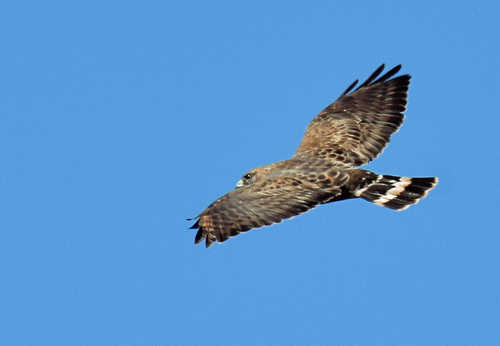
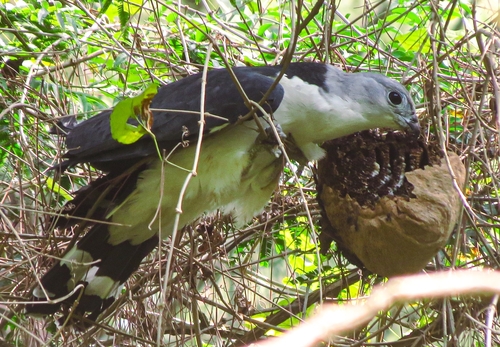
The adult black-collared hawk has a more or less white head, tinged with buff, and with black shaft streaks on the crown. The body, above and below, and the mantle are bright cinnamon-rufous, paler on the chest. There is a black crescent on the upper breast. The back has scattered black shaft stripes; the flight and tail feathers are black with the base of the tail barred with rufous. The eyes are bright reddish brown, the cere and bill black, and the legs bluish white. Immatures are similar, but blotched with black, including on the crown, and the rufous barring on the tail is more extensive. The pale area on the chest is also more clearly marked. The upper surface of the wings is barred, and the eyes are brown.

The nest is usually placed in a large tree, frequently near water, but sometimes in shade trees in coffee plantations or suburban areas. The nest is lined with green leaves. The female lays three to five eggs, dull white, spotted with pale yellow-brown or red-brown and a few darker freckles. There is no further information on its reproduction.

The black-collared hawk lives on a diet mainly composed of fish. It also eats water bugs and occasionally other large insects, snakes, lizards, frogs, snails, other molluscs, crustaceans, small birds and nestlings, rodents and other small mammals.

In the 1870s, Ridgeway wrote that Busarellus (then known as Ichthyoborus) had the "general form and appearance of Buteogallus aequinoctialis", but that it "is much more nearly related to the heliatine groups", in which he included Milvus, Haliastur, and Haliaaetus. During the early-to-mid 20th century, Busarellus was conventionally placed near Buteogallus in taxonomic order.

The black-collared hawk has the basal phalanges of the inner toe fused, which may be an adaptation to prevent the toe from bending back when catching prey. This feature is shared with Ictinia and with the group of true milvine kites and sea eagles (Milvus, Haliastur, Haliaaetus, and Icthyophaga). Research in molecular phylogenetics during the early 21st century indicates that there is a clear milvine–haliaetine clade that is related to a large group of buteonine hawks and their relatives. Wikipedia →

Sounds

Call0:20

Brazil · 2025

© Joost van Bruggen · XC1050433 · CC BY-NC-ND 4.0

Subsong0:05

Bolivia · 2021

© Jacob Wijpkema · XC655671 · CC BY-NC-SA 4.0

Flight call0:04

Brazil · 2020

© Jerome Fischer · XC592751 · CC BY-NC-SA 4.0

Global Distribution

Parks Where Found

# Park Country Daily sighting probability
1 Parque Estadual Encontro das Águas 🇧🇷 Brazil
~70%
2 Iberá National Park 🇦🇷 Argentina
~20%
3 Amacayacu National Natural Park 🇨🇴 Colombia
~20%
4 Tortuguero National Park 🇨🇷 Costa Rica
~10%
5 Anavilhanas National Park 🇧🇷 Brazil
~10%
6 El Impenetrable National Park 🇦🇷 Argentina
~10%
7 Manu National Park 🇵🇪 Peru
<5%
8 Darién National Park 🇵🇦 Panama
<5%
9 Cuyabeno Wildlife Reserve 🇪🇨 Ecuador
<5%
10 Tikal National Park 🇬🇹 Guatemala
<5%
11 Yasuní National Park 🇪🇨 Ecuador
<5%
12 Tambopata National Reserve 🇵🇪 Peru
<5%
13 Soberanía National Park 🇵🇦 Panama
<5%

Cities Where Found

# City Country Daily sighting probability
1 Barranquilla 🇨🇴 Colombia
~10%
2 Santa Cruz de la Sierra 🇧🇴 Bolivia
~10%
3 Asuncion 🇵🇾 Paraguay
<5%
4 Campo Grande 🇧🇷 Brazil
<5%

Zoos & Centres Where Found

# Zoo / Centre Country
1 Aviario Nacional de Colombia 🇨🇴 Colombia In captivity

Before you go

What are the chances of seeing a Black-collared Hawk in Tortuguero National Park?

With luck

About 10% of wildlife watchers report a Black-collared Hawk sighting in Tortuguero National Park on a given day, based on 337 verified sightings from GBIF citizen-science data from 2019 to 2026. It is the 110th most-seen of the 348 birds we can rate there. Over three days the chance rises to about 20%, and over a week to about 50%, if each day is a fresh chance.

When is the best time to see a Black-collared Hawk in Tortuguero National Park?

July

In that month about 20% of wildlife watchers report a Black-collared Hawk in Tortuguero National Park on a given day, against under 5% in January and March, the lowest months. That is one of Tortuguero National Park's wettest months, with about 540 mm of rain against 160 mm in March.

What time of day is best to see a Black-collared Hawk?

Between 7 and 10 am

Across all the parks we cover, that three-hour window holds the most Black-collared Hawk sightings with a recorded time, and about 9 in 10 of them come between 6 am and 6 pm: it is a daytime animal.

Which relatives of the Black-collared Hawk live in Tortuguero National Park?

Same family: Accipitridae

The closest relatives of the Black-collared Hawk that you can see in Tortuguero National Park (family Accipitridae, Hawks, Eagles, and Kites) are Common Black-Hawk (about 40%), Roadside Hawk (about 10%) and Broad-winged Hawk (about 10%), with each one's daily chance of a sighting.

Where does the Black-collared Hawk sighting chance come from?

GBIF citizen-science records

It is estimated from how often the Black-collared Hawk is recorded against all the birds logged in Tortuguero National Park (337 verified sightings from 2019 to 2026), calibrated against known sighting rates. Figures are rounded to the nearest 10% because citizen-science data supports honest approximations, not decimals, and months with records from fewer than five people show "—". How it works.

← Back to Tortuguero National Park