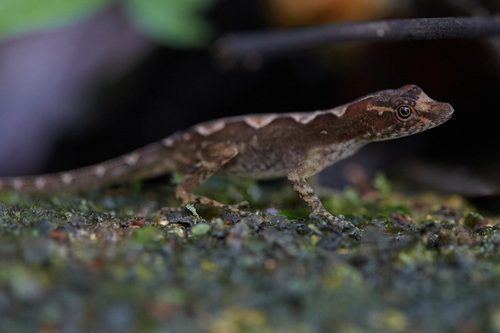
Turniptail Gecko

Turniptail Gecko

Thecadactylus rapicauda

Silhouette: Jose Carlos Arenas-Monroy · PhyloPic

LCLeast ConcernNTVUENCR
Daily sighting probability ~10% · With luck
at Tortuguero National Park

In 3 days ~30% in a week ~60%

8 Verified sightings at Tortuguero National Park From 2019 to 2026
549 In all 18 parks
November Best month
🌙 Nocturnal When it's spotted

About the Turniptail Gecko

The turnip-tailed gecko (Thecadactylus rapicauda) is a species of gecko widely distributed from Mexico southward through Central America and into South America as far south as Brazil, and on many islands in the Lesser Antilles. It was long thought to be the only member of its genus, until T. solimoensis was described in 2007.

It is a large gecko, reaching a length of 120 mm snout-to-vent. Its color varies from pale to dark gray to deep orange. Individuals can also change color. It can vocalize a series of chirps, which it mainly does while active at night. Its name comes from its swollen tail, which is used to store fat. It also waves its tail as a sign of aggression, and can shed its tail to distract predators. They are nocturnal in nature and are frequently found 5–30 feet up the trunks of palm trees.

It is called tai-marɛɁa in the Kwaza language of Rondônia, Brazil. Predators of T. rapicauda include the phyllostomid bat, Chrotopterus auritus. Parasites of T. rapicauda include the malarial parasite Plasmodium aurulentum.

Media related to Thecadactylus rapicauda at Wikimedia Commons Thecadactylus... Wikipedia →

Global Distribution

Parks Where Found

# Park Country Daily sighting probability
1 Main Ridge Forest Reserve 🇹🇹 Trinidad and Tobago
~60%
2 Brownsberg Nature Park 🇸🇷 Suriname
~60%
3 Tayrona National Natural Park 🇨🇴 Colombia
~40%
4 Piedras Blancas National Park 🇨🇷 Costa Rica
~40%
5 Braulio Carrillo National Park 🇨🇷 Costa Rica
~40%
6 Gandoca-Manzanillo Wildlife Refuge 🇨🇷 Costa Rica
~30%
7 Pico Bonito National Park 🇭🇳 Honduras
~30%
8 Corcovado National Park 🇨🇷 Costa Rica
~20%
9 Marino Ballena National Park 🇨🇷 Costa Rica
~20%
10 Calakmul Biosphere Reserve 🇲🇽 Mexico
~20%
11 Carara National Park 🇨🇷 Costa Rica
~20%
12 Cerro Azul Meámbar National Park 🇭🇳 Honduras
~20%
13 Soberanía National Park 🇵🇦 Panama
~10%
14 Arenal Volcano National Park 🇨🇷 Costa Rica
~10%
15 Tortuguero National Park 🇨🇷 Costa Rica
~10%
16 Manuel Antonio National Park 🇨🇷 Costa Rica
~10%
17 Parque Natural Metropolitano 🇵🇦 Panama
~10%
18 La Amistad International Park (Panama) 🇵🇦 Panama
<5%

Before you go

What are the chances of seeing a Turniptail Gecko in Tortuguero National Park?

With luck

About 10% of wildlife watchers report a Turniptail Gecko sighting in Tortuguero National Park on a given day, based on 8 verified sightings from GBIF citizen-science data from 2019 to 2026. It is the 30th most-seen of the 34 reptiles we can rate there. Over three days the chance rises to about 30%, and over a week to about 60%, if each day is a fresh chance.

When is the best time to see a Turniptail Gecko in Tortuguero National Park?

November

In that month about 30% of wildlife watchers report a Turniptail Gecko in Tortuguero National Park on a given day, against under 5% in February–March, June–July and September–October, the lowest months. That is one of Tortuguero National Park's wettest months, with about 530 mm of rain against 160 mm in March.

What time of day is best to see a Turniptail Gecko?

Between 7 and 10 pm

Across all the parks we cover, that three-hour window holds the most Turniptail Gecko sightings with a recorded time, and about 7 in 10 of them come between 6 pm and 6 am: it is mostly seen at night.

Where does the Turniptail Gecko sighting chance come from?

GBIF citizen-science records

It is estimated from how often the Turniptail Gecko is recorded against all the reptiles logged in Tortuguero National Park (8 verified sightings from 2019 to 2026), calibrated against known sighting rates. Figures are rounded to the nearest 10% because citizen-science data supports honest approximations, not decimals, and months with records from fewer than five people show "—". How it works.

← Back to Tortuguero National Park