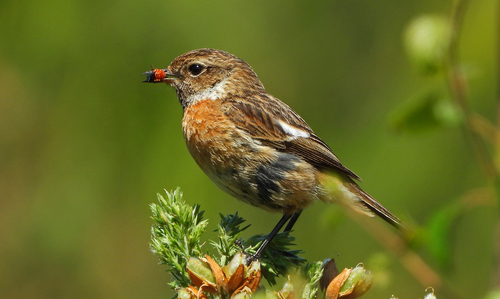
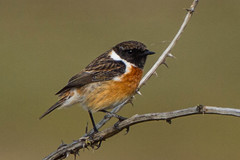
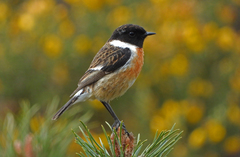
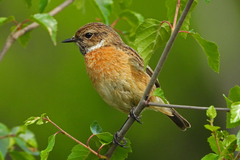
About the European Stonechat
The European stonechat (Saxicola rubicola) is a small passerine bird that was formerly classed as a subspecies of the common stonechat. Long considered a member of the thrush family, Turdidae, genetic evidence has placed it and its relatives in the Old World flycatcher family, Muscicapidae. It is found across Europe, as far east as Ukraine and the South Caucasus, and in parts of North Africa.
The European stonechat was formally described by the Swedish naturalist Carl Linnaeus in 1766 in the twelfth edition of his Systema Naturae under the binomial name Motacilla rubicola. This species is now placed in the genus Saxicola that was introduced by the German naturalist Johann Matthäus Bechstein in 1802. The English name derives from its call, sounding like two stones knocked together. The scientific name Saxicola means "rock-dweller", from Latin saxum meaning "a rock" and incola meaning "dwelling in". The specific epithet combines the Latin rubus meaning "brambles" with incola. The subspecies name hibernans refers to Ireland (Latin, Hibernia).
In the past, the European stonechat was generally considered conspecific with the Siberian stonechat and African stonechat... Wikipedia →