Australian Raven

Australian Raven

Corvus coronoides

Silhouette: Peileppe · PhyloPic

LCLeast ConcernNTVUENCR Endemic
Daily sighting probability ~10% · With luck
at Uluru-Kata Tjuta National Park

In 3 days ~10% in a week ~30%

19 Verified sightings at Uluru-Kata Tjuta National Park From 2019 to 2026
6,699 In all 11 parks
August Best month
☀️ Diurnal When it's spotted

About the Australian Raven

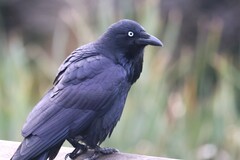
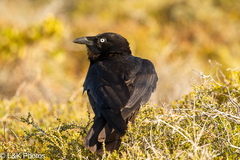
The Australian raven (Corvus coronoides) is a passerine corvid bird native to Australia. Measuring 46–53 centimetres (18–21 in) in length, it has an all-black plumage, beak and mouth, as well as strong, greyish-black legs and feet. The upperparts of its body are glossy, with a purple-blue, greenish sheen; its black feathers have grey bases. The Australian raven is distinguished from the Australian crow, and other related corvids, by its long chest feathers, or throat hackles, which are prominent in mature birds. Older individuals and subadults have white irises, while the younger birds' eyes display blue inner rims; hatchlings and young birds have brown, dark irises until about fifteen months of age, at which point their irises become hazel-coloured, with an inner blue rim around each pupil, this lasting until they are roughly 2.5 to 3 years of age. Nicholas Aylward Vigors and Thomas Horsfield described the Australian raven in 1827, its species name coronoides highlighting its similarity with the carrion crow (C. corone). Two subspecies are recognised, which differ slightly in their vocalisations, and are quite divergent, genetically.

The preferred habitat of the Australian raven includes open woodlands and transitional zones, in addition to cities and towns; it has adapted well to human settlements and other urban environments, and is a commonly sighted bird in several major cities, including Sydney, Canberra, Perth, Adelaide and Brisbane. The Australian raven is territorial, with pairs generally bonding for life. Breeding takes place between July and September, with almost no variation across its range. The nest is a bowl-shaped structure of sticks sited high in a tree, or occasionally in a man-made structure such as a windmill or other building.

An omnivorous and opportunistic feeder, the Australian raven eats a wide variety of plant and animal material, from fruits and seeds to lizards, chicks of other bird species, and small mammals; they will also scour waste bins and disposal sites for human food waste, such as various produce, meats, seafood, eggs, etc. The ravens living in eastern Australia are often associated with sheep farms, and have been blamed for the killing of lambs; however, this is an exceedingly rare occurrence, as the ravens are likely seeking the afterbirth from ewes that may have recently given birth. Wikipedia →

Sounds

Call0:43

Australia · 2024

© Romuald Mikusek · XC1173701 · CC BY-NC-SA 4.0

Uncertain0:57

Australia · 2026

© JJSUN · XC1088192 · CC BY-NC-SA 4.0

Song0:34

Australia · 2025

© Hugo Caverzasi · XC995299 · CC BY-NC-SA 4.0

Global Distribution

Parks Where Found

# Park Country Daily sighting probability
1 Rottnest Island 🇦🇺 Australia
~90%
2 Flinders Ranges National Park 🇦🇺 Australia
~80%
3 Royal National Park 🇦🇺 Australia
~70%
4 Hattah-Kulkyne National Park 🇦🇺 Australia
~50%
5 Kosciuszko National Park 🇦🇺 Australia
~50%
6 Flinders Chase 🇦🇺 Australia
~50%
7 Booderee National Park 🇦🇺 Australia
~40%
8 Blue Mountains National Park 🇦🇺 Australia
~40%
9 Grampians National Park 🇦🇺 Australia
~20%
10 Wilsons Promontory National Park 🇦🇺 Australia
~10%
11 Uluru-Kata Tjuta National Park 🇦🇺 Australia
~10%

Cities Where Found

# City Country Daily sighting probability
1 Perth 🇦🇺 Australia
~90%
2 Sydney 🇦🇺 Australia
~70%
3 Melbourne 🇦🇺 Australia
<5%

Zoos & Centres Where Found

# Zoo / Centre Country
1 Kangaroo Island Wildlife Park 🇦🇺 Australia In captivity

Before you go

What are the chances of seeing an Australian Raven in Uluru-Kata Tjuta National Park?

With luck

About 10% of wildlife watchers report an Australian Raven sighting in Uluru-Kata Tjuta National Park on a given day, based on 19 verified sightings from GBIF citizen-science data from 2019 to 2026. It is the 57th most-seen of the 84 birds we can rate there. Over three days the chance rises to about 10%, and over a week to about 30%, if each day is a fresh chance.

When is the best time to see an Australian Raven in Uluru-Kata Tjuta National Park?

March–April and July–September

In those months about 10% of wildlife watchers report an Australian Raven in Uluru-Kata Tjuta National Park on a given day, against under 5% in May–June and October–February, the lowest months. Those are among Uluru-Kata Tjuta National Park's driest months, with about 10 mm of rain a month against 65 mm in January.

What time of day is best to see an Australian Raven?

Between 1 and 4 pm

Across all the parks we cover, that three-hour window holds the most Australian Raven sightings with a recorded time, and nearly all of them come between 6 am and 6 pm: it is a daytime animal.

Which relatives of the Australian Raven live in Uluru-Kata Tjuta National Park?

Same genus: Corvus

The closest relatives of the Australian Raven that you can see in Uluru-Kata Tjuta National Park (genus Corvus, Crows and Ravens) are Torresian Crow (about 10%) and Little Crow (about 10%), with each one's daily chance of a sighting.

Where does the Australian Raven sighting chance come from?

GBIF citizen-science records

It is estimated from how often the Australian Raven is recorded against all the birds logged in Uluru-Kata Tjuta National Park (19 verified sightings from 2019 to 2026), calibrated against known sighting rates. Figures are rounded to the nearest 10% because citizen-science data supports honest approximations, not decimals, and months with records from fewer than five people show "—". How it works.

← Back to Uluru-Kata Tjuta National Park