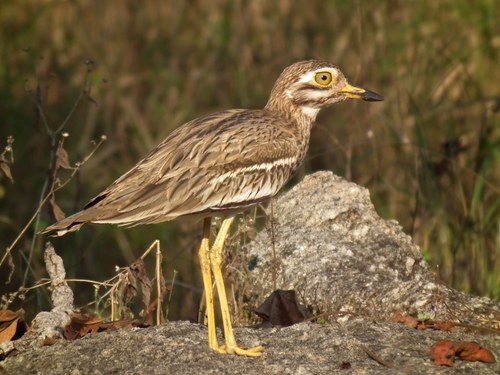
Great Thick-knee

Great Thick-knee

Esacus recurvirostris

Silhouette: Auckland Museum · PhyloPic

LCNTNear ThreatenedVUENCR
Daily sighting probability ~40% · Likely
at Wilpattu National Park

In 3 days ~70% in a week >90%

227 Verified sightings at Wilpattu National Park From 2019 to 2026
1,624 In all 12 parks
April Best month
🌅 Crepuscular When it's spotted

About the Great Thick-knee

The great stone-curlew or great thick-knee (Esacus recurvirostris) is a large wader which is a resident breeder in tropical southern Asia from India, Pakistan, Sri Lanka, Bangladesh into South-east Asia. The great stone-curlew was formally described in 1829 by the French naturalist Georges Cuvier and given the binomial name Oedicnemus recurvirostris. The type locality is Nepal. The specific epithet recurvirostris combines Latin recurvis meaning "bent backwards" with -rostris meaning "-billed". The species is now placed in the genus Esacus that was introduced in 1831 to accommodate the great stone-curlew by the French naturalist René Lesson. The species is monotypic: no subspecies are recognised.

The great thick-knee is a large wader at 49–55 cm, and has a massive 7 cm bill with the lower mandible with a sharp angle giving it an upturned appearance. It has unstreaked grey-brown upperparts and breast, with rest of the underparts whitish. The face has a striking black and white pattern, and the bill is black with a yellow base. The eyes are bright yellow and the legs a duller greenish-yellow. In flight, the great thick-knee shows black and white flight... Wikipedia →

Sounds

Call1:24

India · 2024

© Viral Patel & Pankaj Maheria · XC956752 · CC BY-NC-SA 4.0

Alarm call0:46

Iran · 2017

© Patrik Åberg · XC405184 · CC BY-NC-SA 4.0

Flight call0:24

Vietnam · 2023

© Paul Lenrumé · XC780764 · CC BY-NC-SA 4.0

Global Distribution

Parks Where Found

# Park Country Daily sighting probability
1 Yala National Park 🇱🇰 Sri Lanka
~40%
2 Wilpattu National Park 🇱🇰 Sri Lanka
~40%
3 Udawalawe National Park 🇱🇰 Sri Lanka
~20%
4 Ranthambore National Park 🇮🇳 India
~20%
5 Kaziranga National Park 🇮🇳 India
~10%
6 Satpura National Park 🇮🇳 India
~10%
7 Gir National Park 🇮🇳 India
~10%
8 Jim Corbett National Park 🇮🇳 India
<5%
9 Minneriya National Park 🇱🇰 Sri Lanka
<5%
10 Manas National Park 🇮🇳 India
<5%
11 Keoladeo National Park 🇮🇳 India
<5%
12 Kanha National Park 🇮🇳 India
<5%

Cities Where Found

# City Country Daily sighting probability
1 Coimbatore 🇮🇳 India
<5%
2 Kathmandu 🇳🇵 Nepal
<5%
3 Colombo [Sri Jayawardenepura Kotte] 🇱🇰 Sri Lanka
<5%

Before you go

What are the chances of seeing a Great Thick-knee in Wilpattu National Park?

Likely

About 40% of wildlife watchers report a Great Thick-knee sighting in Wilpattu National Park on a given day, based on 227 verified sightings from GBIF citizen-science data from 2019 to 2026. It is the 47th most-seen of the 169 birds we can rate there. Over three days the chance rises to about 70%, and over a week to over 90%, if each day is a fresh chance.

When is the best time to see a Great Thick-knee in Wilpattu National Park?

April and May

In those months about 50% of wildlife watchers report a Great Thick-knee in Wilpattu National Park on a given day, against about 20% in November, the lowest month.

What time of day is best to see a Great Thick-knee?

Between 4 and 7 am

Across all the parks we cover, that three-hour window holds the most Great Thick-knee sightings with a recorded time, and about half of them come between 6 am and 6 pm: it is most active around dawn and dusk.

Is Wilpattu National Park the best place to see a Great Thick-knee?

Among the best

Of the 12 parks where we can rate Great Thick-knee sightings, Wilpattu National Park ranks 2nd at about 40%, level with the leaders once rounded. The best odds are in Yala National Park (Sri Lanka, about 40%). All parks ranked.

Where does the Great Thick-knee sighting chance come from?

GBIF citizen-science records

It is estimated from how often the Great Thick-knee is recorded against all the birds logged in Wilpattu National Park (227 verified sightings from 2019 to 2026), calibrated against known sighting rates. Figures are rounded to the nearest 10% because citizen-science data supports honest approximations, not decimals, and months with records from fewer than five people show "—". How it works.

← Back to Wilpattu National Park