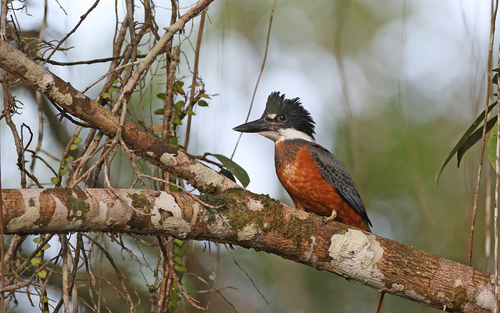
Green-and-rufous Kingfisher

Green-and-rufous Kingfisher

Chloroceryle inda

Silhouette: Steven Traver · PhyloPic

LCLeast ConcernNTVUENCR
Daily sighting probability ~20% · Possible
at Yasuní National Park

In 3 days ~50% in a week ~80%

640 Verified sightings at Yasuní National Park From 2019 to 2026
1,616 In all 14 parks
September Best month
☀️ Diurnal When it's spotted

About the Green-and-rufous Kingfisher

The green-and-rufous kingfisher (Chloroceryle inda) is a species of "water kingfisher" in subfamily Cerylinae of family Alcedinidae. It is found in the American tropics from Nicaragua to Panama and in every mainland South American country except Argentina, Chile, and Uruguay.

The first formal description of the green-and-rufous kingfisher was by the Swedish naturalist Carl Linnaeus in 1766 in the 12th edition of his Systema Naturae. He coined the binomial name Alcedo inda. Linnaeus based his description on George Edwards's "Spotted King's-Fisher" but mistakenly gave the type locality as India occidentali instead of Guiana. Linnaeus's specific epithet inda is from the Latin Indus for India. The current genus Chloroceryle was erected by Johann Jakob Kaup in 1848.

A molecular phylogenetic study published in 2006 found that the green-and-rufous kingfisher is a sister species to the smaller green kingfisher (C. americana). The green-and-rufous kingfisher is about 24 cm (9.4 in) long. Males weigh 40 to 60... Wikipedia →

Sounds

Call0:31

Ecuador · 2025

© Marc Anderson · XC981847 · CC BY-NC-ND 4.0

Song0:11

Brazil · 2024

© JAYRSON ARAUJO DE OLIVEIRA · XC901551 · CC BY-NC-SA 4.0

Flight call0:04

Colombia · 2021

© Mauricio Cuellar Ramirez (@Birding.travel) · XC636094 · CC BY-NC-SA 4.0

Global Distribution

Parks Where Found

# Park Country Daily sighting probability
1 Cuyabeno Wildlife Reserve 🇪🇨 Ecuador
~30%
2 Yasuní National Park 🇪🇨 Ecuador
~20%
3 Amacayacu National Natural Park 🇨🇴 Colombia
~10%
4 Anavilhanas National Park 🇧🇷 Brazil
~10%
5 Parque Estadual Encontro das Águas 🇧🇷 Brazil
<5%
6 Tortuguero National Park 🇨🇷 Costa Rica
<5%
7 Tambopata National Reserve 🇵🇪 Peru
<5%
8 Manu National Park 🇵🇪 Peru
<5%
9 Darién National Park 🇵🇦 Panama
<5%
10 Soberanía National Park 🇵🇦 Panama
<5%
11 Gandoca-Manzanillo Wildlife Refuge 🇨🇷 Costa Rica
<5%
12 Bastimentos Island National Marine Park 🇵🇦 Panama
<5%
13 Sierra de la Macarena National Park 🇨🇴 Colombia
<5%
14 La Amistad International Park (Panama) 🇵🇦 Panama
<5%

Cities Where Found

# City Country Daily sighting probability
1 Panama City 🇵🇦 Panama
<5%

Before you go

What are the chances of seeing a Green-and-rufous Kingfisher in Yasuní National Park?

Possible

About 20% of wildlife watchers report a Green-and-rufous Kingfisher sighting in Yasuní National Park on a given day, based on 640 verified sightings from GBIF citizen-science data from 2019 to 2026. It is the 82nd most-seen of the 533 birds we can rate there. Over three days the chance rises to about 50%, and over a week to about 80%, if each day is a fresh chance.

When is the best time to see a Green-and-rufous Kingfisher in Yasuní National Park?

September

In that month about 40% of wildlife watchers report a Green-and-rufous Kingfisher in Yasuní National Park on a given day, against about 10% in May, July and November–December, the lowest months.

What time of day is best to see a Green-and-rufous Kingfisher?

Between 8 and 11 am

Across all the parks we cover, that three-hour window holds the most Green-and-rufous Kingfisher sightings with a recorded time, and about 9 in 10 of them come between 6 am and 6 pm: it is a daytime animal.

Is Yasuní National Park the best place to see a Green-and-rufous Kingfisher?

2nd of 14

Of the 14 parks where we can rate Green-and-rufous Kingfisher sightings, Yasuní National Park ranks 2nd at about 20%. The best odds are in Cuyabeno Wildlife Reserve (Ecuador, about 30%).

Which relatives of the Green-and-rufous Kingfisher live in Yasuní National Park?

Same genus: Chloroceryle

The closest relatives of the Green-and-rufous Kingfisher that you can see in Yasuní National Park (genus Chloroceryle, American Green Kingfishers) are American Pygmy Kingfisher (about 20%), Green Kingfisher (about 20%) and Amazon Kingfisher (about 10%), with each one's daily chance of a sighting.

Where does the Green-and-rufous Kingfisher sighting chance come from?

GBIF citizen-science records

It is estimated from how often the Green-and-rufous Kingfisher is recorded against all the birds logged in Yasuní National Park (640 verified sightings from 2019 to 2026), calibrated against known sighting rates. Figures are rounded to the nearest 10% because citizen-science data supports honest approximations, not decimals, and months with records from fewer than five people show "—". How it works.

← Back to Yasuní National Park