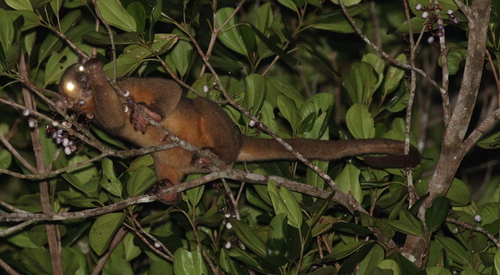
South American Coati

South American Coati

Nasua nasua

Silhouette: Rebecca Groom · PhyloPic

LCLeast ConcernNTVUENCR
Daily sighting probability ~10% · With luck
at Yasuní National Park

In 3 days ~20% in a week ~50%

6 Verified sightings at Yasuní National Park From 2019 to 2026
1,956 In all 7 parks
January Best month
☀️ Diurnal When it's spotted

About the South American Coati

The South American coati (Nasua nasua), also known as the ring-tailed coati or brown-nosed coati, is a coati species and a member of the raccoon family (Procyonidae), found in the tropical and subtropical parts of South America. An adult generally weighs from 2–7.2 kg (4.4–15.9 lb) and is 85–113 cm (33–44 in) long, with half of that being its tail. Its color is highly variable and the rings on the tail may be only somewhat visible, but its most distinguishing characteristic is that it lacks the largely white snout (or "nose") of its northern relative, the white-nosed coati.

The South American coati is widespread in tropical and subtropical South America. It occurs in the lowland forests east of the Andes as high as 2,500 m (8,200 ft) from Colombia and The Guianas south to Uruguay and northern Argentina. Nasua nasua occupancy is significantly and negatively related to elevation but positively related to forest cover.

It has been recorded in west Ecuador, and north and west Colombia. In Argentina, it has been recorded in Santa Fe and Salta Provinces. It has been introduced and naturalized on the island of Mallorca, where it is considered an invasive species... Wikipedia →

Sounds

Alarm call1:27

Brazil · 2025

© Douglas Meyer · XC1068251 · CC BY-NC-SA 4.0

Alarm call0:20

French Guiana · 2019

© Brice de la Croix · XC984228 · CC BY-NC-SA 4.0

Alarm call0:21

Mexico · 2025

© Bob Jones wannabe · XC1042927 · CC BY-NC-SA 4.0

Global Distribution

Parks Where Found

# Park Country Daily sighting probability
1 Iguazú National Park 🇦🇷 Argentina
~90%
2 Iguaçu National Park 🇧🇷 Brazil
~80%
3 Tijuca National Park 🇧🇷 Brazil
~30%
4 Podocarpus National Park 🇪🇨 Ecuador
~30%
5 Manu National Park 🇵🇪 Peru
~10%
6 Tambopata National Reserve 🇵🇪 Peru
~10%
7 Yasuní National Park 🇪🇨 Ecuador
~10%

Cities Where Found

# City Country Daily sighting probability
1 Campo Grande 🇧🇷 Brazil
~50%
2 Rio de Janeiro 🇧🇷 Brazil
~20%
3 São Paulo 🇧🇷 Brazil
~20%
4 Belo Horizonte 🇧🇷 Brazil
~10%
5 Maceió 🇧🇷 Brazil
~10%

Zoos & Centres Where Found

# Zoo / Centre Country
1 San Diego Zoo 🇺🇸 United States In captivity
2 Moscow Zoo 🇷🇺 Russia In captivity
3 Pairi Daiza 🇧🇪 Belgium In captivity
4 ZooParc de Beauval 🇫🇷 France In captivity
5 Leipzig Zoological Garden 🇩🇪 Germany In captivity
6 Brno Zoo 🇨🇿 Czechia In captivity
7 Zoo d'Amiens 🇫🇷 France In captivity
8 Zoobotanic Park of Brusque 🇧🇷 Brazil In captivity
9 San Diego Zoo Safari Park 🇺🇸 United States In captivity
10 Beijing Wildlife Park 🇨🇳 China In captivity
11 Taipei Zoo 🇹🇼 Taiwan In captivity
12 Bronx Zoo 🇺🇸 United States In captivity
13 Badoca Safari Park 🇵🇹 Portugal In captivity
14 Planète Sauvage 🇫🇷 France In captivity
15 Bioparque da Amazônia 🇧🇷 Brazil In captivity
16 Givskud Zoo 🇩🇰 Denmark In captivity
17 Beijing Zoo 🇨🇳 China In captivity
18 Shenzhen Safari Park 🇨🇳 China In captivity
19 Wild Animal Safari 🇺🇸 United States In captivity
20 São Paulo Zoo 🇧🇷 Brazil In captivity
21 Marwell Zoo 🇬🇧 United Kingdom In captivity
22 Selwo Aventura 🇪🇸 Spain In captivity
23 حديقة الحيوانات والتسلية برابطية القالة 🇩🇿 Algeria In captivity
24 Chongqing Zoo 🇨🇳 China In captivity
25 Yaroslavl Zoo 🇷🇺 Russia In captivity
26 Bear Country USA 🇺🇸 United States In captivity
27 Карельский зоопарк 🇷🇺 Russia In captivity
28 Novosibirsk Zoo 🇷🇺 Russia In captivity
29 Parc du Reynou 🇫🇷 France In captivity
30 Zoo La Barben 🇫🇷 France In captivity
31 Kyiv Zoo 🇺🇦 Ukraine In captivity
32 Nyírjesi Füvészkert és Vadaspark 🇭🇺 Hungary In captivity
33 Friguia Park 🇹🇳 Tunisia In captivity
34 Burgers' Ocean 🇳🇱 Netherlands In captivity
35 Dierenpark Hoenderdaell 🇳🇱 Netherlands In captivity
36 Royal Burgers' Zoo 🇳🇱 Netherlands In captivity
37 Gramado Zoo 🇧🇷 Brazil In captivity
38 Lüneburg Heath Wildlife Park 🇩🇪 Germany In captivity
39 Parque Zoobotânico Getúlio Vargas 🇧🇷 Brazil In captivity
40 Zoologischer Garten Leipzig 🇩🇪 Germany In captivity
41 Parc de l'Auxois 🇫🇷 France In captivity
42 Tierwelt Herberstein 🇦🇹 Austria In captivity
43 Wilhelma 🇩🇪 Germany In captivity
44 Zoo de La Flèche 🇫🇷 France In captivity
45 Allwetterzoo Münster 🇩🇪 Germany In captivity
46 Münster Zoo 🇩🇪 Germany In captivity
47 Austin Zoo 🇺🇸 United States In captivity
48 Arizona-Sonora Desert Museum 🇺🇸 United States In captivity
49 Zoológico Dois Irmãos 🇧🇷 Brazil In captivity
50 Bioparque Municipal Vesty Pakos 🇧🇴 Bolivia In captivity

Before you go

What are the chances of seeing a South American Coati in Yasuní National Park?

With luck

About 10% of wildlife watchers report a South American Coati sighting in Yasuní National Park on a given day, based on 6 verified sightings from GBIF citizen-science data from 2019 to 2026. It is the 27th most-seen of the 33 mammals we can rate there. Over three days the chance rises to about 20%, and over a week to about 50%, if each day is a fresh chance.

When is the best time to see a South American Coati in Yasuní National Park?

January

In that month about 30% of wildlife watchers report a South American Coati in Yasuní National Park on a given day, against under 5% in February–September and November–December, the lowest months.

What time of day is best to see a South American Coati?

Between noon and 3 pm

Across all the parks we cover, that three-hour window holds the most South American Coati sightings with a recorded time, and about 9 in 10 of them come between 6 am and 6 pm: it is a daytime animal.

Where does the South American Coati sighting chance come from?

GBIF citizen-science records

It is estimated from how often the South American Coati is recorded against all the mammals logged in Yasuní National Park (6 verified sightings from 2019 to 2026), calibrated against known sighting rates. Figures are rounded to the nearest 10% because citizen-science data supports honest approximations, not decimals, and months with records from fewer than five people show "—". How it works.

← Back to Yasuní National Park