White-browed Fantail

White-browed Fantail

Rhipidura aureola

Silhouette: Michael Scroggie · PhyloPic

LCLeast ConcernNTVUENCR
Daily sighting probability ~30% · Possible
at Bandhavgarh National Park

In 3 days ~70% in a week ~90%

519 Verified sightings at Bandhavgarh National Park From 2019 to 2026
3,853 In all 18 parks
January Best month
🌅 Crepuscular When it's spotted

About the White-browed Fantail

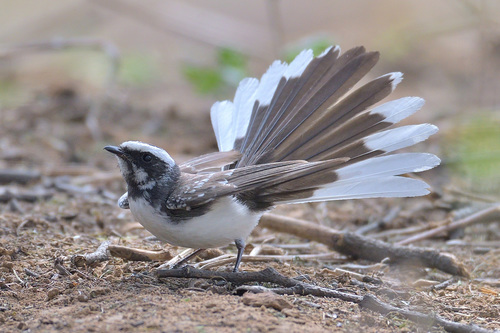
The white-browed fantail (Rhipidura aureola) is a small passerine bird belonging to the family Rhipiduridae. The adult white-browed fantail is about 18 cm long. It has dark brown upperparts, with white spots on the wings, and whitish underparts. The fan-shaped tail is edged in white, and the long white supercilia meet on the forehead. The throat and eyemask are blackish and border whitish moustachial stripes.

The white-browed fantail breeds across tropical regions of the Indian subcontinent and Southeast Asia. The species ranges from eastern Pakistan to southern Indochina. It is found in forest and other woodland. Three eggs are laid in a small cup nest in a tree. The white-browed fantail is insectivorous, and often fans its tail as it moves through the undergrowth.

Birds of India by Grimmett, Inskipp and Inskipp, ISBN 0-691-04910-6 Wikipedia →

Sounds

Song and call0:26

India · 2025

© Peter Boesman · XC1030854 · CC BY-NC-ND 4.0

Call0:26

Thailand · 2024

© Greg Irving · XC951551 · CC BY-NC-SA 4.0

Song0:16

India · 2016

© Frank Lambert · XC409711 · CC BY-NC-ND 4.0

Global Distribution

Parks Where Found

# Park Country Daily sighting probability
1 Udawalawe National Park 🇱🇰 Sri Lanka
~70%
2 Yala National Park 🇱🇰 Sri Lanka
~60%
3 Ranthambore National Park 🇮🇳 India
~60%
4 Gir National Park 🇮🇳 India
~60%
5 Bandhavgarh National Park 🇮🇳 India
~30%
6 Satpura National Park 🇮🇳 India
~20%
7 Minneriya National Park 🇱🇰 Sri Lanka
~20%
8 Mudumalai National Park 🇮🇳 India
~20%
9 Wilpattu National Park 🇱🇰 Sri Lanka
~20%
10 Royal Bardia National Park 🇳🇵 Nepal
~10%
11 Bandipur National Park 🇮🇳 India
~10%
12 Sinharaja Forest Reserve 🇱🇰 Sri Lanka
~10%
13 Chitwan National Park 🇳🇵 Nepal
<5%
14 Kanha National Park 🇮🇳 India
<5%
15 Horton Plains National Park 🇱🇰 Sri Lanka
<5%
16 Keoladeo National Park 🇮🇳 India
<5%
17 Jim Corbett National Park 🇮🇳 India
<5%
18 Nagarhole National Park 🇮🇳 India
<5%

Cities Where Found

# City Country Daily sighting probability
1 Jaipur 🇮🇳 India
~30%
2 Chhatrapati Sambhajinagar 🇮🇳 India
~20%
3 Jodhpur 🇮🇳 India
~20%
4 Karachi 🇵🇰 Pakistan
~20%
5 Indore 🇮🇳 India
~10%
6 Lahore 🇵🇰 Pakistan
~10%
7 Jabalpur 🇮🇳 India
~10%
8 Bhopal 🇮🇳 India
~10%
9 Surat 🇮🇳 India
~10%
10 Thrissur 🇮🇳 India
~10%

Before you go

What are the chances of seeing a White-browed Fantail in Bandhavgarh National Park?

Possible

About 30% of wildlife watchers report a White-browed Fantail sighting in Bandhavgarh National Park on a given day, based on 519 verified sightings from GBIF citizen-science data from 2019 to 2026. It is the 42nd most-seen of the 241 birds we can rate there. Over three days the chance rises to about 70%, and over a week to about 90%, if each day is a fresh chance.

When is the best time to see a White-browed Fantail in Bandhavgarh National Park?

January

In that month about 50% of wildlife watchers report a White-browed Fantail in Bandhavgarh National Park on a given day, against about 10% in July, the lowest month. That is one of Bandhavgarh National Park's driest months, with about 15 mm of rain against 400 mm in August.

What time of day is best to see a White-browed Fantail?

Between 4 and 7 am

Across all the parks we cover, that three-hour window holds the most White-browed Fantail sightings with a recorded time, and about 6 in 10 of them come between 6 am and 6 pm: it is most active around dawn and dusk.

Where does the White-browed Fantail sighting chance come from?

GBIF citizen-science records

It is estimated from how often the White-browed Fantail is recorded against all the birds logged in Bandhavgarh National Park (519 verified sightings from 2019 to 2026), calibrated against known sighting rates. Figures are rounded to the nearest 10% because citizen-science data supports honest approximations, not decimals, and months with records from fewer than five people show "—". How it works.
← Back to Bandhavgarh National Park