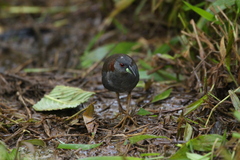
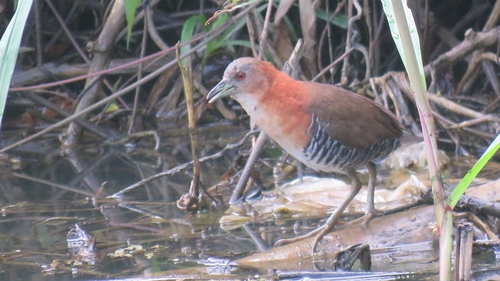
Gray-breasted Crake

Gray-breasted Crake

Laterallus exilis

Silhouette: Sheatherius · PhyloPic

LCLeast ConcernNTVUENCR
Daily sighting probability <5% · Rare
at Bastimentos Island National Marine Park

In 3 days ~10%

65 Verified sightings at Bastimentos Island National Marine Park From 2019 to 2026
941 In all 16 parks
February Best month
☀️ Diurnal When it's spotted

About the Gray-breasted Crake

The grey-breasted crake (Laterallus exilis) is a species of bird in subfamily Rallinae of family Rallidae, the rails, gallinules, and coots. It is found in Belize, Costa Rica, Guatemala, Honduras, Nicaragua, Panama, Trinidad and Tobago, and every mainland South American country except Chile and Uruguay.

The grey-breasted crake is monotypic, though the population along the Honduras-Nicaragua border was once proposed as a subspecies. The grey-breasted crake is 14 to 15.5 cm (5.5 to 6.1 in) long. Males weigh 26.5 to 39 g (0.93 to 1.4 oz) and females 29 to 43 g (1.0 to 1.5 oz). The sexes are alike. Adults have a pale gray head and breast, a white throat, and a chesnut nape. The rest of their upperparts are olive brown and their flanks are heavily barred black and white.

The grey-breasted crake has several discreet ranges. One is from Belize and eastern Guatemala through Honduras, Nicaragua, Costa Rica, and Panama into Colombia and western Venezuela. Another is in central Venezuela and a third extends through the Guianas into Brazil. The largest encompasses most of Amazonian Brazil, Colombia, Ecuador, and Bolivia... Wikipedia →

Sounds

Call0:09

Brazil · 2026

© JAYRSON ARAUJO DE OLIVEIRA · XC1183906 · CC BY-NC-SA 4.0

Song0:09

French Guiana · 2025

© Paul Lenrumé · XC1015369 · CC BY-NC-SA 4.0

Alarm call0:05

Brazil · 2021

© Nunes D´Acosta · XC684503 · CC BY-NC-SA 4.0

Global Distribution

Parks Where Found

# Park Country Daily sighting probability
1 Amacayacu National Natural Park 🇨🇴 Colombia
~10%
2 Lago de Yojoa 🇭🇳 Honduras
~10%
3 Cerro Azul Meámbar National Park 🇭🇳 Honduras
~10%
4 Yasuní National Park 🇪🇨 Ecuador
<5%
5 Tortuguero National Park 🇨🇷 Costa Rica
<5%
6 Manu National Park 🇵🇪 Peru
<5%
7 Cuyabeno Wildlife Reserve 🇪🇨 Ecuador
<5%
8 Parque Estadual Encontro das Águas 🇧🇷 Brazil
<5%
9 Bastimentos Island National Marine Park 🇵🇦 Panama
<5%
10 La Amistad International Park (Panama) 🇵🇦 Panama
<5%
11 Gandoca-Manzanillo Wildlife Refuge 🇨🇷 Costa Rica
<5%
12 Piedras Blancas National Park 🇨🇷 Costa Rica
<5%
13 Manuel Antonio National Park 🇨🇷 Costa Rica
<5%
14 Tambopata National Reserve 🇵🇪 Peru
<5%
15 Corcovado National Park 🇨🇷 Costa Rica
<5%
16 Soberanía National Park 🇵🇦 Panama
<5%

Cities Where Found

# City Country Daily sighting probability
1 Asuncion 🇵🇾 Paraguay
<5%

Before you go

What are the chances of seeing a Gray-breasted Crake in Bastimentos Island National Marine Park?

Rare

Under 5% of wildlife watchers report a Gray-breasted Crake sighting in Bastimentos Island National Marine Park on a given day, based on 65 verified sightings from GBIF citizen-science data from 2019 to 2026. It is the 257th most-seen of the 375 birds we can rate there. Over three days the chance rises to about 10%, if each day is a fresh chance.

When is the best time to see a Gray-breasted Crake in Bastimentos Island National Marine Park?

Any time of year

In every month with enough records, under 5% of wildlife watchers report a Gray-breasted Crake in Bastimentos Island National Marine Park on a given day, so our monthly data shows no clear season.

What time of day is best to see a Gray-breasted Crake?

Between 6 and 9 am

Across all the parks we cover, that three-hour window holds the most Gray-breasted Crake sightings with a recorded time, and about 8 in 10 of them come between 6 am and 6 pm: it is a daytime animal.

Is Bastimentos Island National Marine Park the best place to see a Gray-breasted Crake?

9th of 16

Of the 16 parks where we can rate Gray-breasted Crake sightings, Bastimentos Island National Marine Park ranks 9th at under 5%. The best odds are in Amacayacu National Natural Park (Colombia, about 10%), Lago de Yojoa (Honduras, about 10%) and Cerro Azul Meámbar National Park (Honduras, about 10%).

Where does the Gray-breasted Crake sighting chance come from?

GBIF citizen-science records

It is estimated from how often the Gray-breasted Crake is recorded against all the birds logged in Bastimentos Island National Marine Park (65 verified sightings from 2019 to 2026), calibrated against known sighting rates. Figures are rounded to the nearest 10% because citizen-science data supports honest approximations, not decimals, and months with records from fewer than five people show "—". How it works.

← Back to Bastimentos Island National Marine Park