Broad-billed Motmot

Broad-billed Motmot

Electron platyrhynchum

Silhouette: Sofía Terán Sánchez · PhyloPic

LCLeast ConcernNTVUENCR
Daily sighting probability <5% · Rare
at Cahuita National Park

In 3 days ~10% in a week ~30%

48 Verified sightings at Cahuita National Park From 2019 to 2026
15,060 In all 20 parks
October Best month
☀️ Diurnal When it's spotted

About the Broad-billed Motmot

The broad-billed motmot (Electron platyrhynchum) is a fairly common Central and South American bird of the Momotidae family. They are nonmigratory, sedentary birds that are most frequently seen in singles or pairs. There exist six subspecies of the broad-billed motmot.

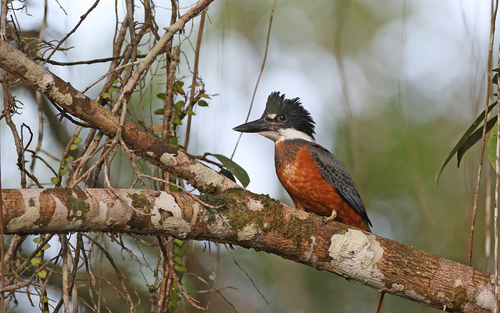
At about 12 inches long, the broad-billed motmot is one of the smallest members of the family Momotidae. These birds weigh 60 grams on average. They have dark eyes and feet. Most of its upper body, including its head, neck and chest, is a cinnamon-rufous colour. There is a black patch on either side of its head that covers the cheeks and auricular area, as well as one on the centre of its chest. The lower half of its body is more greenish above and becomes more blueish below. The broad-billed motmot has a long tail that gradually changes from blue to black. It also has two racquet-shaped central feathers are much longer than the rest. As its name suggests, the broad-billed motmot has a broad, flattened bill. Its bill is black, has serrated edges, and has a keel on the upper mandible. This species does not demonstrate sexual dimorphism, which means that both the male and female look alike.

Juveniles... Wikipedia →

Sounds

Alarm call0:29

Ecuador · 2025

© Manuel Sánchez-Nivicela · XC1163145 · CC BY-NC-ND 4.0

Song0:58

Brazil · 2025

© Joost van Bruggen · XC1050448 · CC BY-NC-ND 4.0

Call0:44

Costa Rica · 2025

© Chris Harrison · XC1043328 · CC BY-NC-SA 4.0

Global Distribution

Parks Where Found

# Park Country Daily sighting probability
1 Arenal Volcano National Park 🇨🇷 Costa Rica
~40%
2 Soberanía National Park 🇵🇦 Panama
~40%
3 Tenorio Volcano National Park 🇨🇷 Costa Rica
~20%
4 Braulio Carrillo National Park 🇨🇷 Costa Rica
~20%
5 Tambopata National Reserve 🇵🇪 Peru
~20%
6 Chagres National Park 🇵🇦 Panama
~10%
7 San Lorenzo Protected Forest 🇵🇦 Panama
~10%
8 Manu National Park 🇵🇪 Peru
~10%
9 Darién National Park 🇵🇦 Panama
~10%
10 Tapantí-Macizo de la Muerte National Park 🇨🇷 Costa Rica
~10%
11 Farallones de Cali National Natural Park 🇨🇴 Colombia
<5%
12 Cahuita National Park 🇨🇷 Costa Rica
<5%
13 Rincón de la Vieja National Park 🇨🇷 Costa Rica
<5%
14 Parque Natural Metropolitano 🇵🇦 Panama
<5%
15 Yasuní National Park 🇪🇨 Ecuador
<5%
16 La Amistad International Park (Panama) 🇵🇦 Panama
<5%
17 Gandoca-Manzanillo Wildlife Refuge 🇨🇷 Costa Rica
<5%
18 Monteverde Cloud Forest Reserve 🇨🇷 Costa Rica
<5%
19 Poás Volcano National Park 🇨🇷 Costa Rica
<5%
20 Tortuguero National Park 🇨🇷 Costa Rica
<5%

Before you go

What are the chances of seeing a Broad-billed Motmot in Cahuita National Park?

Rare

Under 5% of wildlife watchers report a Broad-billed Motmot sighting in Cahuita National Park on a given day, based on 48 verified sightings from GBIF citizen-science data from 2019 to 2026. It is the 163rd most-seen of the 303 birds we can rate there. Over three days the chance rises to about 10%, and over a week to about 30%, if each day is a fresh chance.

When is the best time to see a Broad-billed Motmot in Cahuita National Park?

September and October

In those months about 10% of wildlife watchers report a Broad-billed Motmot in Cahuita National Park on a given day, against under 5% in November to August, the lowest months.

What time of day is best to see a Broad-billed Motmot?

Between 9 am and noon

Across all the parks we cover, that three-hour window holds the most Broad-billed Motmot sightings with a recorded time, and about 9 in 10 of them come between 6 am and 6 pm: it is a daytime animal.

Where does the Broad-billed Motmot sighting chance come from?

GBIF citizen-science records

It is estimated from how often the Broad-billed Motmot is recorded against all the birds logged in Cahuita National Park (48 verified sightings from 2019 to 2026), calibrated against known sighting rates. Figures are rounded to the nearest 10% because citizen-science data supports honest approximations, not decimals, and months with records from fewer than five people show "—". How it works.

← Back to Cahuita National Park