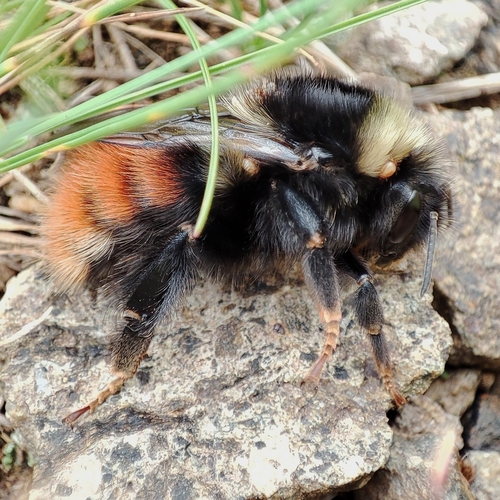
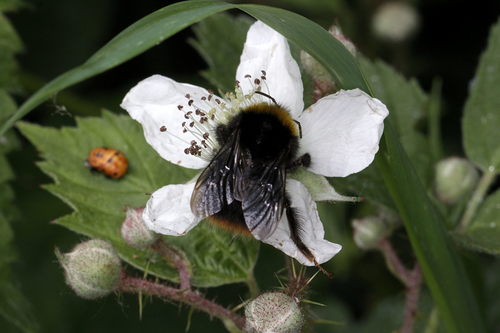
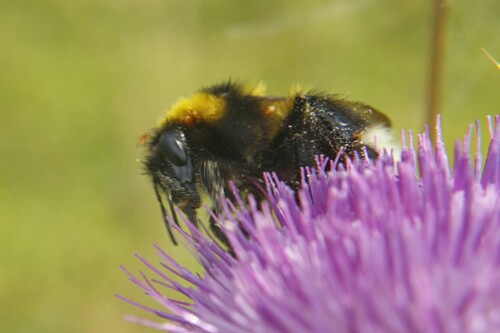
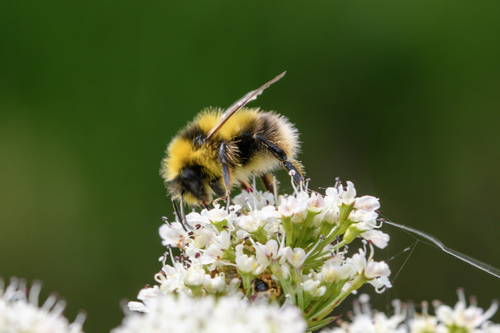
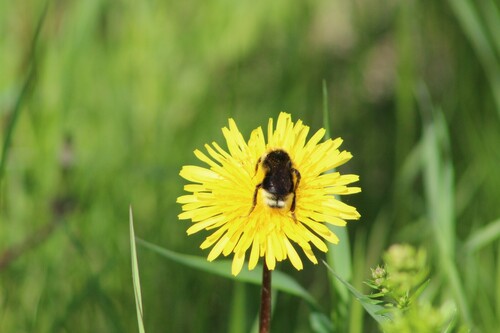
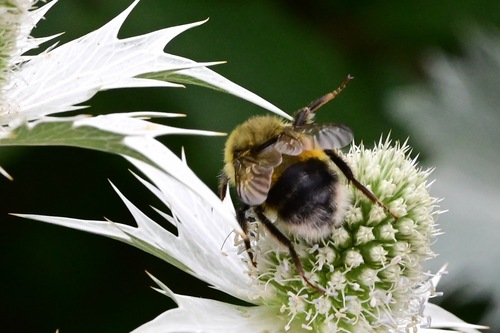
Buff-Tailed Bumble Bee

Buff-Tailed Bumble Bee

Bombus terrestris

Daily sighting probability ~10% · With luck
at Cairngorms National Park

In 3 days ~20% in a week ~30%

5 Verified sightings at Cairngorms National Park From 2019 to 2026
543 In all 20 parks
April Best month
☀️ Diurnal When it's spotted

About the Buff-Tailed Bumble Bee

Bombus terrestris, the buff-tailed bumblebee or large earth bumblebee, is one of the most numerous bumblebee species in Europe. It is one of the main species used in greenhouse pollination, and so can be found in many countries and areas where it is not native, such as Tasmania. Moreover, it is a eusocial insect with an overlap of generations, a division of labour, and cooperative brood care. The queen is monogamous, which means she mates with only one male. B. terrestris workers learn flower colours and forage efficiently.

B. terrestris is part of the order Hymenoptera, which is composed of ants, bees, and wasps. The family Apidae specifically consists of bees. It is also part of the subfamily Apinae. There are 14 tribe lineages within Apinae, and B. terrestris is in the bumblebee tribe, Bombini. It is in the genus Bombus, which consists entirely of bumblebees, and the subgenus Bombus sensu stricto. This subgenus contains closely related species such as Bombus affinis, Bombus cryptarum, Bombus franklini, Bombus ignitus, Bombus lucorum, Bombus magnus, Bombus occidentalis, and Bombus terricola. There are nine recognized subspecies: B. terrestris africanus... Wikipedia →

Global Distribution

Parks Where Found

# Park Country Daily sighting probability
1 Nahuel Huapi National Park 🇦🇷 Argentina
~40%
2 Vicente Pérez Rosales National Park 🇨🇱 Chile
~40%
3 Tierra del Fuego National Park 🇦🇷 Argentina
~40%
4 Aoraki Mount Cook National Park 🇳🇿 New Zealand
~30%
5 Cradle Mountain-Lake St Clair National Park 🇦🇺 Australia
~30%
6 Rakiura National Park 🇳🇿 New Zealand
~30%
7 Torres del Paine National Park 🇨🇱 Chile
~30%
8 Maria Island National Park 🇦🇺 Australia
~30%
9 Abel Tasman National Park 🇳🇿 New Zealand
~30%
10 Fiordland National Park 🇳🇿 New Zealand
~20%
11 Arthur's Pass National Park 🇳🇿 New Zealand
~20%
12 Sierra Nevada National Park 🇪🇸 Spain
~20%
13 Freycinet National Park 🇦🇺 Australia
~20%
14 Snowdonia National Park 🇬🇧 United Kingdom
~10%
15 Egmont National Park 🇳🇿 New Zealand
~10%
16 Sierra de Guadarrama National Park 🇪🇸 Spain
~10%
17 Cévennes National Park 🇫🇷 France
~10%
18 Pyrénées National Park 🇫🇷 France
~10%
19 Cairngorms National Park 🇬🇧 United Kingdom
~10%
20 Wadden Sea National Park 🇩🇪 Germany
~10%

Cities Where Found

# City Country Daily sighting probability
1 Santiago 🇨🇱 Chile
~30%
2 Hobart 🇦🇺 Australia
~30%
3 Liverpool 🇬🇧 United Kingdom
~30%
4 London 🇬🇧 United Kingdom
~30%
5 Auckland 🇳🇿 New Zealand
~30%
6 Birmingham 🇬🇧 United Kingdom
~30%
7 Manchester 🇬🇧 United Kingdom
~30%
8 Sapporo 🇯🇵 Japan
~20%
9 Jerusalem 🇮🇱 Israel
~20%
10 Dublin 🇮🇪 Ireland
~20%

Before you go

What are the chances of seeing a Buff-Tailed Bumble Bee in Cairngorms National Park?

With luck

About 10% of wildlife watchers report a Buff-Tailed Bumble Bee sighting in Cairngorms National Park on a given day, based on 5 verified sightings from GBIF citizen-science data from 2019 to 2026. It is the 260th most-seen of the 300 insects we can rate there. Over three days the chance rises to about 20%, and over a week to about 30%, if each day is a fresh chance.

When is the best time to see a Buff-Tailed Bumble Bee in Cairngorms National Park?

April and June–August

In those months about 10% of wildlife watchers report a Buff-Tailed Bumble Bee in Cairngorms National Park on a given day, against under 5% in May and September–March, the lowest months.

What time of day is best to see a Buff-Tailed Bumble Bee?

Between 11 am and 2 pm

Across all the parks we cover, that three-hour window holds the most Buff-Tailed Bumble Bee sightings with a recorded time, and about 9 in 10 of them come between 6 am and 6 pm: it is a daytime animal.

Which relatives of the Buff-Tailed Bumble Bee live in Cairngorms National Park?

Same genus: Bombus

The closest relatives of the Buff-Tailed Bumble Bee that you can see in Cairngorms National Park (genus Bombus, Bumble Bees) are Mountain Bumble Bee (about 30%), Common Carder Bumble Bee (about 20%) and Early Bumble Bee (about 20%), with each one's daily chance of a sighting.

Where does the Buff-Tailed Bumble Bee sighting chance come from?

GBIF citizen-science records

It is estimated from how often the Buff-Tailed Bumble Bee is recorded against all the insects logged in Cairngorms National Park (5 verified sightings from 2019 to 2026), calibrated against known sighting rates. Figures are rounded to the nearest 10% because citizen-science data supports honest approximations, not decimals, and months with records from fewer than five people show "—". How it works.

← Back to Cairngorms National Park