Eared Grebe

Eared Grebe

Podiceps nigricollis

Silhouette: Doug Backlund (photo), John E. McCormack, Michael G. Harvey, Brant C. Faircloth, Nicholas G. Crawford, Travis C. Glenn, Robb T. Brumfield & T. Michael Keesey · PhyloPic

LCLeast ConcernNTVUENCR
Daily sighting probability ~10% · With luck
at Camargue

In 3 days ~20% in a week ~50%

155 Verified sightings at Camargue From 2019 to 2026
4,473 In all 39 parks
December Best month
☀️ Diurnal When it's spotted

About the Eared Grebe

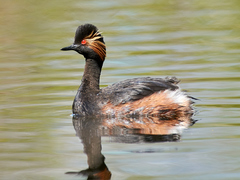
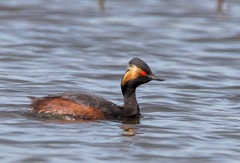
The black-necked grebe or eared grebe (Podiceps nigricollis) is a member of the grebe family of water birds. It was described in 1831 by Christian Ludwig Brehm. Its breeding plumage features distinctive ochre-coloured feathers which extend behind its eye and over its ear coverts. The rest of the upper parts, including the head, neck, and breast, are coloured black to blackish brown. The flanks are tawny rufous to maroon-chestnut, and the abdomen is white. In its non-breeding plumage, this bird has greyish-black upper parts, including the top of the head and a vertical stripe on the back of the neck. The flanks are also greyish-black. The rest of the body is a white or whitish colour. The juvenile has more brown in its darker areas. This species is present in parts of Africa, Eurasia, and the Americas.

The black-necked grebe uses multiple foraging techniques. Insects, which make up the majority of this bird's diet, are caught either on the surface of the water or when they are in flight; this species occasionally practices foliage gleaning. This grebe dives to catch crustaceans, molluscs, tadpoles, and small frogs and fish. When moulting at saline lakes, this bird feeds mostly on brine shrimps (such as Artemia franciscana, and "Artemia parthenogenetica"). The black-necked grebe makes a floating cup nest on an open lake. The nest cup is covered with a disc. This nest is located both in colonies and by itself. During the breeding season, which varies depending on location, this species will lay one (sometimes two) clutch of three to four eggs. The number of eggs is sometimes larger due to conspecific brood parasitism. After a 21-day incubation period, the eggs hatch, and then the nest is deserted. After about 10 days, the parents split up the chicks between themselves. After this, the chicks become independent in about 10 days, and fledge in about three weeks.

Although it generally avoids flight, the black-necked grebe travels as far as 6,000 kilometres (3,700 mi) during migration. In addition, it becomes flightless for at least a month after completing a migration to reach an area where it can moult safely. During this moult, the grebe can double in weight. The migration to reach these areas can be dangerous, sometimes with thousands of grebe deaths. In spite of this, it is classified as a least concern species by the International Union for Conservation of Nature (IUCN). It is likely that this is the most numerous grebe in the world. Wikipedia →

Sounds

Call0:13

France · 2026

© Julien Piette · XC1084603 · CC BY-NC-SA 4.0

Nocturnal flight call0:17

Belgium · 2024

© Alain De Broyer · XC896456 · CC BY-NC-SA 4.0

Begging call0:06

Sweden · 2020

© Patrik Åberg · XC600633 · CC BY-NC-SA 4.0

Global Distribution

Parks Where Found

# Park Country Daily sighting probability
1 El Vizcaíno Biosphere Reserve 🇲🇽 Mexico
~30%
2 De Hoop Nature Reserve 🇿🇦 South Africa
~20%
3 Hortobágy National Park 🇭🇺 Hungary
~20%
4 Channel Islands National Park 🇺🇸 United States
~20%
5 Elk Island National Park 🇨🇦 Canada
~20%
6 Bahía de Loreto National Park 🇲🇽 Mexico
~20%
7 Doñana National Park 🇪🇸 Spain
~10%
8 Kiskunság National Park 🇭🇺 Hungary
~10%
9 Garden Route National Park 🇿🇦 South Africa
~10%
10 Camargue 🇫🇷 France
~10%
11 Yellowstone National Park 🇺🇸 United States
~10%
12 Death Valley National Park 🇺🇸 United States
~10%
13 Nikko National Park 🇯🇵 Japan
~10%
14 Redwood National Park 🇺🇸 United States
~10%
15 Wadden Sea National Park 🇩🇪 Germany
<5%
16 Sierra de Guadarrama National Park 🇪🇸 Spain
<5%
17 Biebrza National Park 🇵🇱 Poland
<5%
18 Padre Island National Seashore 🇺🇸 United States
<5%
19 Lake Nakuru National Park 🇰🇪 Kenya
<5%
20 Bavarian Forest National Park 🇩🇪 Germany
<5%
21 Grand Teton National Park 🇺🇸 United States
<5%
22 Fertő-Hanság National Park 🇭🇺 Hungary
<5%
23 Ngorongoro Conservation Area 🇹🇿 Tanzania
<5%
24 Badlands National Park 🇺🇸 United States
<5%
25 Addo Elephant National Park 🇿🇦 South Africa
<5%
26 Zion National Park 🇺🇸 United States
<5%
27 Riding Mountain National Park 🇨🇦 Canada
<5%
28 Arusha National Park 🇹🇿 Tanzania
<5%
29 Etosha National Park 🇳🇦 Namibia
<5%
30 Serengeti National Park 🇹🇿 Tanzania
<5%
31 Banff National Park 🇨🇦 Canada
<5%
32 Olympic National Park 🇺🇸 United States
<5%
33 Pacific Rim National Park Reserve 🇨🇦 Canada
<5%
34 Yosemite National Park 🇺🇸 United States
<5%
35 Rocky Mountain National Park 🇺🇸 United States
<5%
36 Table Mountain National Park 🇿🇦 South Africa
<5%
37 Grand Canyon National Park 🇺🇸 United States
<5%
38 Glacier National Park 🇺🇸 United States
<5%
39 Point Pelee National Park 🇨🇦 Canada
<5%

Cities Where Found

# City Country Daily sighting probability
1 Ciudad Juárez 🇲🇽 México
~20%
2 San Diego 🇺🇸 United States
~10%
3 Sendai 🇯🇵 Japan
~10%
4 Los Angeles 🇺🇸 United States
~10%
5 San Francisco 🇺🇸 United States
~10%
6 Novosibirsk 🇷🇺 Russia
~10%
7 Las Vegas 🇺🇸 United States
~10%
8 Busan 🇰🇷 South Korea
~10%
9 Kyiv 🇺🇦 Ukraine
~10%
10 Kazan 🇷🇺 Russia
~10%

Zoos & Centres Where Found

# Zoo / Centre Country
1 Slimbridge Wetland Centre 🇬🇧 United Kingdom In captivity
2 Augsburg Zoo 🇩🇪 Germany In captivity
3 L'Oceanogràfic 🇪🇸 Spain In captivity
4 Freilandanlage, Wasserstern 1904, Terrarien, Aquarien 🇩🇪 Germany In captivity

Before you go

What are the chances of seeing an Eared Grebe in Camargue?

With luck

About 10% of wildlife watchers report an Eared Grebe sighting in Camargue on a given day, based on 155 verified sightings from GBIF citizen-science data from 2019 to 2026. It is the 98th most-seen of the 212 birds we can rate there. Over three days the chance rises to about 20%, and over a week to about 50%, if each day is a fresh chance.

When is the best time to see an Eared Grebe in Camargue?

December

In that month about 30% of wildlife watchers report an Eared Grebe in Camargue on a given day, against under 5% in April to August, the lowest months.

What time of day is best to see an Eared Grebe?

Between 1 and 4 pm

Across all the parks we cover, that three-hour window holds the most Eared Grebe sightings with a recorded time, and about 8 in 10 of them come between 6 am and 6 pm: it is a daytime animal.

Where does the Eared Grebe sighting chance come from?

GBIF citizen-science records

It is estimated from how often the Eared Grebe is recorded against all the birds logged in Camargue (155 verified sightings from 2019 to 2026), calibrated against known sighting rates. Figures are rounded to the nearest 10% because citizen-science data supports honest approximations, not decimals, and months with records from fewer than five people show "—". How it works.

← Back to Camargue