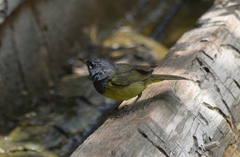
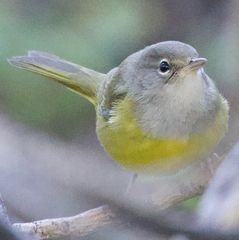
MacGillivray's Warbler

MacGillivray's Warbler

Geothlypis tolmiei

Silhouette: Andy Wilson · PhyloPic

LCLeast ConcernNTVUENCR
Daily sighting probability <5% · Rare
at Cañón del Sumidero National Park

In 3 days ~10% in a week ~30%

28 Verified sightings at Cañón del Sumidero National Park From 2019 to 2026
6,059 In all 36 parks
January Best month
☀️ Diurnal When it's spotted

About the MacGillivray's Warbler

MacGillivray's warbler (Geothlypis tolmiei) is a species of bird in the family Parulidae, the New World warblers. It is found from southeastern Alaska and western Canada to Panama. MacGillivray's warbler was formally described by John Townsend in 1839 with the binomial Sylvia Tolmiei [sic] and the English name "Tolmie's Warbler". He drew on paintings in Audubon's Birds of America, in which Audubon had confused it with what was later named the mourning warbler (Geothlypis philadelphia). Townsend's names honor his friend William Fraser Tolmie. MaGillivray's and the mourning warblers are sister species and hybridize extensively. Audubon gave the species its current English name to honor William MacGillivray.

MacGillivray's warbler was long assigned to the genus Oporornis. The American Ornithological Society moved it to its present genus Geothlypis in 2011. The IOC made the change in 2012, BirdLife International's Handbook of the Birds of the World (HBW) in 2016, and the Clements taxonomy by 2018.

However, the further taxonomy of MacGillivray's warbler is unsettled. Wikipedia →

Sounds

Call0:11

Mexico · 2026

© Manuel Grosselet · XC1176768 · CC BY-NC-SA 4.0

Song1:10

United States · 2026

© Greg Irving · XC1150066 · CC BY-NC-SA 4.0

Song1:07

United States · 2024

© Sue Riffe · XC939377 · CC BY-NC-SA 4.0

Global Distribution

Parks Where Found

# Park Country Daily sighting probability
1 Glacier National Park 🇺🇸 United States
~40%
2 Yosemite National Park 🇺🇸 United States
~30%
3 Sequoia and Kings Canyon National Parks 🇺🇸 United States
~30%
4 El Triunfo 🇲🇽 Mexico
~20%
5 Grand Teton National Park 🇺🇸 United States
~20%
6 Cabo Pulmo National Park 🇲🇽 Mexico
~20%
7 Celaque National Park 🇭🇳 Honduras
~10%
8 Rocky Mountain National Park 🇺🇸 United States
~10%
9 Death Valley National Park 🇺🇸 United States
~10%
10 La Tigra National Park 🇭🇳 Honduras
~10%
11 Big Bend National Park 🇺🇸 United States
~10%
12 Yellowstone National Park 🇺🇸 United States
~10%
13 Kluane National Park 🇨🇦 Canada
<5%
14 Cañón del Sumidero National Park 🇲🇽 Mexico
<5%
15 Guadalupe Mountains National Park 🇺🇸 United States
<5%
16 Grand Canyon National Park 🇺🇸 United States
<5%
17 Great Bear Rainforest 🇨🇦 Canada
<5%
18 Banff National Park 🇨🇦 Canada
<5%
19 Joshua Tree National Park 🇺🇸 United States
<5%
20 Zion National Park 🇺🇸 United States
<5%
21 Bahía de Loreto National Park 🇲🇽 Mexico
<5%
22 Jasper National Park 🇨🇦 Canada
<5%
23 Olympic National Park 🇺🇸 United States
<5%
24 Saguaro National Park 🇺🇸 United States
<5%
25 Pacific Rim National Park Reserve 🇨🇦 Canada
<5%
26 Redwood National Park 🇺🇸 United States
<5%
27 Cumbres de Monterrey National Park 🇲🇽 Mexico
<5%
28 El Vizcaíno Biosphere Reserve 🇲🇽 Mexico
<5%
29 Volcán Barú National Park 🇵🇦 Panama
<5%
30 La Amistad International Park (Panama) 🇵🇦 Panama
<5%
31 Monteverde Cloud Forest Reserve 🇨🇷 Costa Rica
<5%
32 Channel Islands National Park 🇺🇸 United States
<5%
33 Braulio Carrillo National Park 🇨🇷 Costa Rica
<5%
34 Los Quetzales National Park 🇨🇷 Costa Rica
<5%
35 Tapantí-Macizo de la Muerte National Park 🇨🇷 Costa Rica
<5%
36 Arenal Volcano National Park 🇨🇷 Costa Rica
<5%

Cities Where Found

# City Country Daily sighting probability
1 San Luis Potosí 🇲🇽 México
~10%
2 Mexico City 🇲🇽 México
~10%
3 Guadalajara 🇲🇽 México
~10%
4 Guatemala City 🇬🇹 Guatemala
~10%
5 Puebla 🇲🇽 México
~10%
6 Phoenix 🇺🇸 United States
<5%
7 Mesa 🇺🇸 United States
<5%
8 Las Vegas 🇺🇸 United States
<5%
9 Washington 🇺🇸 United States
<5%
10 Salt Lake City 🇺🇸 United States
<5%

Before you go

What are the chances of seeing a MacGillivray's Warbler in Cañón del Sumidero National Park?

Rare

Under 5% of wildlife watchers report a MacGillivray's Warbler sighting in Cañón del Sumidero National Park on a given day, based on 28 verified sightings from GBIF citizen-science data from 2019 to 2026. It is the 155th most-seen of the 243 birds we can rate there. Over three days the chance rises to about 10%, and over a week to about 30%, if each day is a fresh chance.

When is the best time to see a MacGillivray's Warbler in Cañón del Sumidero National Park?

March, October and December–January

In those months about 10% of wildlife watchers report a MacGillivray's Warbler in Cañón del Sumidero National Park on a given day, against under 5% in February, April–September and November, the lowest months. Those are among Cañón del Sumidero National Park's driest months, with about 45 mm of rain a month against 260 mm in June.

What time of day is best to see a MacGillivray's Warbler?

Between 8 and 11 am

Across all the parks we cover, that three-hour window holds the most MacGillivray's Warbler sightings with a recorded time, and nearly all of them come between 6 am and 6 pm: it is a daytime animal.

Is Cañón del Sumidero National Park the best place to see a MacGillivray's Warbler?

14th of 36

Of the 36 parks where we can rate MacGillivray's Warbler sightings, Cañón del Sumidero National Park ranks 14th at under 5%. The best odds are in Glacier National Park (United States, about 40%), Yosemite National Park (United States, about 30%) and Sequoia and Kings Canyon National Parks (United States, about 30%).

Which relatives of the MacGillivray's Warbler live in Cañón del Sumidero National Park?

Same genus: Geothlypis

The closest relatives of the MacGillivray's Warbler that you can see in Cañón del Sumidero National Park (genus Geothlypis, Yellowthroats and Allies) are Gray-crowned Yellowthroat (about 10%) and Common Yellowthroat (about 10%), with each one's daily chance of a sighting.

Where does the MacGillivray's Warbler sighting chance come from?

GBIF citizen-science records

It is estimated from how often the MacGillivray's Warbler is recorded against all the birds logged in Cañón del Sumidero National Park (28 verified sightings from 2019 to 2026), calibrated against known sighting rates. Figures are rounded to the nearest 10% because citizen-science data supports honest approximations, not decimals, and months with records from fewer than five people show "—". How it works.

← Back to Cañón del Sumidero National Park