Downy Woodpecker

Downy Woodpecker

Dryobates pubescens

Silhouette: Andy Wilson · PhyloPic

LCLeast ConcernNTVUENCR
Daily sighting probability ~20% · Possible
at Anchorage

In 3 days ~50% in a week ~80%

1,046 Verified sightings at Anchorage
32,444 In all 33 parks From 2019 to 2026
February Best month
☀️ Diurnal When it's spotted

About the Downy Woodpecker

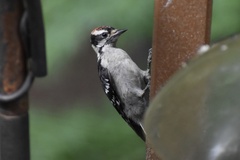
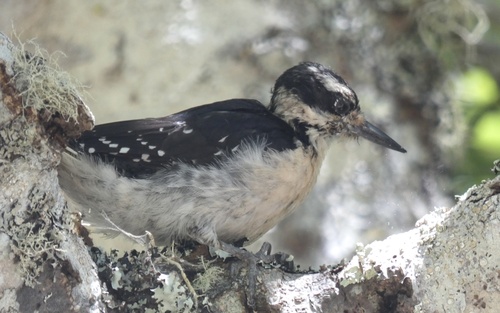
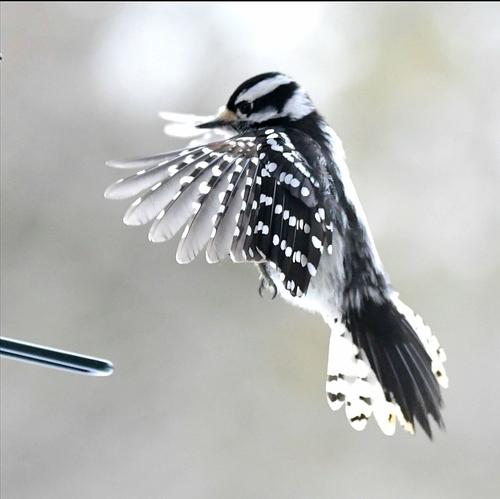
The downy woodpecker (Dryobates pubescens) is a species of woodpecker, the smallest in North America. Length ranges from 14 to 18 cm (5.5 to 7.1 in). Downy woodpeckers primarily live in forested areas throughout the United States and Canada, with the exception of deserts in the southwest and the northern tundra. The bird nests in tree cavities and feeds primarily on insects, although it supplements its diet with seeds and berries. The downy woodpecker is very similar in appearance to the hairy woodpecker, although they are not closely related.

The downy woodpecker was described and illustrated with a hand-coloured plate by the English naturalist Mark Catesby in his The Natural History of Carolina, Florida and the Bahama Islands, which was published between 1729 and 1732. When in 1766 the Swedish naturalist Carl Linnaeus updated his Systema Naturae for the twelfth edition, he included the downy woodpecker, coined the binomial name Picus pubescens and cited Catesby's book. The specific epithet pubescens is the Latin for "pubescent" or "downy". Linnaeus specified the type locality as America septentrionali (North America) but the locality is now restricted to South Carolina... Wikipedia →

Sounds

Call0:09

United States · 2025

© Valerie Heemstra · XC1049467 · CC BY-NC-SA 4.0

Drumming0:38

United States · 2022

© AUDEVARD Aurélien · XC1048814 · CC BY-NC-SA 4.0

Begging call1:00

United States · 2022

© Jules Evens · XC727249 · CC BY-NC-SA 4.0

Global Distribution

Parks Where Found

# Park Country Daily sighting probability
1 Point Pelee National Park 🇨🇦 Canada
~70%
2 Congaree National Park 🇺🇸 United States
~70%
3 Shenandoah National Park 🇺🇸 United States
~50%
4 Great Smoky Mountains National Park 🇺🇸 United States
~40%
5 Kluane National Park 🇨🇦 Canada
~30%
6 Isle Royale National Park 🇺🇸 United States
~30%
7 Acadia National Park 🇺🇸 United States
~30%
8 Cape Breton Highlands National Park 🇨🇦 Canada
~30%
9 Elk Island National Park 🇨🇦 Canada
~30%
10 Gros Morne National Park 🇨🇦 Canada
~30%
11 Big Cypress National Preserve 🇺🇸 United States
~30%
12 Zion National Park 🇺🇸 United States
~20%
13 Merritt Island National Wildlife Refuge 🇺🇸 United States
~20%
14 Riding Mountain National Park 🇨🇦 Canada
~20%
15 Everglades National Park 🇺🇸 United States
~10%
16 Rocky Mountain National Park 🇺🇸 United States
~10%
17 Channel Islands National Park 🇺🇸 United States
~10%
18 Yosemite National Park 🇺🇸 United States
~10%
19 Redwood National Park 🇺🇸 United States
~10%
20 Voyageurs National Park 🇺🇸 United States
~10%
21 Olympic National Park 🇺🇸 United States
~10%
22 Wrangell-St. Elias National Park 🇺🇸 United States
~10%
23 Grand Teton National Park 🇺🇸 United States
~10%
24 Banff National Park 🇨🇦 Canada
~10%
25 Glacier National Park 🇺🇸 United States
~10%
26 Sequoia and Kings Canyon National Parks 🇺🇸 United States
<5%
27 Jasper National Park 🇨🇦 Canada
<5%
28 Kenai Fjords National Park 🇺🇸 United States
<5%
29 Great Bear Rainforest 🇨🇦 Canada
<5%
30 Grand Canyon National Park 🇺🇸 United States
<5%
31 Yellowstone National Park 🇺🇸 United States
<5%
32 Pacific Rim National Park Reserve 🇨🇦 Canada
<5%
33 Badlands National Park 🇺🇸 United States
<5%

Cities Where Found

# City Country Daily sighting probability
1 Minneapolis [Saint Paul] 🇺🇸 United States
~70%
2 Montreal 🇨🇦 Canada
~70%
3 Calgary 🇨🇦 Canada
~60%
4 Houston 🇺🇸 United States
~60%
5 Orlando 🇺🇸 United States
~60%
6 Washington 🇺🇸 United States
~60%
7 Edmonton 🇨🇦 Canada
~60%
8 Philadelphia 🇺🇸 United States
~60%
9 Detroit 🇺🇸 United States
~60%
10 Chicago 🇺🇸 United States
~60%

Zoos & Centres Where Found

# Zoo / Centre Country
1 Cincinnati Zoo and Botanical Garden 🇺🇸 United States In captivity
2 Bronx Zoo 🇺🇸 United States In captivity
3 Ralph Perkins II Wildlife Center and Woods Garden 🇺🇸 United States In captivity

Before you go

What are the chances of seeing a Downy Woodpecker in Anchorage?

Possible

About 20% of wildlife watchers report a Downy Woodpecker sighting in Anchorage on a given day, based on 1,046 verified sightings from GBIF citizen-science data. It is the 31st most-seen of the 138 birds we can rate there. Over three days the chance rises to about 50%, and over a week to about 80%, if each day is a fresh chance.

When is the best time to see a Downy Woodpecker in Anchorage?

February

In that month about 60% of wildlife watchers report a Downy Woodpecker in Anchorage on a given day, against about 10% in July and August, the lowest months.

What time of day is best to see a Downy Woodpecker?

Between 7 and 10 am

Across all the parks we cover, that three-hour window holds the most Downy Woodpecker sightings with a recorded time, and about 9 in 10 of them come between 6 am and 6 pm: it is a daytime animal.

Is Anchorage the best place to see a Downy Woodpecker?

24th of 29

Of the 29 cities where we can rate Downy Woodpecker sightings, Anchorage ranks 24th at about 20%. The best odds are in Minneapolis [Saint Paul] (United States, about 70%), Montreal (Canada, about 70%) and Calgary (Canada, about 60%).

Where does the Downy Woodpecker sighting chance come from?

GBIF citizen-science records

It is estimated from how often the Downy Woodpecker is recorded against all the birds logged in Anchorage (1,046 verified sightings), calibrated against known sighting rates. Figures are rounded to the nearest 10% because citizen-science data supports honest approximations, not decimals, and months with records from fewer than five people show "—". How it works.
← Back to Anchorage