Convolvulus Hawkmoth

Convolvulus Hawkmoth

Agrius convolvuli

Daily sighting probability ~10% · With luck
at Barcelona

In 3 days ~20% in a week ~40%

23 Verified sightings at Barcelona
280 In all 22 parks From 2019 to 2026
September Best month
☀️🌙 Day & Night When it's spotted

About the Convolvulus Hawkmoth

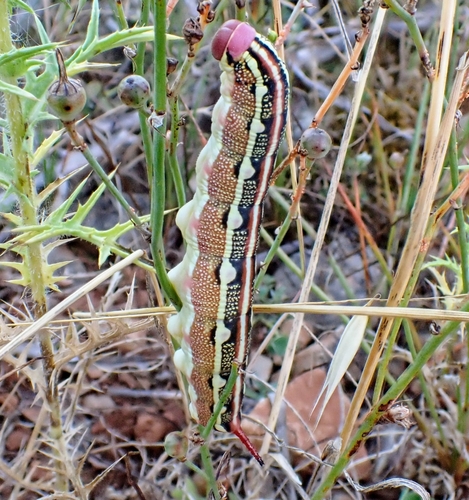
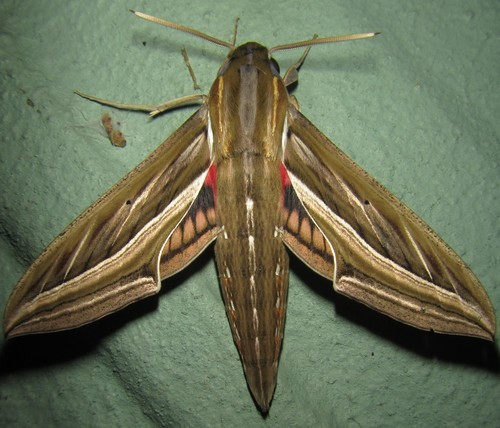
Agrius convolvuli, the convolvulus hawk-moth, is a large hawk-moth. It is common throughout Europe, Asia, Africa, Australia and New Zealand, partly as a migrant. In New Zealand, it is also known as the kumara moth, and in the Māori language as hīhue.

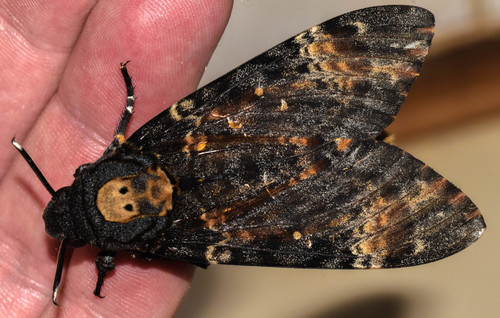
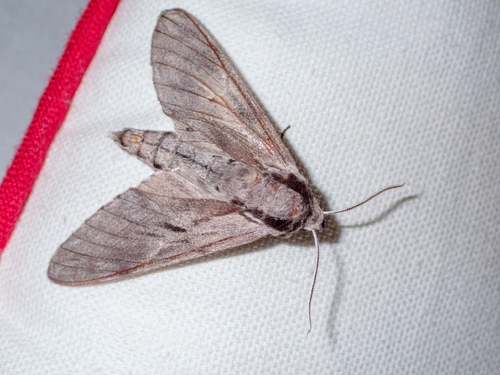
The wingspan is 80–105 millimetres (3.1–4.1 in). This hawkmoth's basic coloration is in grayish tones, but the abdomen has a broad gray dorsal stripe and pink and black bands edged with white on the sides. The hindwings are light gray with darker broad crosslines. Males have more heavier markings than the female and sometimes has a broad central cross band.

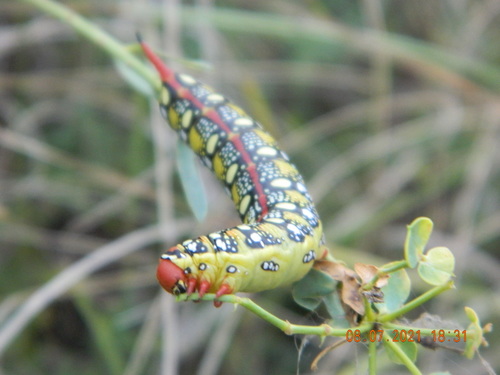
Its favourite time is around sunset and during the twilight, when it is seen in gardens hovering over the flowers. This moth is very attracted to light, so it is often killed by cars on highways. Its caterpillars eat the leaves of the Convolvulus, hence its Latin name "convolvuli". Other recorded food plants include a wide range of plants in the families Araceae, Convolvulaceae, Leguminosae and Malvaceae. It can be a pest of cultivated Ipomoea batatas (sweet potato or kūmara) in New Zealand and the Pacific. The adult feeds on the wing and has a very long... Wikipedia →
Global Distribution

Parks Where Found

# Park Country Daily sighting probability
1 Aberdare National Park 🇰🇪 Kenya
~40%
2 Vanoise National Park 🇫🇷 France
~20%
3 Hwange National Park 🇿🇼 Zimbabwe
~20%
4 Daintree National Park 🇦🇺 Australia
~10%
5 Ningaloo Marine Park 🇦🇺 Australia
~10%
6 Namib-Naukluft National Park 🇳🇦 Namibia
~10%
7 Ecrins National Park 🇫🇷 France
~10%
8 Mercantour National Park 🇫🇷 France
~10%
9 Kgalagadi Transfrontier Park 🇿🇦 South Africa
~10%
10 Kosciuszko National Park 🇦🇺 Australia
~10%
11 Pyrénées National Park 🇫🇷 France
~10%
12 Khao Yai National Park 🇹🇭 Thailand
~10%
13 Fertő-Hanság National Park 🇭🇺 Hungary
~10%
14 Cévennes National Park 🇫🇷 France
~10%
15 Blue Mountains National Park 🇦🇺 Australia
~10%
16 Wadden Sea National Park 🇩🇪 Germany
~10%
17 Bavarian Forest National Park 🇩🇪 Germany
~10%
18 Kruger National Park 🇿🇦 South Africa
~10%
19 Royal National Park 🇦🇺 Australia
~10%
20 Springbrook National Park 🇦🇺 Australia
~10%
21 Garden Route National Park 🇿🇦 South Africa
<5%
22 Table Mountain National Park 🇿🇦 South Africa
<5%

Cities Where Found

# City Country Daily sighting probability
1 Cotonou 🇧🇯 Benin
~30%
2 Karachi 🇵🇰 Pakistan
~20%
3 Nagoya 🇯🇵 Japan
~20%
4 Turin 🇮🇹 Italy
~20%
5 Manila 🇵🇭 Philippines
~10%
6 Nairobi 🇰🇪 Kenya
~10%
7 Yogyakarta 🇮🇩 Indonesia
~10%
8 Denpasar 🇮🇩 Indonesia
~10%
9 Jakarta 🇮🇩 Indonesia
~10%
10 Taichung 🇹🇼 Taiwan
~10%

Before you go

What are the chances of seeing a Convolvulus Hawkmoth in Barcelona?

With luck

About 10% of wildlife watchers report a Convolvulus Hawkmoth sighting in Barcelona on a given day, based on 23 verified sightings from GBIF citizen-science data. It is the 136th most-seen of the 381 insects we can rate there. Over three days the chance rises to about 20%, and over a week to about 40%, if each day is a fresh chance.

When is the best time to see a Convolvulus Hawkmoth in Barcelona?

September

In that month about 20% of wildlife watchers report a Convolvulus Hawkmoth in Barcelona on a given day, against under 5% in June–August and December–April, the lowest months.

What time of day is best to see a Convolvulus Hawkmoth?

Between 7 and 10 pm

Across all the parks we cover, that three-hour window holds the most Convolvulus Hawkmoth sightings with a recorded time, and about half of them come between 6 pm and 6 am: it is seen both by day and at night.

Is Barcelona the best place to see a Convolvulus Hawkmoth?

18th of 56

Of the 56 cities where we can rate Convolvulus Hawkmoth sightings, Barcelona ranks 18th at about 10%. The best odds are in Cotonou (Benin, about 30%), Karachi (Pakistan, about 20%) and Nagoya (Japan, about 20%).

Where does the Convolvulus Hawkmoth sighting chance come from?

GBIF citizen-science records

It is estimated from how often the Convolvulus Hawkmoth is recorded against all the insects logged in Barcelona (23 verified sightings), calibrated against known sighting rates. Figures are rounded to the nearest 10% because citizen-science data supports honest approximations, not decimals, and months with records from fewer than five people show "—". How it works.

← Back to Barcelona